

Trusted by:
University of Southern California
Warner Bros.
Volvo
Amazon
Stanford University
November 20, 2026
6 min read
Have your AML training records ready before the auditor asks. Send every employee a certificate auditors can verify, in one batch, with these 10 free templates.
Research with AI:
When an auditor asks whether your staff completed this year's anti-money laundering training, the quickest answer is pulling up a certificate for every employee who did. Each one records who was trained, on which course, when, and for how long the training counts, linking to a verification page anyone can access to check.
Below you’ll find 10 free anti-money laundering (AML) training certificate templates you can edit online or download as a Word file. They cover annual training for banks and payment firms, onboarding courses for new hires, and deeper training for KYC, crypto, and investigations teams.
Pick a design, add your logo, topics, and signatures, then upload your completion list from a spreadsheet, HR system export, or LMS. Certifier sends every employee their certificate in one batch, so closing a training cycle takes minutes.

An AML training certificate is the record a company or training provider issues when an employee completes anti-money laundering training, showing the course, topics, completion date, credential ID, and the sign-off of the MLRO or compliance lead.
What changes from one certificate to the next is the moment you’re certifying, whether that’s onboarding, the annual cycle, or a role-specific module. Find the right template for your training program in the table below.
What Youre Certifying | Template | Who Receives It | Renewal Shown In The Sample |
|---|---|---|---|
Annual staff training at a bank | 1. Bank AML training certificate | Every employee in the cycle | 12 months |
Annual training under UK rules | 2. AML and CTF training certificate | Staff at banks, payment, accountancy, and law firms | 12 months |
Annual training in an EU entity | 3. EU AML training certificate | Staff at EU banks and payment institutions | 12 months |
Terrorist financing and sanctions training | 4. CFT and AML training certificate | Staff in the Gulf and other high-risk corridors | 12 months |
A baseline course with a test | 5. AML awareness certificate | New hires and non-specialist staff | Optional |
The entry-level course for everyone | 6. AML foundations certificate | All new employees | Optional, often 12 months |
KYC and monitoring training | 7. Fintech AML training certificate | Onboarding, operations, and risk teams | 6 months |
Virtual asset training | 8. Crypto AML training certificate | Exchange and custody staff | 12 months |
Advanced investigation modules | 9. AML investigator certificate | Financial crime analysts | 24 months |
A program delivered to a client firm | 10. Corporate AML certificate | The client company | At the next engagement |
The renewal periods come from the template samples, so you can set whatever interval your policy names.
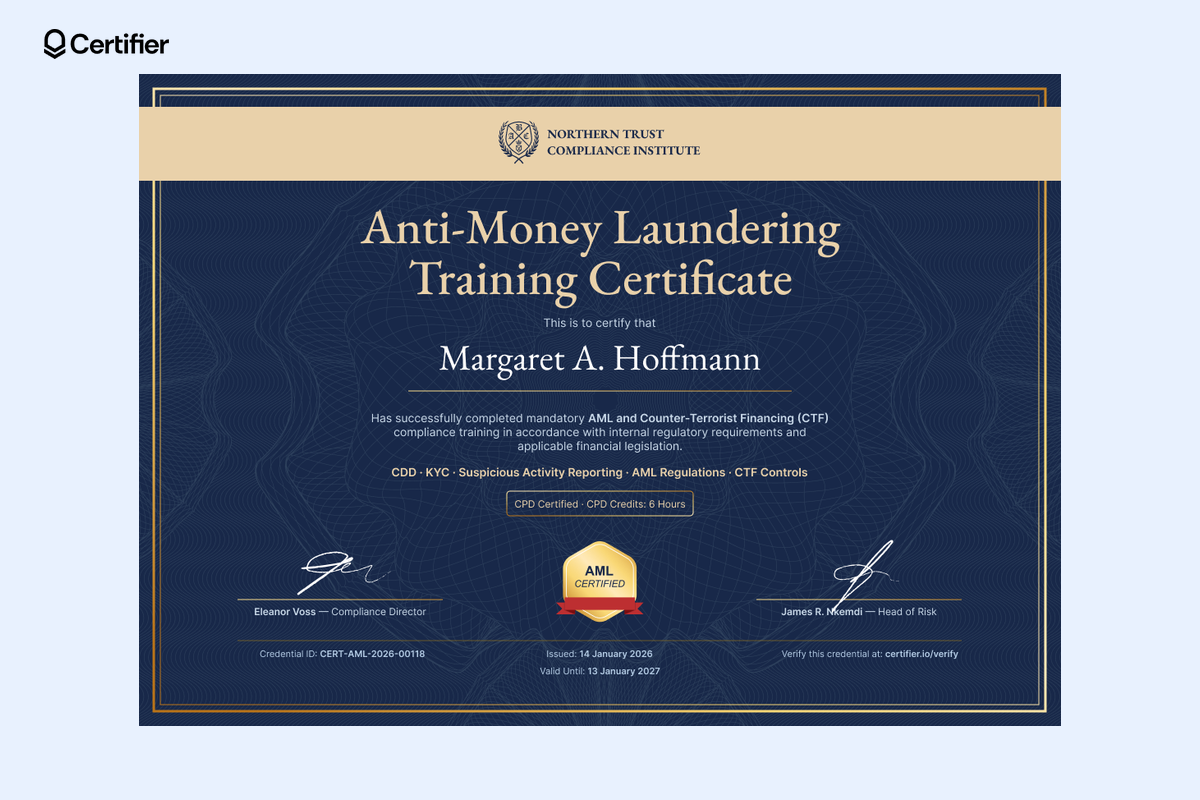
Built for compliance and L&D teams at banks and credit institutions, this navy design puts your institution's name in a gold band across the top. Under the recipient's name, a topics line covers customer due diligence, KYC, suspicious activity reporting, and counter-terrorist financing, with a small box for CPD hours below.
Two signature lines sit on either side of a gold seal, for example, your Compliance Director and Head of Risk. The bottom row holds the credential ID, the issue date, and an expiry date that matches a yearly cycle.
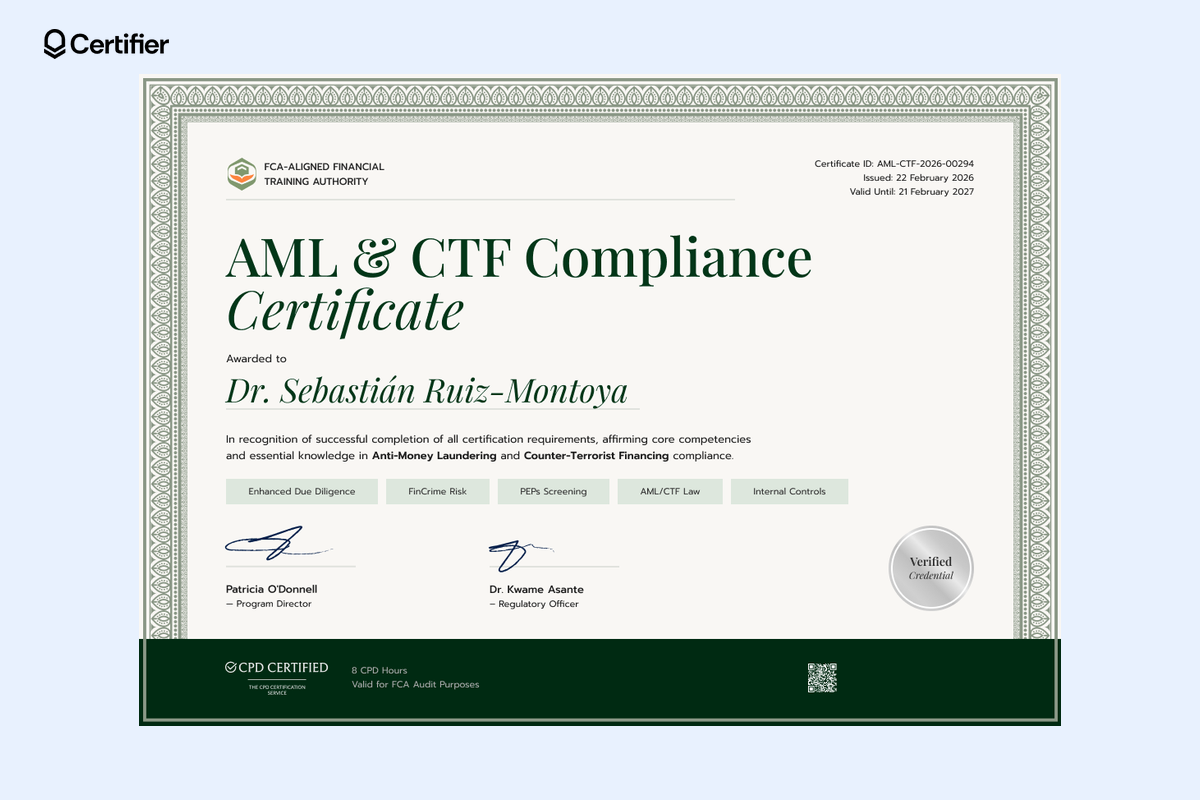
This cream certificate with a green guilloche border suits UK firms that train staff under the Money Laundering Regulations 2017, from banks and payment firms to accountancy practices and law firms. A row of topic chips lists enhanced due diligence, financial crime risk, PEP screening, AML/CTF law, and internal controls.
The certificate ID and dates sit in the top right, and a dark green footer band holds the CPD hours and a QR code. Add your MLRO and program director as signatories, then edit the chips each year as your course changes.
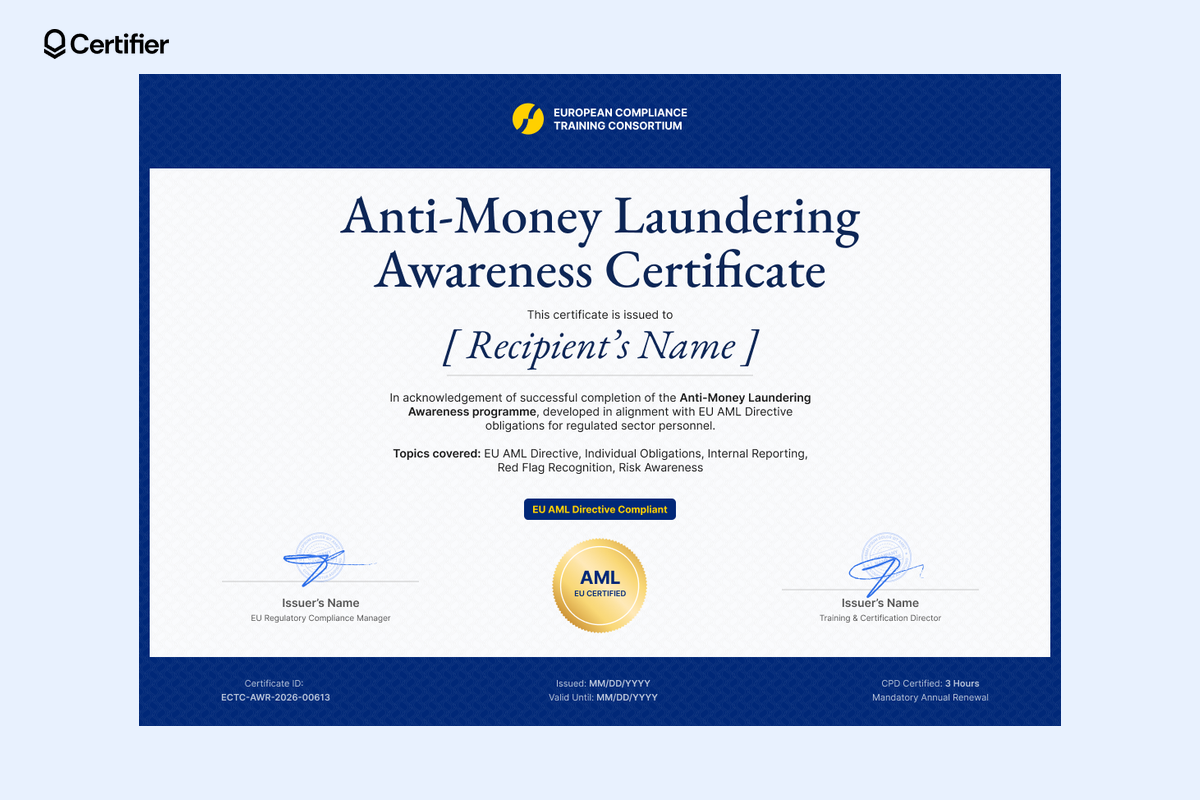
For banks, payment institutions, and investment firms in the EU, this certificate design sets a white panel inside a patterned navy frame, with your logo above the title. A topics line lists what the course covered, such as individual obligations, internal reporting, red flags, and risk awareness.
The footer row keeps the certificate ID, the issue and valid-until dates, and the CPD hours in one line, with two signature lines above it. Group compliance teams can keep one copy of the design per member state, translate the static text, and upload each entity's completions separately.
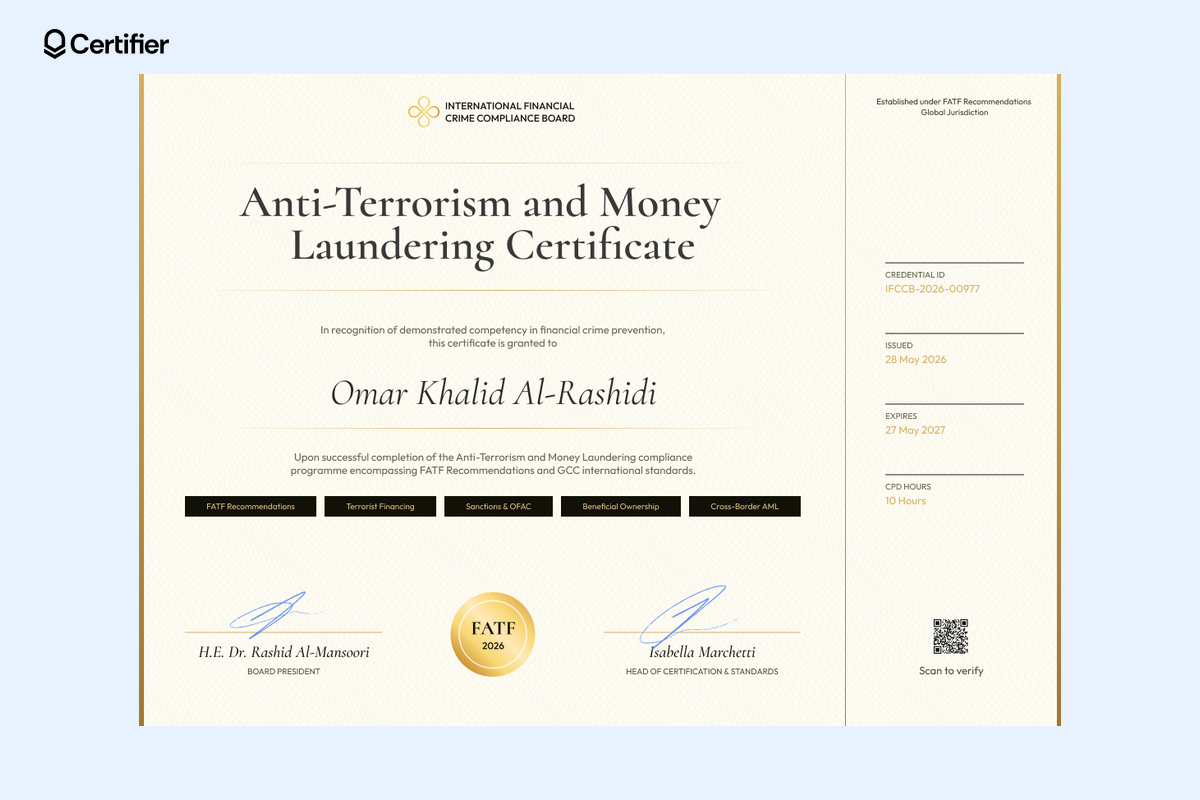
This cream and gold certificate is made for banks, exchange houses, and finance companies in the UAE and the wider Gulf, and for any firm training staff on terrorist financing and sanctions. Black topic tags run across the page, covering terrorist financing, sanctions screening, beneficial ownership, and cross-border risk.
A gold side panel on the right holds the credential ID, issue date, expiry date, CPD hours, and a QR code. If your teams work in two languages, you can attach an English and a secondary language version to the same credential, so both appear on one page.
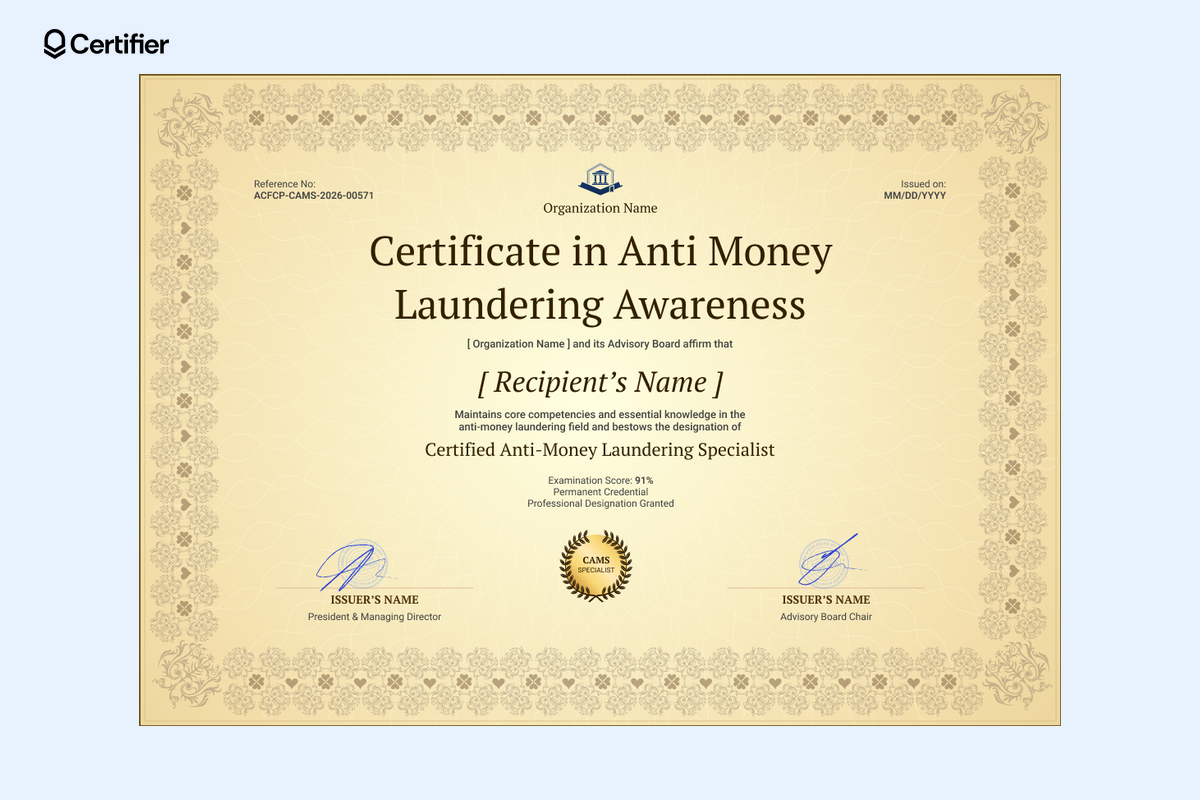
A traditional design with an ornamental gold frame, this one works for organizations that give every new hire a short awareness course, and for providers that sell that course to clients. A reference number sits in the top left and the issue date in the top right, with an exam score line under the recipient's name.
Two signature lines frame a gold seal at the bottom. If your awareness course has no test, delete the exam score field in the design builder and keep the rest of the layout as it is.
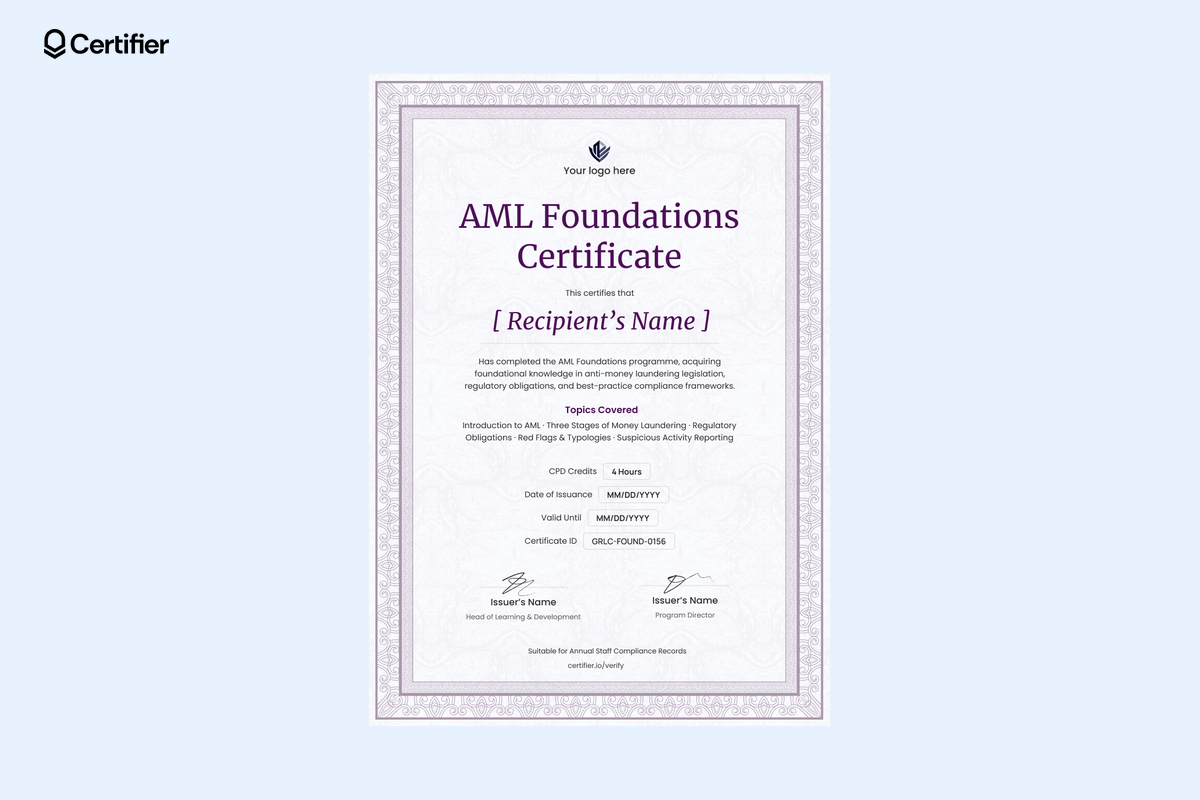
This portrait certificate with a lavender ornamental border is meant for the entry-level course every employee completes. A short topics list covers the basics, from the three stages of money laundering to red flags and suspicious activity reporting.
Four outlined boxes hold the CPD credits, issue date, valid-until date, and certificate ID, above signature lines for your Head of L&D and program director. Connect your LMS or HR system, and each new hire gets the certificate as soon as the course is marked complete.
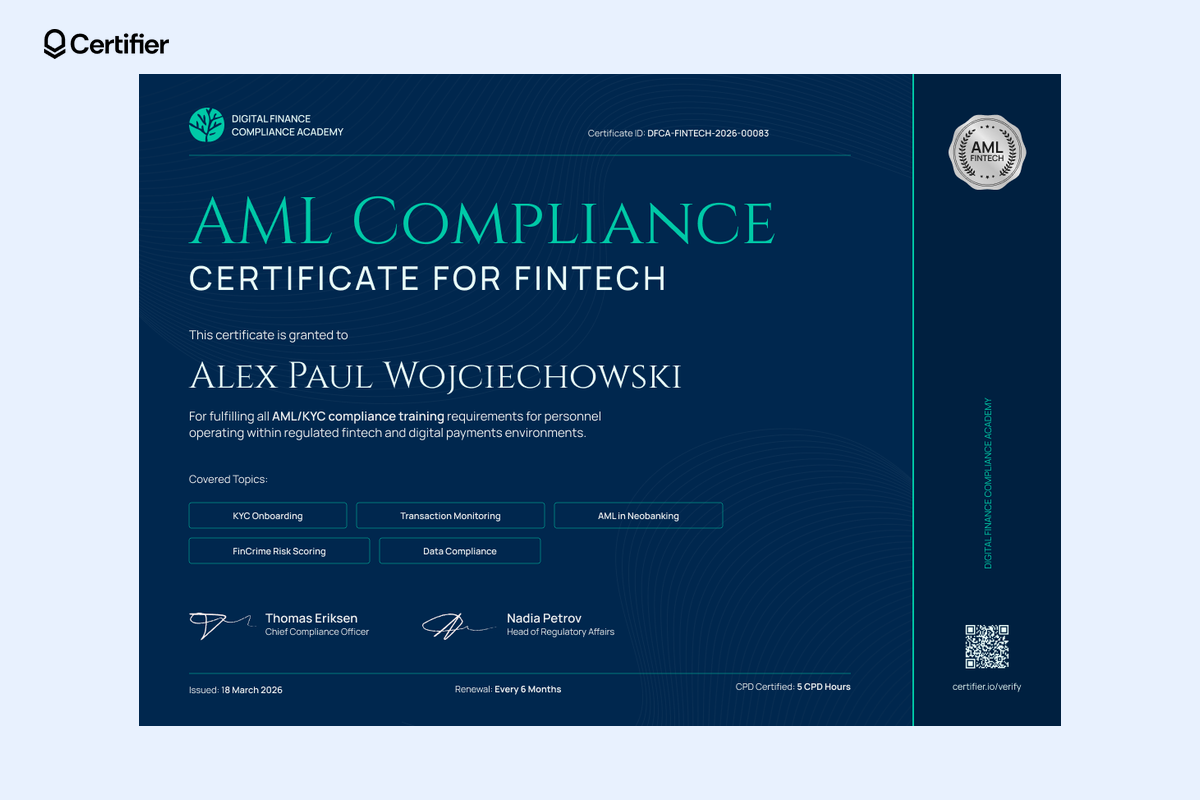
For fintechs, neobanks, and payment companies, this dark navy design with teal lettering fits the onboarding, operations, and risk teams that need regular KYC training. Five outlined boxes list the topics, such as KYC onboarding, transaction monitoring, and financial crime risk scoring.
A vertical band on the right holds a seal and a QR code, and the footer shows the issue date, renewal period, and CPD hours. The sample uses a 6-month renewal for fast-moving teams, so plan for two certificates per person each year if you keep that cycle.
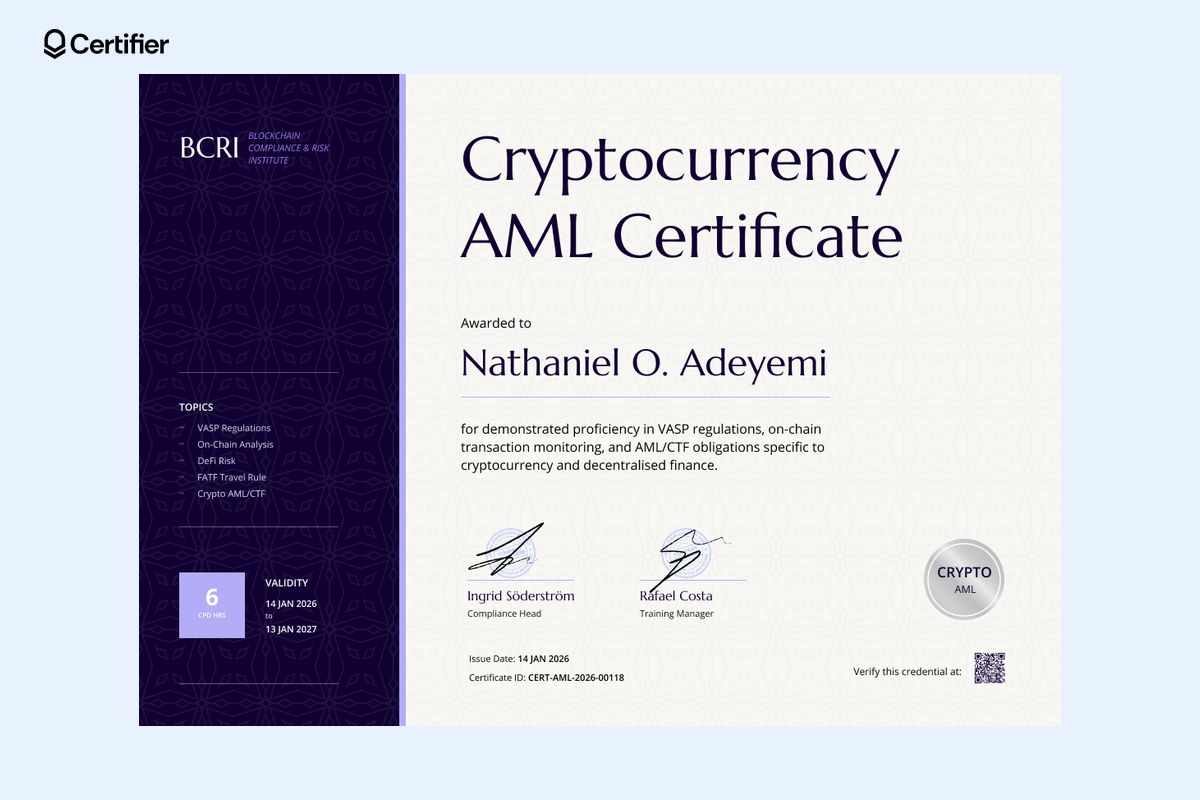
Crypto exchanges, custodians, and other virtual asset service providers can use this split design, with a deep purple panel on the left and a cream page on the right. The panel lists topics like VASP rules, on-chain analysis, DeFi risk, and the FATF Travel Rule, with a box for CPD hours and the validity period below.
The right side holds the title, the recipient's name, a short training statement, two signatures, and a QR code. For more designs in this space, browse our crypto and trading certificate templates.
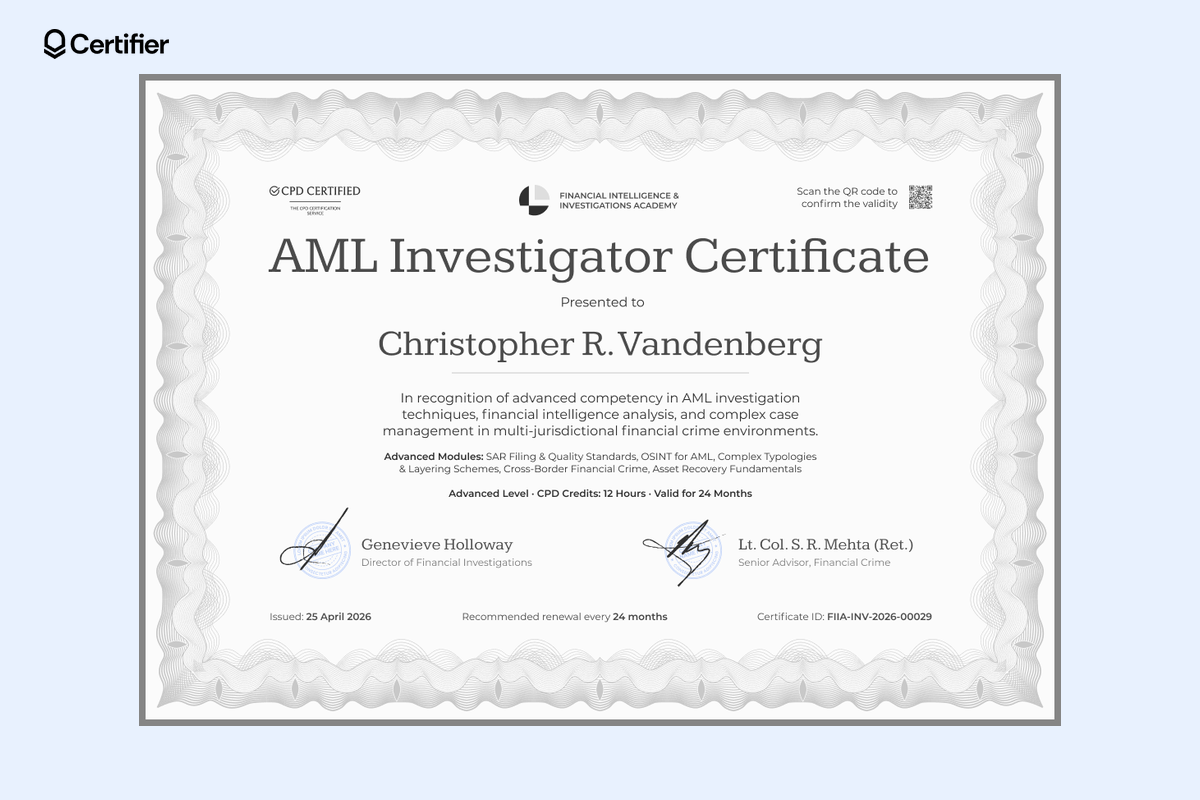
This grey certificate with a guilloche border is for financial crime units, bank investigations teams, and providers of advanced AML programs. An "Advanced modules" line names what the analyst completed, such as SAR writing, OSINT, complex typologies, and cross-border financial crime, followed by the level, CPD hours, and validity.
Map the modules to a spreadsheet column, so that each investigator's certificate shows only the modules they finished. The footer holds the issue date, a 24-month renewal note, and the certificate ID, with two signature lines above.
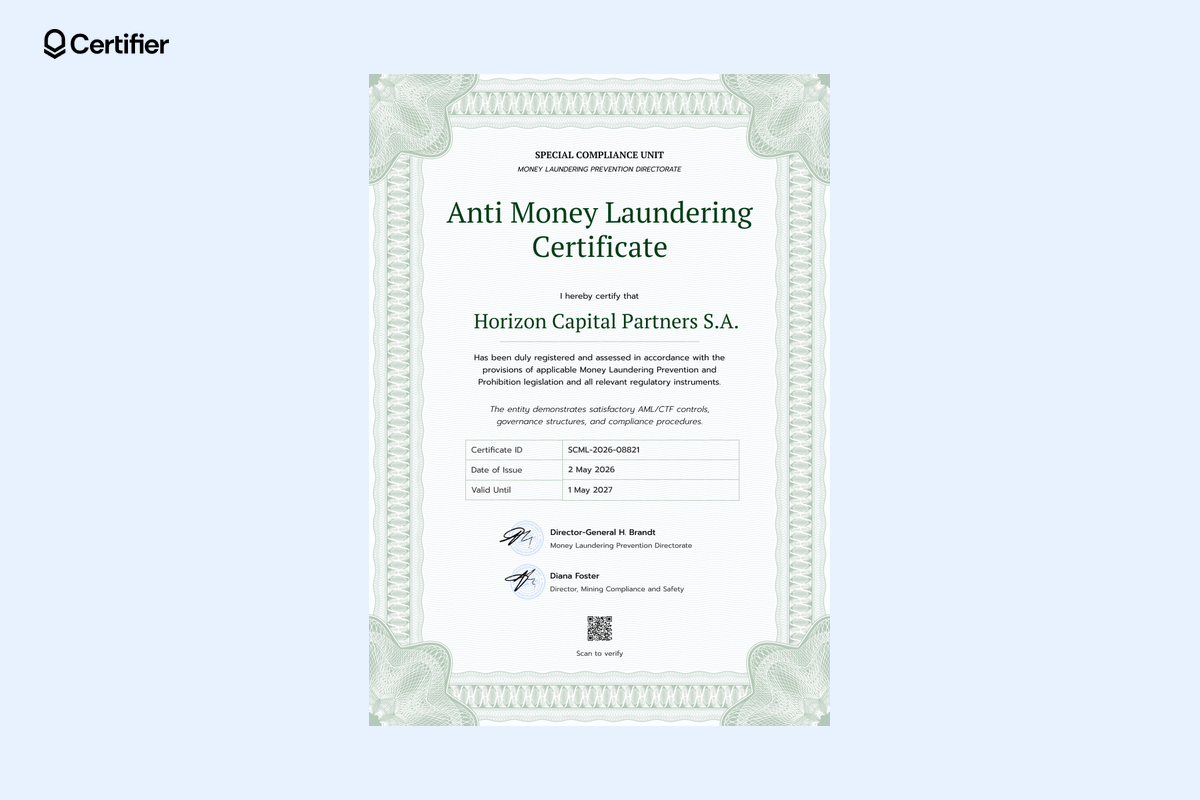
Unlike the others, this portrait certificate is made out to a company. Compliance consultancies and AML training providers use it to confirm that a client firm completed a program with them, such as firm-wide staff training.
A small table holds the certificate ID, issue date, and valid-until date, above two stacked signatures and a QR code. Pair it with an individual certificate for each employee who trained, such as the foundations design, so both levels are on record.
Most firms issue AML training certificates at four moments, and each calls for a different template as follows:

When a new hire finishes onboarding. Send the awareness or foundations certificate as soon as the course is marked complete, so no one starts client work without a record on file.
When the annual training window closes. Issue the bank AML, AML and CTF, or EU AML certificate to everyone in the cycle in a single batch.
When a specialist finishes deeper training. KYC analysts, crypto teams, and investigators get the fintech, crypto, or investigator certificate on top of their annual one.
When a client program ends. Training providers issue the corporate AML certificate to the client firm, alongside individual certificates for its staff.
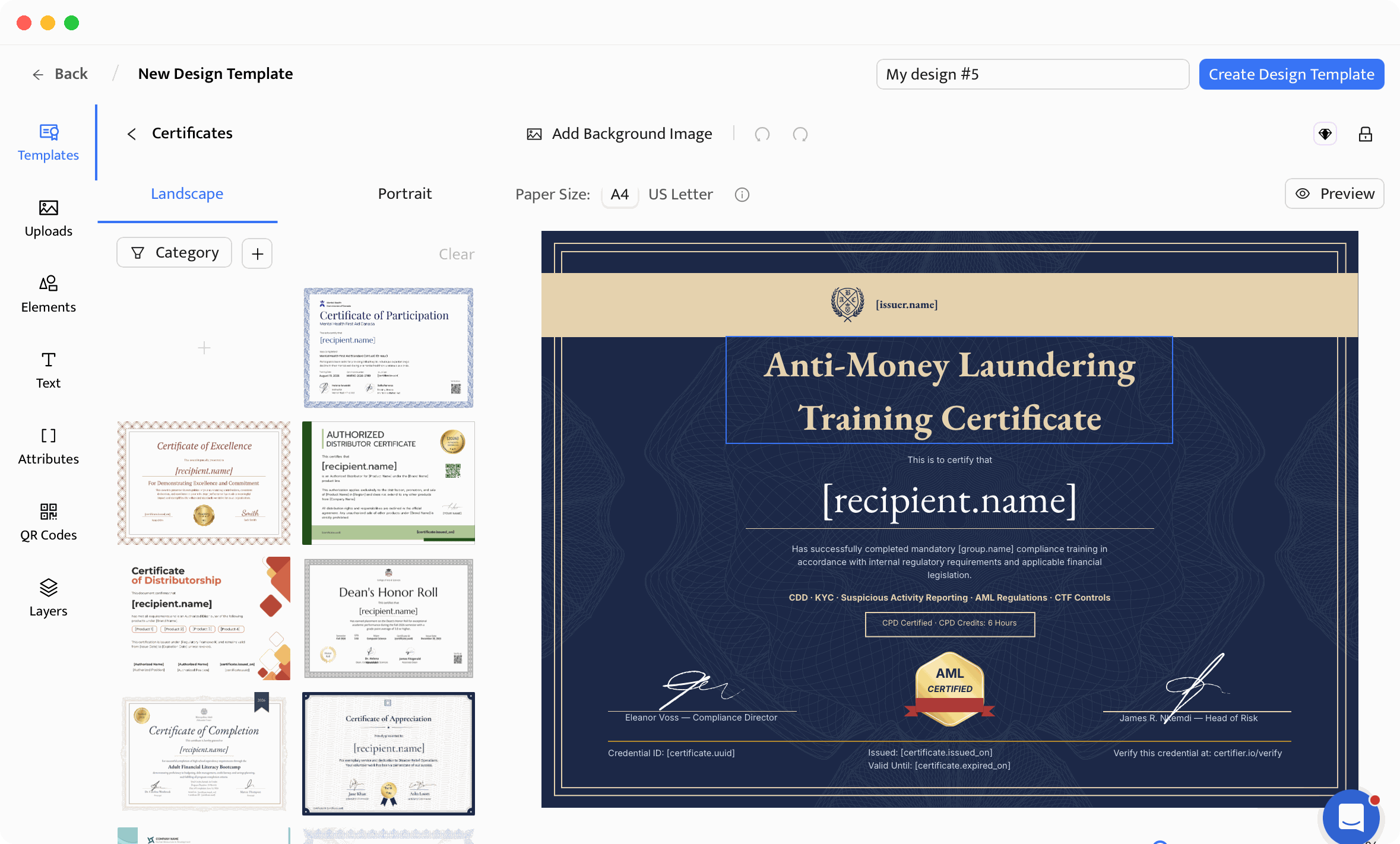

Pick the right template: Use the table above to match the template to the moment you're certifying.
Customize it to match your program: Upload your logo, add the signatures of your MLRO or Head of Compliance, then set this year's topics and CPD hours.
Add completions from your records: Upload a spreadsheet or HR export, or connect your LMS through a native integration or Zapier.
Preview the certificate and issue it in bulk: Check one certificate, add a valid-until date if you use one, then send them to the whole group. Each employee gets an email with their certificate and a public link to the credential page.
Repeat next cycle and track recipient engagement: When next year's course changes, duplicate the design instead of editing last year's. Use the analytics dashboard to see who has opened, downloaded, or shared their certificate, so you can follow up with anyone.
Each renewal is a new certificate, so a firm with 400 employees on a 12-month cycle issues about 400 certificates a year, plus one for every new hire. If an employee spots a typo in their name, they can request a correction from their credential page. Once you review it, you can update it without reissuing.
Select the template that matches your next training cycle, add your branding, and send every certificate in one batch. All 10 designs above work on Certifier's free Starter plan, which includes up to 250 credentials a year.
Sign up for free to edit and issue AML certificates for your next training period.
Yes. Connect your LMS through a native integration or Zapier, so that Certifier issues the certificate when the course is marked complete.
Yes, as long as you duplicate the design first. Edits to a design carry over to every certificate already issued with it, so make a copy for the new cycle and edit that.
Yes. Each renewal is a new certificate, so it counts as one credential per employee per cycle. Deleting an issued certificate doesn't return the credential to your allowance.
If your course is CPD-accredited or counts toward a professional body's CPE requirement, add the hours or credits so employees can log them. If it doesn't, show training hours instead and leave out any accreditation mark.
It depends on your regulator. Some set a period for training records, for example, the Central Bank of the UAE (five years from the date of training). Others, like the UK Money Laundering Regulations, require a written record without naming a period, so firms follow their own retention policy.
Whatever the period, you can export the full list of issued certificates from the Credential Repository and keep it with your training register.
Usually, the person accountable for your AML program, such as the MLRO, nominated officer, BSA/AML officer, or Head of Compliance, alongside the person who owns or delivers the training, such as the Head of L&D. The rules don't name specific signatories, so match the names to how your firm assigns responsibility.

- copywriting
- B2B content marketing
- content strategy
- on-page SEO
- storytelling
Growth Marketer (Freelance)
Anita Coltuneac is a freelance B2B SaaS marketer with 5+ years helping tech companies grow organic visibility, build authority, and support pipeline. She uses storytelling to turn product expertise into useful content.


