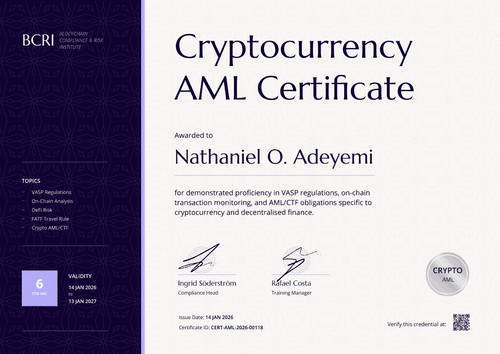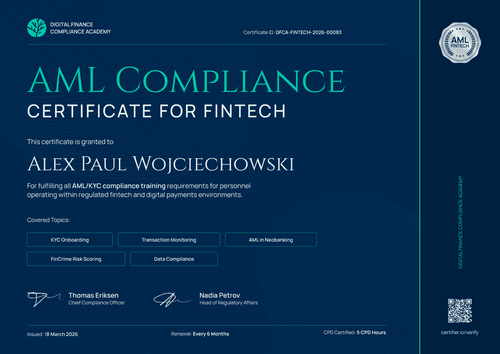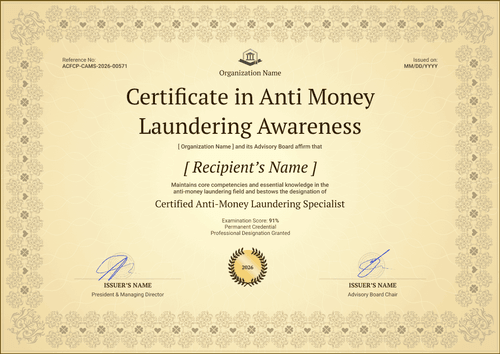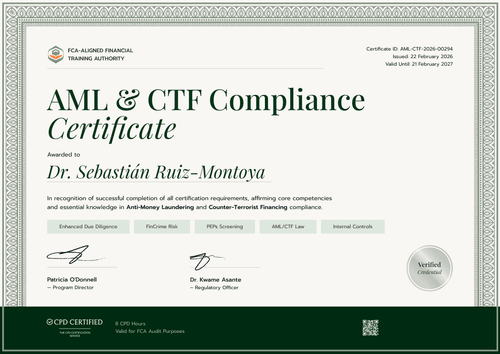

Corporate AML Certificate
A portrait AML certificate made out to a company rather than a person, for providers that certify a client firm, such as a capital partners or investment firm, after a firm-wide AML program.
Customize this template for free
Email and export in bulk
Track recipient engagement
Download in
Don't have Certifier account? Sign up
Formal green corporate AML certificate template
This free corporate AML certificate is issued to an organization, not an individual. Compliance consultancies and AML training providers can use it to confirm that a client firm, for example a capital partners, asset management, or advisory firm, completed a defined anti-money laundering program with them, such as firm-wide staff training or a review of AML policies and controls.
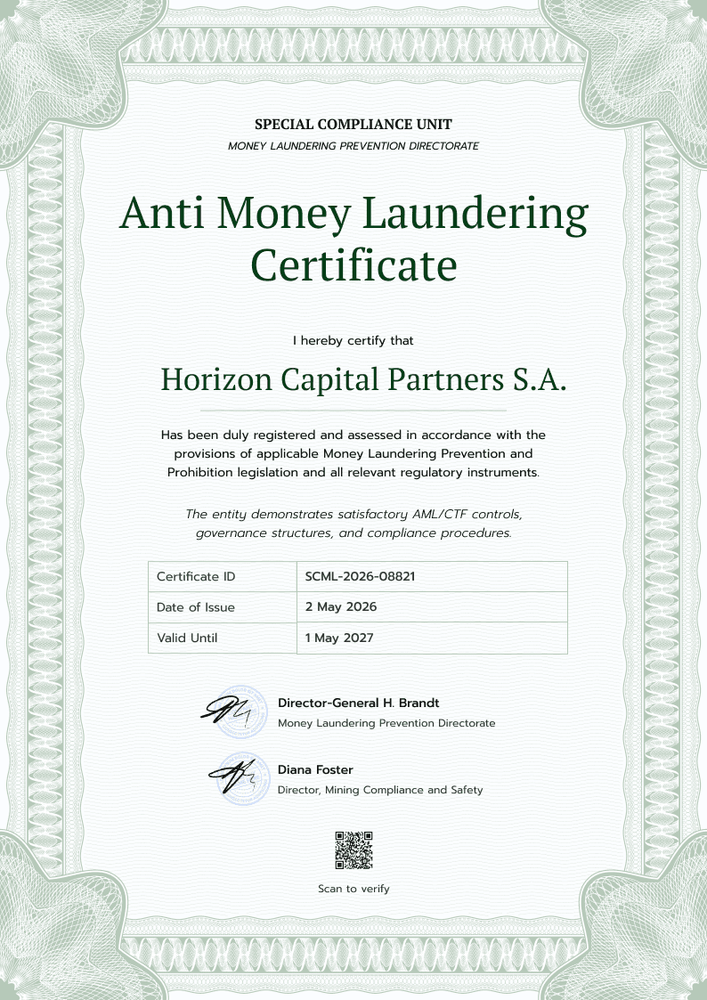
A green guilloche frame surrounds a portrait page with your logo and provider name at the top, a formal serif title, and the client company's name set large in the center. A statement under the company name describes the program completed. A details table lists the ID, the date issued, and the date the certificate runs to, with two signatures and a QR code at the foot.
Consultancies with many client firms can list clients in one spreadsheet, one row per company, and certify every firm that finished the program that quarter. The certificate goes to each firm's compliance contact, with a verification link they can pass to investors, banks, or partners who ask what AML work was done.
What is a corporate AML certificate?
A corporate AML certificate is a certificate made out to a company that records an AML program the company completed with your organization, the date, and how long you consider it current. Typical programs are training for all staff, a policy and procedures update, or an independent review of AML controls.
FATF Recommendation 18 sets out firm-wide AML programs for financial institutions, including internal controls, ongoing staff training, and an independent audit function, and many firms bring in outside specialists for parts of that work. A certificate gives the client firm a record of what the specialist delivered.
Only the regulator that supervises a firm can confirm its registration or compliance status. Issued by a consultancy or trainer, this certificate records the program delivered, so its wording should say "has completed" rather than "is registered" or "is compliant."
This second portrait design sits on an upright A4 page. Sign up to Certifier for free to start editing this template.
What should a corporate AML certificate include?
Name the client firm, the program, who delivered it, and until when it counts. You can change each of them online:
Static fields
- Organization block: Your consultancy or training provider's logo and name, inside the green frame.
- Certificate title: Corporate AML Certificate, or the name of your program.
- Program statement: What the firm completed, worded as completion (e.g., "has completed firm-wide AML/CTF staff training").
- Signature and role areas: Your provider's roles, for instance Managing Director and Lead AML Consultant.
Dynamic fields (automatically populated by Certifier)
- Recipient name: The client company's legal name (e.g., Horizon Capital Partners S.A.).
- Program name: The training or review delivered.
- Issue date: The date the program was completed.
- Expiry date: When you'd expect the firm to repeat or refresh it.
- Certificate ID: Your client and engagement reference.
Certifier's design builder lets you rename the table rows or swap the signer roles to fit how you describe engagements.
How to issue a corporate AML certificate
Certify client firms in four steps:
- Put your provider details on the design: Add your logo, both signatories, and completion wording for the program.
- List the client firms: One row per company with its legal name, program, and compliance contact's email, uploaded or sent through native integrations or Zapier.
- Pick an end date, then issue: Choose an expiry that matches your re-engagement cycle (Professional and Advanced plan feature).
- Plan renewals with clients: The Credential Repository shows which firms' certificates lapse next, so you can schedule the next engagement.
Available corporate AML certificate formats
Edit and issue the template online with Certifier
Keep one design per program and certify every client firm that completes it from a single list.
Download the template in Microsoft Word
Some clients want a signed paper copy for their compliance file. Your email gets you a portrait Word version, in A4 and US Letter formats.
PDF document export
The client's compliance contact can download the PDF from the email and add it to the firm's AML records.
Who issues corporate AML certificates?
Compliance consultancies
Firms that run AML reviews or policy projects for clients certify each engagement once it's complete.
AML training providers
Providers that train every employee at a client firm can issue one company-level certificate alongside individual staff certificates.
Group compliance teams
Groups with several entities, such as a holding company and its capital partners or fund vehicles, can certify each entity once its program is done.
Frequently asked questions
Yes. Certifier's free Starter plan handles it, with the program name as the main custom attribute. Valid-until dates and QR codes are Professional and Advanced plan options.
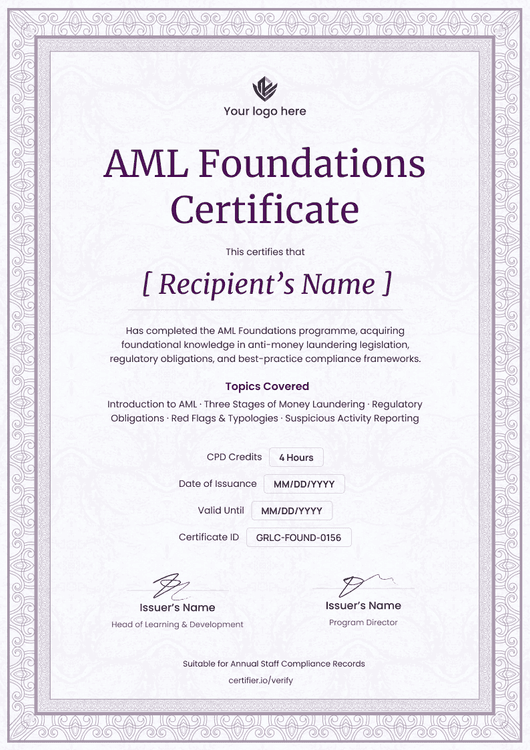
Yes. Issue this certificate to the firm and a separate training certificate to each employee, for example with the AML foundations design, so both levels are on record.
Through the verification link, they see your organization as issuer, the company's name, the program, the issue date, and the certificate ID.
No, it only records a program your organization delivered. Registration and compliance status come only from the firm's supervisor.
After an email check, the compliance contact asks for the correction from the record. After your approval, the company name updates, while the certificate ID stays the same.
Certifier templates are provided for general informational and design purposes only. They do not constitute legal, regulatory, or compliance advice and are not guaranteed to satisfy the requirements of any regulator, auditor, standard, insurer, or jurisdiction. The issuing organization is responsible for the content of its training program and for verifying that its records meet the requirements that apply to it.