
Harness Inspection Training Certificate
A harness inspection training certificate for trainees who learn to select, fit, inspect, and maintain a full-body harness, with a validity period for refresher planning.
Customize this template for free
Email and export in bulk
Track recipient engagement
Download in
Don't have Certifier account? Sign up
Formal brown harness inspection training certificate template
This free harness inspection training certificate records that a trainee completed your course on full-body harness use and inspection. It suits safety trainers, equipment distributors, and employers that teach workers how to select, fit, inspect, and maintain their harnesses before they work at height.
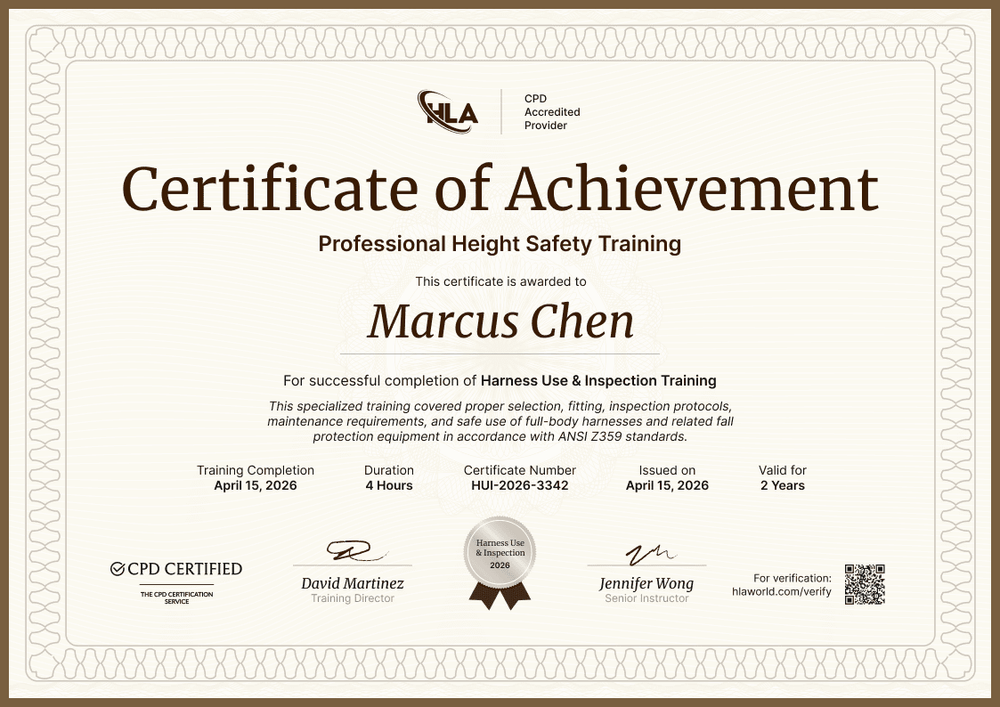
The design uses a cream page inside a fine brown border, with the title set in a large brown serif. The program name and the specific course sit under the title, followed by the trainee's name and an italic paragraph describing what the course covered. A row of five fields holds the completion date, duration, certificate number, issue date, and validity period, with a silver seal between two signature lines.
Equipment courses are short and frequent, so batch them: drop each session's names into a sheet or have your LMS send them. Before handing out a harness, a supervisor can open the trainee's verification link.
What is a harness inspection training certificate?
A harness use and inspection training confirms that a named trainee learned to use and inspect a full-body harness and on which date. Supervisors check it before handing out fall protection equipment for working at heights tasks.
OSHA requires that personal fall protection systems be inspected before initial use during each work shift, and that workers be trained on how to use, maintain, and inspect their equipment. Many courses also follow the ANSI/ASSP Z359 family of industry standards for fall protection equipment, which are voluntary standards rather than law.
Inspection logs and practical checks remain the real evidence that equipment is safe to use. The certificate only shows that the trainee sat your course.
The landscape layout comes on A4 (29.7 cm x 21 cm) with a five-field row along the bottom. Sign up for a free account to start customizing this harness inspection training certificate template.
What should a harness inspection training certificate include?
Show who learned harness inspection, which course, how long it ran, and until when it applies. The online builder lets you edit:
Static fields
- Organization block: Brown-bordered header with your organization's logo.
- Program heading: Certificate of Achievement above Professional Height Safety Training.
- Course name and description: The course and what it covered (e.g., Harness Use and Inspection Training: selection, fitting, inspection, and maintenance of full-body harnesses).
- Seal: A silver seal you can relabel with the course name or year.
- Signature and role areas: Usually a Training Director next to a Senior Instructor.
Dynamic fields (automatically populated by Certifier)
- Recipient name: The trainee (e.g., Marcus Chen).
- Training completion date: The session date.
- Duration: The course length (e.g., 4 hours).
- Certificate number: Matches your session log.
- Issue date: The date sent.
- Validity period (Professional and Advanced): Two years in the sample, after which the record shows as lapsed.
Rename the seal, the fields, or the description in Certifier's design builder to fit the equipment you teach.
How to issue a harness inspection training certificate
Certify each harness session in four simple steps:
- Describe your course: Add your logo, both signatures, the course description, and seal text.
- Add the session's trainees: Upload a list or route sessions in through native integrations or Zapier.
- Set the validity period and send: Apply an expiry date that matches your refresher interval (Professional and Advanced plan feature).
- Schedule refreshers: Plan the next session around the expiry list in the Credential Repository.
Available harness inspection training certificate formats
Edit and issue the template online with Certifier
Keep your harness course description and validity rules in one online design and reuse it for every session.
Download the template in Microsoft Word
Distributors sometimes need an editable file for customer packs. Enter your email to receive landscape zipped Word files, in A4 and Letter formats.
PDF document export
Trainees can file the PDF with their equipment paperwork, while supervisors can download it from the emailed link.
Who issues harness inspection training certificates?
Safety training companies
Trainers that run equipment-specific courses issue a certificate for each session. A validity period on the certificate tells clients when trainees need a refresher.
Equipment distributors and manufacturers
Companies that sell fall protection equipment often train customers on correct use and inspection. A branded certificate gives each trainee a record of that training.
Employers and HSE teams
Employers that issue harnesses to their own workers can record who has been trained before equipment goes out.
Frequently asked questions
Yes. Certifier's free Starter plan supports editing and sending it, because the two custom fields, completion date and duration, fit Starter's limit of five. The validity period and QR code are Professional and Advanced plan features.
OSHA doesn't fix a period, so you or your client decide. The sample shows two years, but you can choose whatever period your course uses.
Yes. The trainee's link, or a paid-plan QR code, opens a record showing your organization, the trainee, the issue date, the certificate number, and whether the validity period is still running.
No. Compliance also rests on inspections, rescue planning, and the rest of your fall protection program. The certificate covers one trainee and one course date.
They can raise it from their record after an email check. Approve the request in your dashboard and the record shows the right spelling, with the validity period unchanged.
Certifier templates are provided for general informational and design purposes only. They do not constitute legal, regulatory, or compliance advice and are not guaranteed to satisfy the requirements of any regulator, auditor, standard, insurer, or jurisdiction. The issuing organization is responsible for the content of its training program and for verifying that its records meet the requirements that apply to it.