

Trusted by:
University of Southern California
Warner Bros.
Volvo
Amazon
Stanford University
Updated: September 11, 2026
7 min read
A capability you watched work in a demo and one you read on a feature page are not the same score. Here's how to weigh microcredential platform requirements for your program and score vendors on what you can actually verify.
Research with AI:
Shortlisting a microcredential platform and defending the shortlist are two entirely different things.
As every vendor website promises the same seven key features in the almost same order, you need a more in-depth tool analysis when proposing your top choices to an executive who sat in none of the demo calls or an IT lead asking where the data lives and how secure it is.
In this article, we break microcredential platform requirements into nine categories from scalable issuance and verification features to cost, ease of use, stacking, and design.
You’ll also get a ready-to-use weighted scorecard for comparing vendors, a 15-task demo script, and the proof artifacts to demand before you sign.
These four evaluation items are built to help you get to a decision you can defend, a credential that stays readable outside the platform that issued it and a program that isn’t hostage to one vendor's product model.
Before you look at vendor features, answer five questions about what you award, whether it stacks, and who signs off will set your requirements.
A microcredential platform has to do nine things well, from reliable issuance and credit fields through verification, stacking, portability and exit.
Score those nine criteria with explicit weights because a shortlist you cannot explain to procurement is not a shortlist.
Weights change by program type. CE and CPD programs should rank credit fields and renewal handling far above design.
Test the finalists against the demo script and don’t forget to request the proof artifacts before you buy the subscription.

Microcredential platform requirements are a translation of program decisions you have already made.
To set your weights and turn strategy into clear specifications, answer these questions before you look at a single platform:

What are you awarding and who reads it? A badge nobody verifies and a CEU record a licensing board audits are different products. This decides how much verification and credit data are worth.
Does anything stack? If component awards roll into a final credential, pathway support becomes a must and your credit budget changes shape.
What triggers issuance and where does that data live? An LMS completion, a webinar, a form, a CRM field. Name the system since that determines whether you need a native connector or an API.
What volume, in a year, not in the pilot? Cost per credential at 5,000 looks nothing like cost at 250.
Who signs off besides you? List them now: director, procurement, IT, the accreditation owner. Each decision-making person adds requirements you’ll otherwise discover late.
The category order comes from what buyers actually struggle with, which is why design sits ninth. Design is the most commoditized thing in this market and the easiest thing in a demo to be impressed by.
01Reliable issuance at volume: Look at bulk upload, per-recipient personalization, resends, corrections, and the handling of invalid rows. A vendor passes this by showing you a failed row and telling you whether the rest of the batch went out anyway.
02Issuance triggers and integrations: Firing on LMS completion, webinar attendance, or a form submission is the easy half of the question. The harder half is whether that connection is native, a Zapier recipe, or something your developers end up maintaining.
03Credit and metadata fields: That includes CEU value, contact hours, provider number, custom attributes. Passing means editing a credit field for one recipient inside a full cohort, live, without disturbing anyone else's record.
04Verification, revocation, and expiry: Ask what a verifier sees after a credential has expired and after it has been withdrawn. Those are two different states and they should produce two visibly different screens.
05Cost and contract terms: Ask about pricing model, renewal, and exit, but above all how credits are counted. Most platforms charge per credential, not per learner, so a stacked program burns through an allowance faster than anyone budgeted for.
06Ease of use and administrative load: No demo can test for ease of use since the person driving is the person who built it. The only honest version is having your own coordinator complete one task unassisted.
07Stacking, pathways, and portability: Check whether component awards roll into a final credential on their own and whether the record travels once it exists. That includes Open Badges 3.0, exportable data, and a verification URL that resolves for someone outside your institution.
08Administration, security, and access: Look for features such as SSO, roles, audit trail retention, and current certifications. This category rarely loses a deal, but it stalls plenty of them, so it’s better to have this answered before IT asks.
09Design and branding: Template quality and branded delivery matter, though less than most demos might imply. The bigger question is whether editing a template quietly rewrites credentials you have already sent.
Every item below is written as a question with a checkable answer so you can lift them into your requirements document as they are.

Can we correct a value on an issued credential, a name or a date, without reissuing it, and does the verification URL survive?
What does correcting a cohort cost in credits, in resends, and in broken URLs?
What is the API rate limit, is there a bulk endpoint, and how long does issuing 5,000 credentials actually take?
What happens to invalid rows in a bulk upload: does the batch stop or do those learners get skipped silently?
Does resending a credential consume allowance and can we see why a delivery failed in one place?
Can we subscribe to an event when a credential expires or only when we change one?
What domain do credentials resolve on by default and does moving to a custom domain break URLs already issued?
Are credential identifiers generated by the platform or set by us? Platform-generated identifiers cannot be tampered with, which is what a verifier wants. Issuer-set identifiers match an existing certificate-numbering scheme, which is what your registrar wants.
How long is the audit log retained and can it be exported on a schedule?
Does the vendor publish a dated changelog and what has shipped in the last twelve months?
When a credential is removed or replaced, does the platform erase it or mark it?
What happens when a credential inside a pathway expires?
Do template changes rewrite credentials already issued and can that be prevented?
Can credit fields be edited per recipient across a full cohort?
Can public credential pages be kept out of search engines?
Everything above tests what a platform can do. These questions answer what happens when you want to leave, which is the set buyers skip because nobody is planning an exit on the day they sign.
They are also the questions that decide whether your credentials stay interoperable or become one vendor's file format.
Can we export every credential we have issued, with verification URLs and Open Badges 3.0 metadata intact, in a single action?
Does a credential a learner already downloaded still validate against a third-party validator after the hosted page is gone?
What happens to issued credentials if we stop paying? Do they stay verifiable and does anyone charge us to keep them alive?
If we move to another platform, what specifically doesn’t transfer?
Does the credential carry a published standard that a competitor could read or a proprietary format only this vendor renders?
Who owns the verification domain and what happens to filed URLs if that domain changes?
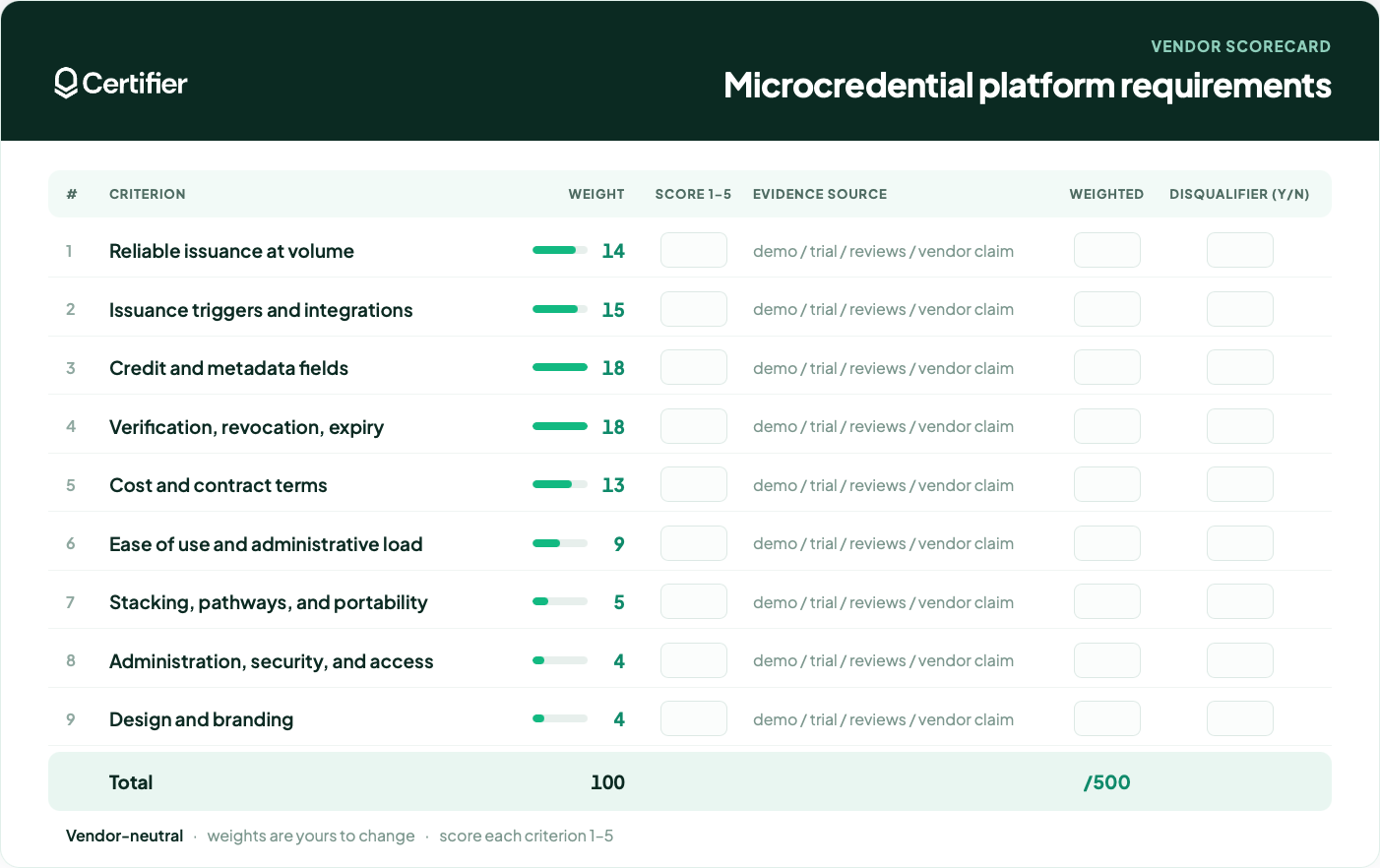
Scorecard Methodology
Criteria are grounded in three external sources: IACET for CEU, contact-hour and provider-number requirements, 1EdTech for Open Badges 3.0 and CLR and the published rating dimensions of the G2 Digital Credential Management category, which scores this exact category on weighted criteria.
The weights are an editable starting point shaped by patterns we see across buyer conversations. They aren’t a standard and you should change them to match your program.
Score each criterion 1 to 5, record how you verified it, multiply by the weight, then work out the score.
Use our free microcredential platform requirements workbook to fill in your own scorecard and compare vendors against the demo script and the artifact proof checklists. When you click on the link, it opens a copy in your own Google Drive so your edits stay private to you.
Most buyers skip the evidence column, but procurement asks about it first. A 5 you watched happen in a demo is worth more than a 5 you read on a feature page, so record which one you have.
The two sources answer different questions. While a demo shows you something is possible, reviews and a trial tell you what month seven looks like, when your coordinator is running it alone and the renewal quote has landed.
Two categories draw almost no public review coverage, specifically portability and standards, and microcredential stacking and pathways. You either test them on purpose for the beginning or you find out later.
One failed non-negotiable beats any total, however wide the margin looks. If your program has to produce IACET-compliant records, a platform that cannot carry the provider number in a per-recipient field has already failed.
Any strength everywhere else doesn’t buy that back, so flag your disqualifiers before you score anything.
Common disqualifiers by profile include:
cannot carry a provider number or CEU value per recipient (CE/CPD)
no SAML SSO (higher education and enterprise)
verification URL doesn’t survive a template change or a withdrawal (all profiles)
no full data export on exit (all profiles)
Scorecard example below: A healthcare CPD provider issuing about 1,200 credentials a year, using the CE/CPD weights below, scoring three anonymized archetypes.
Criterion | Weight | Enterprise Suite | Badge Specialist | Certificate Tool |
|---|---|---|---|---|
Reliable issuance at volume | 14 | 4 | 5 | 4 |
Issuance triggers and integrations | 15 | 5 | 4 | 2 |
Credit and metadata fields | 18 | 5 | 3 | 2 |
Verification, revocation, expiry | 18 | 4 | 4 | 1 |
Cost and contract terms | 13 | 1 | 4 | 5 |
Ease of use and administrative load | 9 | 2 | 4 | 5 |
Stacking, pathways, portability | 5 | 4 | 5 | 1 |
Administration, security, access | 4 | 5 | 3 | 2 |
Design and branding | 4 | 3 | 4 | 5 |
Total | 100 | 387 | 404 | 271 |
The certificate tool is disqualified twice over, on credit fields and also on withdrawal behavior. Although the enterprise suite scores well, it still loses on cost and on administrative load.
Generic checklists fail because they hand everyone the same criteria and assume every program values them the same way. However, weights are not universal.
For example, the gaps between the three profiles below are wide enough to change which platform wins.
Criterion | Ce Cpd | Highered Extension | Corporate Ld |
|---|---|---|---|
Reliable issuance at volume | 14 | 14 | 17 |
Issuance triggers and integrations | 15 | 16 | 22 |
Credit and metadata fields | 18 | 8 | 5 |
Verification, revocation, expiry | 18 | 10 | 10 |
Cost and contract terms | 13 | 13 | 15 |
Ease of use and administrative load | 9 | 8 | 12 |
Stacking, pathways, and portability | 5 | 14 | 7 |
Administration, security, and access | 4 | 11 | 8 |
Design and branding | 4 | 6 | 4 |
Total | 100 | 100 | 100 |
Credit fields and renewal handling rise to joint top. A platform that cannot handle expiry, reminders, and reissuance on a cycle fails the program even when it scores well everywhere else, so treat expiry handling as disqualifier-eligible.
Portability drops away because a board wants a record it can check, not a credential that travels between institutions.
Stacking, portability, and institutional security are all essential. SSO and CLR alignment are procurement gates and cohort sizes turn bulk behavior into a scale problem.
If you want the vendor comparison instead, digital credential platforms for higher education is the shortlist version of this page.
Integrations take the top weight here as the HRIS and LMS connection is not part of the workflow, it is the workflow. Credit fields and portability fall away in the same move, since the audience is internal and no outside body will ever review the record.
Create and Send Digital Credentials
You can send this list in advance before a live demo call. Watch out for reroutes as these are easier to oversee in a call.
Getting "Absolutely, we handle that, let me show you the reporting view" in response to task 5 is most likely a no.
Connect to my LMS live and show me the run log after a test completion.
Trigger an issuance from a form submission, then show me the same event in the log with its error detail and retry state.
Show me which integration paths sit on which plan.
Issue a credential to me now and send me the verification URL.
Expire it, withdraw it, and delete it while I watch, and show me what a verifier sees after each one.
Produce a sample Open Badges 3.0 credential JSON and confirm it resolves outside your platform.
Tell me what happens at renewal and at overage, in writing.
If a learner earns three component credentials and one completion credential, how many credits does that consume? Show me the usage counter before and after.
Add a CEU value, contact hours, and a provider number as per-recipient fields on a credential issued to me.
Change one of those values on one recipient inside a batch, without reissuing.
Build a two-step pathway and issue the completion credential automatically.
Brand the credential and the delivery email live, from our logo and our sending domain.
Edit the template now and show me whether the credential you issued in step 4 changed.
A demo cannot test this, so hand over the keys: let our coordinator, not your sales engineer, complete one issuance unassisted.
Show me your dated changelog and walk me through what shipped in the last twelve months.
Note: If the platform has a free plan, you don’t need a sales call to run most of this script. Create a free Certifier account and perform tasks 4, 6, 9, and 10 on us yourself in less than ten minutes. No credit card required.
These standard requests help you put your mind at ease before you buy the subscription:
Artifact | What It Proves | Who Asks For It |
|---|---|---|
Security certification documents (ISO 27001, ISO 9001) | An independent auditor has checked their controls, so your security team has a known standard to verify against | IT and security review |
Signable data processing agreement, plus a data residency statement | Legal can countersign without a bespoke negotiation, and you know which country the data sits in | Legal, IT |
FERPA documentation, for US institutions or the GDPR equivalent | Credential records containing student data are handled under a framework your registrar already recognizes | Registrar, legal, IT |
Published subprocessor list | You can see every third party touching recipient data, each of which your procurement team may need to approve separately | Procurement, IT |
Uptime and incident history from a public status page | Reliability is measured, not asserted, and past incidents were disclosed | IT, procurement |
A sample Open Badges 3.0 credential JSON | The credential is readable by something other than this vendor's own software | Compliance, IT |
A full data export, including verification URLs and metadata | You can leave and the record leaves with you | Procurement, compliance |
A verification URL that resolves for a third party | An employer or a board can check a credential without contacting you | Compliance, accreditation owner |
Written confirmation of credential status after contract end | Credentials you already issued stay verifiable when you stop paying | Procurement, finance |
Cost per credential at your projected volume, including pathway awards | The real price at the scale you will actually run, not the sticker price | Finance |
Here are some examples of requirements that only surface after go-live:

Editing a template can rewrite credentials already issued. Useful if you want a retroactive branding fix, a problem if an auditor expects issued records to be frozen. Ask which behavior you get and whether it can be turned off.
Enabling SSO later is a migration, not a toggle. Turning it on at the organization level can delete or disable existing non-owner users. Ask what happens to your team's accounts on the day you enable it.
Moving to a custom domain can change every URL already issued. QR codes get printed onto certificates and pasted into board submissions. Ask whether old URLs redirect permanently. If the answer is vague, set the custom domain up before you issue anything.
Changing the program after sign-up can require changing the plan. Pathways, custom domains, and other structural features are commonly gated to higher tiers. As stacked microcredential programs usually get designed after the first cohort has already shipped, the capability check lands months after the pricing decision. Ask which tier covers pathways and custom domains and what the upgrade costs at your expected issuing volume.
Sign up for a free account and run the scorecard against Certifier yourself.
The free plan covers 250 credentials a year and three text custom attributes, which is exactly enough to carry a CEU value, contact hours, and a provider number, so you can test the highest-weighted CE requirement yourself instead of taking our word for it.
Issue a credential, open the verification URL, download the Open Badges 3.0 JSON, and check it against a third-party validator. Then score us honestly.
Three things you cannot test on the free plan, but that you can bring to a demo call: expiry rules and QR codes (Professional plan), and Pathways (Advanced plan).
Most platforms charge per credential per year, not per seat. Multiply learners by credentials per learner, count the completion awards in any pathway, then add a margin for corrections. Certifier's free Starter plan covers 250 credentials a year and Professional starts at $67/month for 1,000.
This depends on three things: whether the platform issues a completion credential automatically when component awards are earned, how deep its LMS integration runs, and whether it supports your identity provider. Score those three first.
There are two key criteria you need to keep in mind. First, how the platform prices volume: cost per credential at 5,000 a year, not at 250, including every award in a stacked pathway. Second, how bulk issuance fails: whether a bad row stops the batch or gets skipped quietly and whether you can see why a delivery bounced.
They open a verification URL, usually from a QR code or a link in the credential itself, and read what the page reports. That is why verification permanence matters more than the badge artwork: the URL has to survive a template change and say plainly whether the credential is still valid.

- copywriting
- B2B content marketing
- content strategy
- on-page SEO
- storytelling
Growth Marketer (Freelance)
Anita Coltuneac is a freelance B2B SaaS marketer with 5+ years helping tech companies grow organic visibility, build authority, and support pipeline. She uses storytelling to turn product expertise into useful content.


