

Trusted by:
University of Southern California
Warner Bros.
Volvo
Amazon
Stanford University
Updated: July 31, 2026
10 min read
While the market has grown to meet enterprise demand, most platforms fall short in key areas. In this article, we compiled a list of the top five enterprise credential management platforms that consistently make it onto enterprise shortlists.
Research with AI:
Reportedly, nearly half of Fortune 500 companies issue digital badges and certificates as part of how they recognize employees, certify partners, and showcase verified skills. Credentialing, once owned by one L&D team, is now part of enterprise infrastructure and must be held to the same standards as the rest of the stack. Now, the enterprise-ready tool should offer high security, audit readiness, integration with HR systems, and provide an admin experience that doesn't slow teams down.
While the market has grown to meet enterprise demand, most platforms fall short in key areas, like compliance gaps that stall procurement, integrations that need third-party workarounds, or governance that breaks the moment a program spans more than one team, region, or brand.
Below, we compiled a list of the top five enterprise credential management platforms that consistently make it onto enterprise shortlists according to our research. The goal is not to decide on an overall winner for best enterprise badges, but to help you identify the platforms that best fit your program, acquisition committee, and implementation constraints.
Certifier is the strongest fit for modern enterprise credentialing: combining full lifecycle control( easy post-issuance editing, AI design builder, multiple designs for each credential), complete enterprise security and compliance (Open Badge 3.0, ISO 27001, ISO 9001, GDPR, SSO, RBAC), and native integrations in one platform.
Credly and Accredible anchor the legacy end of the market: strong pedigree and large ecosystems, but trade-offs around recipient experience, post-issuance control, and product velocity show up at enterprise scale.
Sertifier and CertifyMe sit in the mid-market with credible compliance baselines, but narrower integrations and lighter enterprise governance documentation.

Each platform on this list has a clear strength and a real trade-off. The table below pulls both into one view, so you can find the right fit before deciding which sections to read in full.
Platform | Best For | Main Strength | Main Tradeoff |
|---|---|---|---|
Certifier | Modern enterprise L&D and certification programs, customer education, product training, and certification teams | Fast program rollout, full enterprise governance, native integrations included on the core platform, and a branded recipient experience | No publicly documented SOC 2 Type II |
Credly | Global certification bodies prioritizing employer-network discoverability | Credential network reach | Badges only, vendor-branded recipient experience |
Accredible | Universities and learning-led enterprises with established Accredible investment | Stackable credential pathways for complex academic programs and white labeling | Limited post-issuance control and design depth |
Sertifier | Mid-market organizations and training providers in education-anchored or LMS-driven credentialing programs | SOC 2 Type II + GDPR + FERPA compliance baseline with strong LMS fit | Design editor inconsistencies and bulk workflow friction at scale |
CertifyMe | High-volume global certification programs need transcript management | SOC 2 Type II + GDPR + FERPA compliance baseline with strong LMS fit | Customization limitations across branding and templates |
Before getting into each tool, it's worth explaining how we built this list and what mattered most when ranking them.
We started with G2's Best Enterprise Digital Credential Management Software article as the anchor, which offers an independent benchmark that showcases various levels of enterprise fit for every platform on this list, including our own.
From there, we cross-referenced public vendor documentation, security hubs, trust centers, and pricing pages (where available) against verified buyer feedback on G2 and Capterra. No single source tells the full story, but layered together, they give a fair read on each platform's real strengths and gaps.
The weight we gave each criterion reflected what actually decides enterprise deals:

Governance and security
Automation and integration depth
Credential lifecycle control
Verification and recipient experience
Customer pedigree
Evaluation for enterprise rollout and friction
A note on transparency: this comparison is based entirely on publicly available information, and every platform was held to the same standard.
A platform that looked solid a few years ago can fall short today on increased enterprise demands like verification depth, integration coverage, or compliance posture. To establish what criteria and tool capabilities matter the most today, we compiled a list of key factors that separate enterprise-ready badging solutions from the rest of the market options.
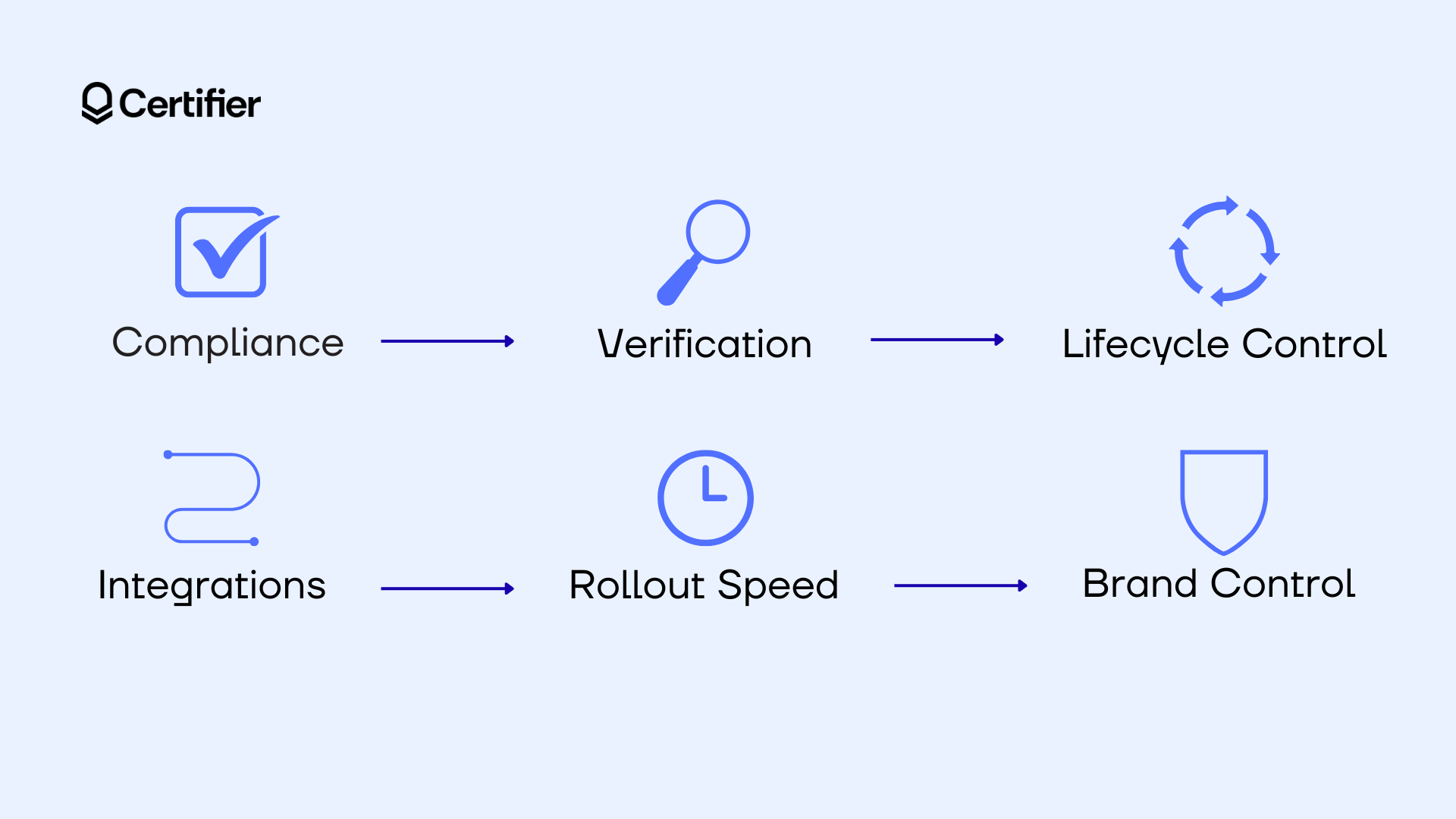
For enterprise issuers, security and compliance often become the most important part of choosing a credentialing vendor. Credentials carry recipient data, connect to HR and identity systems, and fall under regulations like GDPR.
Two things separate platforms that clear procurement quickly from those that stall:

Recognized certifications. Independent audits confirm that the vendor actually does what its security page claims. ISO 27001 is the baseline most enterprise security teams expect, and GDPR compliance is non-negotiable for any program handling EU recipient data. ISO 9001 and SOC 2 Type II are useful additional signals, depending on your region and industry.
Safe integration with your stack. Due to automations and the intertwined nature of credentialing, the issuing platform sits next to your internal systems. The important part here is to prove that credentialing management software doesn't pose a risk to your operational tools and sensitive data that they hold. SAML 2.0 SSO, multi-factor authentication, role-based access control, audit logs for admin activity, and audited API access are the standard controls that let those integrations happen safely.
Credential management platforms that publish certifications and provide security guidelines give issuers evidence of compliance, which will help clear any technical/security review in weeks. On the other hand, badge issuers that only produce compliance evidence on request can stretch the same review into months.
For a full breakdown, see our Enterprise Security Requirements for Digital Credentials guide.
For an enterprise issuer, the value of a digital credential rests on how reliably it can be proven authentic by a third party. That proof has to hold up against tampering and forgery, and it has to be accessible to anyone who wants to verify your credentials outside the organization.
The verification model a platform uses determines how defensible each credential is. A few things are worth checking:
A unique credential ID is on every issued credential, so each certificate or badge can be traced to a unique number or issuance event.
A public verification page for every credential, accessible without a login or third-party account. The verifier sees the issuer, the recipient, the date, the criteria, and the current status — valid, expired, or revoked — at the source.
A QR code on the credential itself that routes directly to that verification page. No manual URL lookup, no email exchange.
Issuer details and skills built into the credential — the organization that issued it, what it certifies, and the standards it's aligned with (Open Badge 3.0, W3C Verifiable Credentials). This keeps the credential verifiable even if the recipient shares it outside the issuing platform.
The verification flow on your branded domain, with your organization's name and identity on the page that confirms authenticity.
How enterprise credential platforms handle these basics shapes the certificate or badge’s defensibility long after it's issued.
Unique IDs, live verification pages, and clear status indicators are what let an auditor confirm a credential years later or let a verifier spot a forgery in seconds. Without them, even a well-designed credential becomes hard to defend if challenged.
Enterprise credential programs don’t end at issuance. Certifications lapse, validity windows close, recipients re-certify, licenses get revoked, and typos surface. How a platform handles those changes is what separates a credentialing program your team can manage from the madness your team constantly cleans up after.
Approaches across the category fall into two camps:

Revoke-and-reissue. The original credential is deleted and replaced with a new one. Simple, but it can break any links the recipient has already shared on LinkedIn or sent to an employer.
In-place updates. Data and design edits apply to the existing credential, expiration triggers automated renewal reminders, and revocation marks the verification page accordingly. Some platforms also let recipients request corrections directly, removing the admin step.
For programs issuing a few hundred credentials a year, either approach is manageable. At enterprise volumes, the difference in operational overhead adds up quickly.
How much of a credentialing program runs automatically depends on how well the platform connects to the systems your team already uses — LMS, CRM, HR, event tools, and spreadsheets.
Manual issuance may work for pilot programs, but it does not scale. Before adding a badge maker to your shortlist, check for the connection paths your system needs, which can be grouped into two categories:
Native integrations are direct, prebuilt connections between the credentialing platform and another system. They run in real time and don't require additional tooling. The systems most credentialing programs rely on nowadays are HubSpot, Salesforce, Google Sheets, Excel, Zoom, Typeform, etc. So coverage across these basic platforms is a good signal of how much a platform can automate out of the box.
APIs and connector apps cover everything outside the native set. A REST API lets engineering build custom workflows, while connector apps like Zapier, Make, and Pipedream let non-technical users link the platform to thousands of additional tools without code. Both extend the platform's reach beyond what's natively supported. For example, you can connect Certifier to Microsoft Dynamics via Zapier to introduce automated certificates or badges for custom events.
Most platforms offer some mix of both. The right balance depends on your stack: programs triggered by mainstream systems benefit most from native integrations, while programs built on niche or internal tools rely more on APIs and connectors.
For a deeper look at stack fit, see our guide to digital credentials integration. It explains which systems to connect, which integration approach to choose, and when a custom setup is worth the effort.
Implementation timelines vary widely across credentialing platforms. Some teams start issuing credentials within days; others stretch across weeks of sales conversations and infrastructure setup before any credentials get issued.
Two factors shape how long your rollout actually takes:
A structured onboarding process. A clear rollout plan with defined steps like account setup, branding capabilities, integrations, and issuing of the first credential gets a program live faster than a vendor that treats each one as a discovery exercise.
What's included by default. Most enterprise tiers include a dedicated account manager, but branding configuration, workspace setup, and integration work are often charged separately as professional services or billed as setup fees. For larger deployments, those professional services can add anywhere from $5,000 to $25,000+ on top of the contract.
For teams on tight timelines, rollout speed can matter as much as feature depth. A platform with broad capabilities and a six-month implementation may deliver less value in year one than a simpler one that gets credentials issuing in two weeks.
Every credential is a touchpoint with the recipient, and often with thousands of people they'll share it with after. A well-branded credential experience extends the issuer's identity across every step of that journey, from the moment the credential lands in a recipient's inbox to when it appears on their LinkedIn profile months later.
A vendor-branded experience cuts that visibility short, routing the recognition through the platform's brand instead of the issuer's. A few capabilities shape how much of that experience the issuer actually owns:
Branded email sender. Credential notifications arrive from the issuer's own domain and sender name, not the platform's. Recipients see the credential as coming from the organization that issued it — improving open rates and reinforcing the issuer's authority from the first interaction.
Branded credential pages. Each credential lives on a page that carries the issuer's logo, colors, and brand identity, so the recipient and any verifier see the issuing organization first, not the platform hosting it.
Custom domain and white-labeling. Verification pages, the credentials portal, and the recipient claim flow all live on the issuer's own domain (e.g., credentials.yourcompany.com). The platform itself disappears from the recipient's view.
LinkedIn and social sharing. One-click sharing to LinkedIn, X, Facebook, and branded email turns each credential into organic reach for the issuing organization.
No recipient account required. Recipients access and share their credentials without creating an account on the issuing platform. The relationship stays between the issuer and the recipient, with no third-party intermediary in the way.
Together, these capabilities determine whether a credential reinforces the issuer's brand or dilutes it.
The five platforms below come up most often in enterprise evaluations in 2026. Some are built around a different version of the same buyer, like HR or IT running L&D programs, while others are designed around a specific need, such as fit for compliance-heavy industries.
The right choice depends on what your program needs to do, who the credentials need to reach, and which trade-offs your team can absorb. Let’s explore the enterprise digital credential management software one by one:
Best for: Enterprise L&D teams, certification bodies, customer education, training providers, and corporate programs that need governance and modern product velocity in the same platform.

Certifier is a digital credentialing platform purpose-built for the way enterprise teams actually work: it’s fast to set up, easy to brand, and engineered to meet the security and governance demands of IT and procurement.
Used by Amazon, Volvo, Duolingo, Warner Bros., Stanford, and other leading enterprises to issue verifiable badges and certificates at scale, Certifier combines a self-serve admin experience with the enterprise infrastructure typically reserved for legacy vendors.
It’s a modern product that keeps moving. Most enterprise credentialing platforms were built years ago and now spend their roadmap catching up. Certifier ships continuously against current standards like Open Badge 3.0, in-place credential editing, and branded verification on your own domain. As a result, your program isn't carrying technical debt you'll need to migrate off in two years.
Programs your team runs independently. Ease of use is the most-cited theme in Certifier's G2 reviews, meaning L&D and customer education teams launch, brand, and scale programs without filing tickets to IT or queuing design work.
Enterprise governance that clears procurement. Certifier publishes its compliance evidence (ISO 27001, ISO 9001, GDPR and more) openly in a public security hub, alongside SSO, role-based permissions, and audit logs. That transparency lets IT and security teams complete their review in weeks rather than dragging it across quarters.
Certifier covers the compliance ground most enterprise buyers care about — ISO 27001, ISO 9001, and GDPR, all publicly documented from our headquarters in Poland. SOC 2 Type II is on the roadmap but not yet in place, which is worth flagging early if it's a hard procurement requirement for your team.
The other place we'd point you elsewhere is official academic transcripts and diploma issuance tied to degree conferral: Certifier is purpose-built for credentialing programs, not SIS-integrated registrar workflows, so institutions managing those should look at specialist platforms.
Best for: Global certification bodies and programs where employer-network discoverability justifies premium pricing and a more vendor-anchored recipient experience.

Credly is one of the longest-established names in enterprise digital credentialing and operates the largest employer-facing badge network in the category. Used by IBM, Cisco, Oracle, and other corporate certification programs to issue badges discoverable across LinkedIn and enterprise recruiter networks.
Credly's strategic role is to reach: the platform trades recipient-side ownership and pricing flexibility for visibility inside the largest talent-side network in the category, which is why it remains the default choice for programs where employer recognition is part of the credential's purpose.
The largest employer-facing network in the category. Credly's strategic role in the category is reach: the platform trades recipient-side ownership and pricing flexibility for visibility inside the largest employer-facing badge network, with deep LinkedIn integration that surfaces credentials in skills-based talent searches.
Procurement familiarity. As one of the longest-established platforms in the category, Credly is usually already on enterprise IT and procurement teams' radar, which can shorten internal vendor evaluation, particularly in organizations standardizing on previously cleared vendors.
Built for high-volume technical certification. Credly is well-suited to programs issuing thousands of skills-based badges per quarter — IT certifications, cloud credentials, and professional skill verifications where employer recognition matters as much as the credential itself.
Credly's reach comes with structural trade-offs: the platform is badges-only, all certificates are available only as basic PDFs, so programs that need both formats with consistent brand quality won't find them here.
The recipient experience routes through Credly's brand rather than the issuer's: credentials sit on Credly's domain, the talent directory carries Credly's identity, and recipients must create a Credly account to claim each credential.
Best for: Universities, certification bodies, and learning-led enterprises with consistent high-volume issuance and an established investment in the Accredible ecosystem.
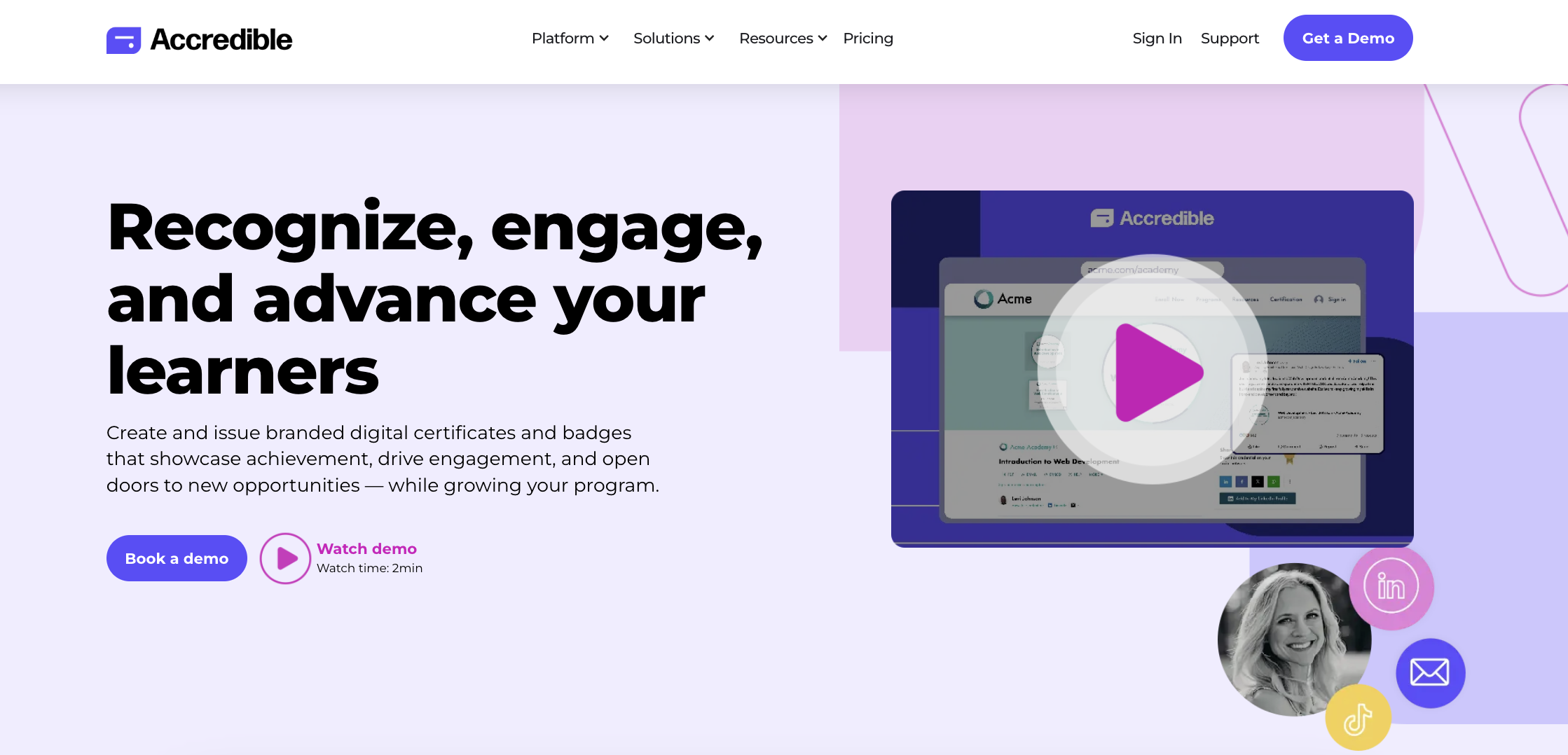
Accredible is one of the longest-established names in enterprise credentialing, with a particularly strong footprint across higher education and corporate learning. Customers include Google, Slack, and the University of Cambridge.
Accredible's strategic role in the category is depth: the platform is built for institutions where credentialing is a multi-year program with multiple stakeholders, not a single-issuance event. For buyers already operating at that complexity, Accredible reads as a familiar, proven environment.
Built for complex, multi-stakeholder programs. Course sequencing, sub-departments, and retroactive editing let admins structure layered certification tiers without external workarounds. It’s useful for institutions issuing credentials across academic terms, departments, or recurring re-certification cycles.
Compliance posture that clears formal procurement. SOC 2 Type II and GDPR are publicly documented, with optional blockchain credential recording. For procurement teams treating formal attestations as non-negotiable, that removes one of the longer evaluation stretches upfront.
A decade of operational maturity. Long-running experience in the education and training space has shaped the platform's day-to-day toolset ( analytics, lifecycle management, and learner engagement features) that institutions running complex, multi-region credentialing programs rely on to keep those programs organized.
Post-issuance editing is limited to credential attributes, meaning corrections beyond simple text fields require revoking and reissuing the credential, which breaks any links recipients have already shared.
G2 reviewers also flag "limited options" around design and branding. This is a real constraint for enterprise programs needing tight, consistent brand control across regions, business units, or multiple credential types.
Best for: Mid-market organizations and training providers in education-anchored or LMS-driven credentialing programs.
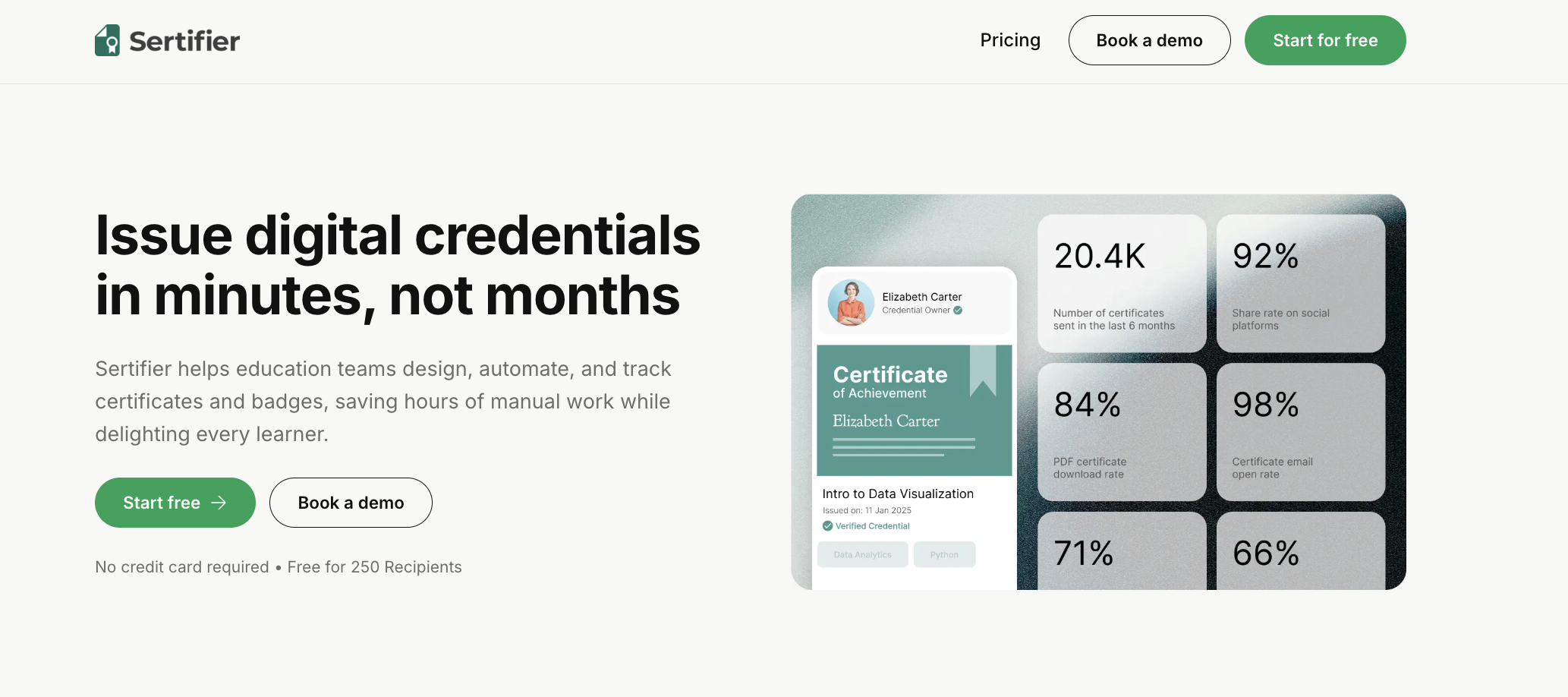
Sertifier is a digital credentialing platform with strong adoption across education and training organizations. Customers include Johnson & Johnson, Pfizer and others, primarily across mid-market programs and global development institutions.
Sertifier's strategic role is compliance-first credentialing for the mid-market: a credible enterprise security baseline at a footprint that LMS-driven education programs can absorb.
Compliance that holds up to formal review. SOC 2 Type II audited, GDPR and FERPA aligned, with US or EU data residency. For procurement teams in regulated industries or US higher education, that combination clears one of the more time-consuming evaluation stretches upfront.
Identity controls that IT teams already screen for. SSO, SCIM provisioning, role-based permissions, and audit logs — these are the four boxes every enterprise security review checks. Their presence means Sertifier rarely stalls at the security review stage.
A natural fit for LMS-driven credentialing. Sertifier is tailored for education and training programs issuing credentials within structured learning workflows.
Customer reviewers note inconsistencies in Sertifier's design editor, with elements occasionally shifting and rendered output not always matching the designed version. For programs managing brand-consistent credentials at high volume, that kind of drift can become a friction point.
Bulk workflows draw similar feedback: list imports require re-downloading templates each time, and locating already-issued credentials takes more effort than reviewers expect. At enterprise scale, small operational gaps like these can add up.
Best for: High-volume global certification programs and education institutions needing transcript management alongside credentialing, particularly across emerging markets.
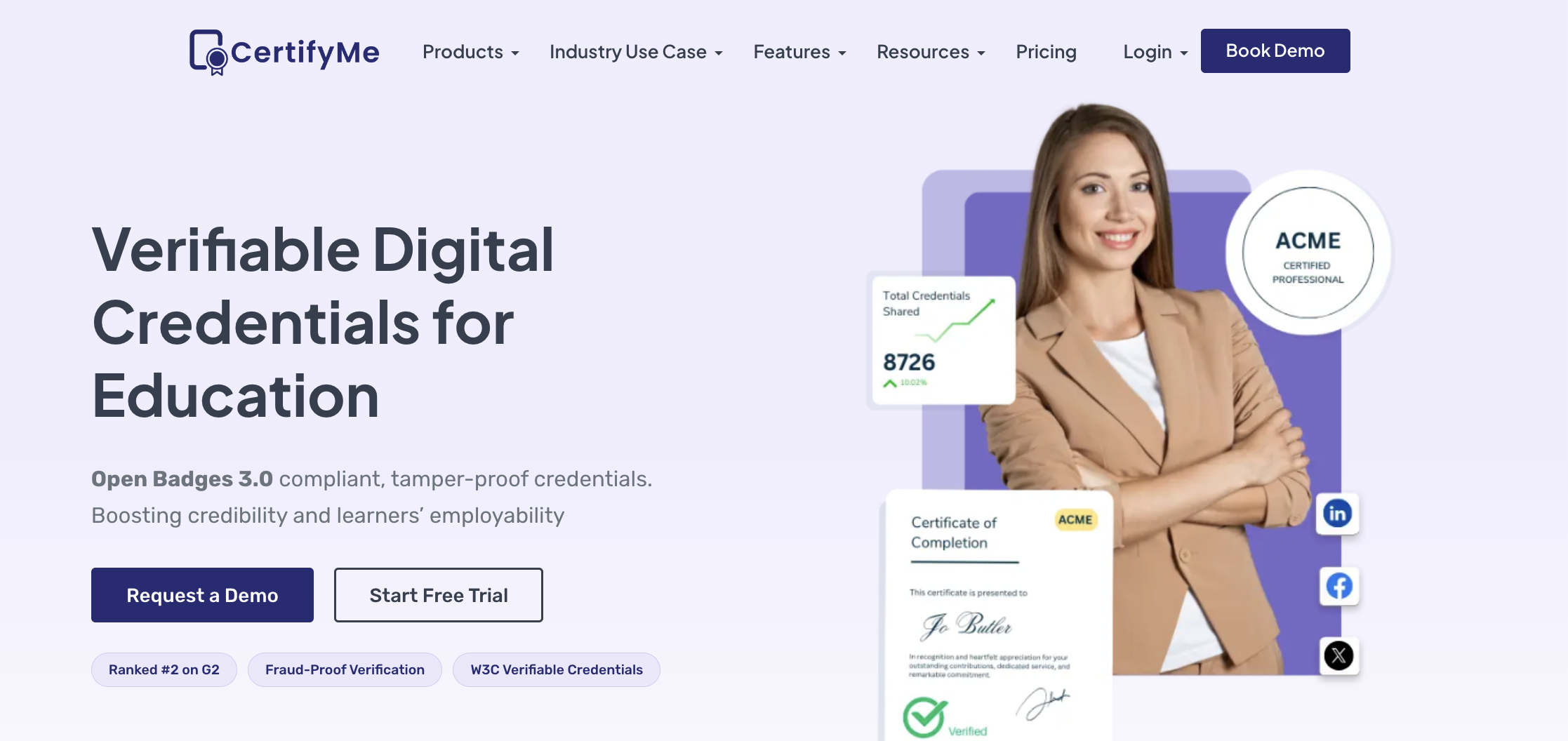
CertifyMe is a SaaS digital credentialing platform with broad adoption across global education and training organizations. Customers include Harvard Business Publishing, PMI, and the State University of New York.
CertifyMe's strategic role in the category is high-volume global credentialing with academic-grade compliance.
Transcript management for higher education. EduTranscript (CertifyMe's transcript exchange product for higher education institutions) automates transcript request workflows, secure storage, and academic database integration — useful for institutions that want to handle credentialing and transcript exchange under the same vendor.
Wider international compliance documentation. Publicly documented across ISO 9001, ISO 27001, ISO 27701, GDPR, FERPA, and COPPA. For institutions that need to satisfy multiple regional data privacy frameworks, this range of attestations does some of the procurement work upfront.
Reach across international markets. CertifyMe’s customer base is concentrated in international education and training organizations. For programs whose recipient bases span international markets and regional sharing networks, that customer profile signals an existing fit for distributed credentialing.
CertifyMe's customization and design depth show up as a recurring theme in user reviews, with reviewers pointing to limitations in template variety, design flexibility, and overall customization. For enterprise programs running brand-tight credentialing across regions or sub-brands, consistent feedback is worth weighing.
The procurement side carries a separate consideration: features like SSO, RBAC, and audit logs aren't surfaced in CertifyMe's public marketing or product documentation. For US enterprise IT teams that screen for these controls in early vendor review, the absence of public evidence can lengthen the evaluation cycle.
Every platform on this list can be part of enterprise credentialing shortlists, but each one is built around different buyers and needs:
Credly emphasizes employer-network discoverability.
Accredible serves long-running academic and corporate learning programs.
Sertifier goes for LMS-driven mid-market education.
CertifyMe aims for global certification at scale.
Certifier sits at the intersection: modern product infrastructure, full enterprise governance, and native integrations on a continuously improving platform. These features make Certifier one of the best certificate managers for enterprises in 2026.
If you're looking for a future-proof solution that helps you issue secure, high-quality credentials at scale, reach out for a tailored conversation with us. We'll map all of your requirements and outline a rollout plan to a timeline that fits you best.
At its core, the list of the main compliance certifications comes down to:
ISO 27001 — the baseline most enterprise security teams expect.
GDPR — non-negotiable for any program handling EU recipient data.
ISO 9001 — quality management discipline, valued in European and global procurement.
FERPA — required for US higher education programs handling student records.
SOC 2 Type II — widely expected by US enterprises, particularly in regulated industries.
Platforms that publish certifications in a public security hub clear procurement in weeks; those that produce evidence on request can stretch the same review into months.
Certifier Enterprise plan includes every feature from our Advanced tier (which starts at $339/month on annual subscriptions) plus everything your organization needs to run credentials at scale, from custom users and teams to SSO, audit and activity logs, tailored integrations, full white-labeling, premier customer support, and more.
The total cost for enterprise credentialing management with Certifier is scoped around each specific setup, tailored to your organization rather than our fixed plans. Contact our sales team and we'll give you an accurate estimate for your needs.
Modern platforms ship continuous updates against current standards like Open Badge 3.0, let admins edit credentials after issuance without contacting support, host credentials on the issuer's own domain, and include native integrations and APIs on the core platform — not gated to higher tiers.
Legacy platforms were built before these became standard. They typically run on multi-week, sales-gated implementations, host credentials on vendor-branded domains, restrict post-issuance editing, and treat integrations or API access as upsells rather than baseline capabilities.
Three criteria matter most:
Lifecycle control. In-place credential updates beat revoke-and-reissue workflows that break already-shared links.
Integration depth. Native connections to the LMS, CRM, and event tools the program already runs on — HubSpot, Salesforce, Zoom, Eventbrite — should be included, not paid add-ons.
Brand control. Credentials should live on the issuer's domain, not on a vendor portal that routes recipients through third-party accounts.
Beyond these, weigh compliance posture, governance features (SSO, RBAC, audit logs), and rollout speed.
Issue With Certifier
Create digital certificates and badges that perfectly suit your organization.

- Content Writing
- On-page SEO
- Localization
- Market Research
- Keyword Research
Content Specialist
Daria creates practical guides and templates that help training providers, educators, and event organizers solve digital credentialing challenges.
Virtue Market Research: Digital Badges Market Report
https://virtuemarketresearch.com/report/digital-badges-marketG2 Best Enterprise Digital Credential Management Software
https://www.g2.com/categories/digital-credential-management/enterpriseCredly (by Pearson)
https://www.credly.com/Accredible
https://www.accredible.com/Sertifier
https://sertifier.com/CertifyMe
https://www.certifyme.online/


