

Trusted by:
University of Southern California
Warner Bros.
Volvo
Amazon
Stanford University
Updated: September 25, 2026
6 min read
Microcredentials in higher education blur the line between what central policy decides and what a department may do. Here's how a university microcredential policy divides governance from credential operations, in an editable kit your committee can fill in.
Research with AI:
Two departments at the same university can issue microcredentials that look identical but mean completely different things.
One goes through a curriculum committee and sits in the student information system, while the other is built in an afternoon and lives in a spreadsheet. Yet, both carry the university's name.
Governing microcredentials in higher education means answering the question a university’s microcredential policy must settle: who has authority to decide what, and who has to be told afterward?
Use the free university microcredential governance kit below to assign that authority across your multi-unit educational institution. The kit includes a RACI table, approval gates by credential type, a minimum-data worksheet, a lifecycle with exception routing, a one-page issuance handoff, and an annual review sheet.
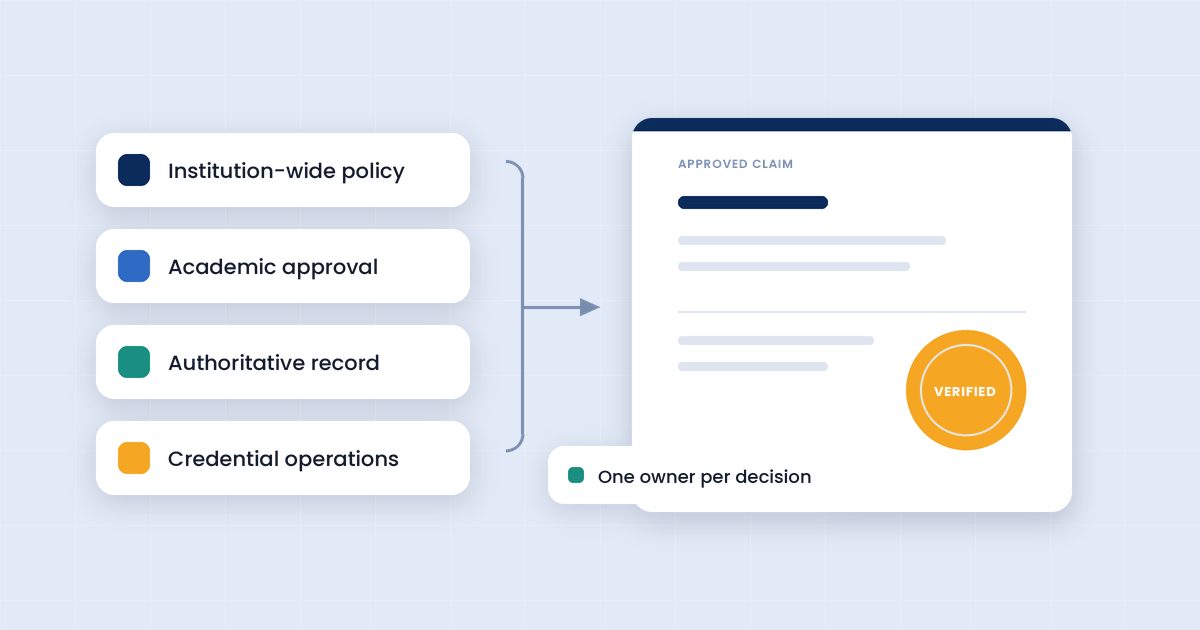
Split microcredential governance into four separate decision levels: institution-wide policy, academic or program approval, authoritative record ownership, and credential operations.
Every decision needs one accountable owner and one written trigger that returns it to approval.
Approve the claim before the template gets built to avoid unresolved academic, record, accessibility, and privacy decisions being made silently.
Every public credential field should trace back to an authoritative source and a named owner.
Treat a platform role as permission to execute, not proof of academic authority.

Centralize the rules and exceptions that make the institutional claim credible. Delegate bounded administration only after the claim, the source record, and the escalation conditions are approved.
The centralized vs. decentralized discussion forces one answer onto four separate decisions.
Function | What It Decides | Where It Usually Sits | What It Must Never Be Confused With |
|---|---|---|---|
Institutional policy authority | What may be called an official university microcredential, naming and brand rules, the accessibility floor, privacy and retention rules | Provost's office, academic affairs, or a designated senior officer | Approval of any individual program |
Academic or program approval authority | Outcomes, assessment evidence, credit status, who may earn a specific claim | Faculty governance, curriculum committee, graduate council, or a named non-credit review group | A decision the issuing unit can make alone |
Authoritative record ownership | Which system answers "did this person earn this?" and controls eligibility | Registrar and SIS for credit; CE registration system, LMS gradebook, or a designated unit record for non-credit | The credential platform's copy of the data |
Credential operations | Building the template, loading the approved cohort, sending, resending, correcting within a defined boundary | Continuing education, credential operations, a faculty administrator, or a program coordinator | Authority to change the claim being made |
Policy is the only part of micro-credentialing in higher education that should look identical in every faculty, school, and center.
It states what qualifies as a microcredential, what may carry the university's name, the accessibility standard the learner-facing artifact must meet, the retention period, and who may grant an exception.
Approval routes vary by credential type and by institution.

UNLV's microcredential policy routes credit-bearing microcredentials for registered students through the Faculty Senate or the Graduate Programs Committee, and non-credit student microcredentials through a co-curricular and experiential learning committee. Faculty and staff microcredentials go to a learning and development unit, and community microcredentials go to a separate non-credit review group.
Stony Brook's policy runs academic microcredentials through college curriculum processes and the Graduate Council of the University Senate. Co-curricular microcredentials need faculty endorsement first, and the Provost gives final approval.
The examples above show distinct routes by credential type and recipient group, with one named approver per route. Have a look at these top university microcredential examples to see what that looks like in practice.
Every approved claim needs one system of record that controls eligibility and answers verification questions later. Without it, the issuing unit holds the credential but not the proof.
The failure mode is specific. Someone calls to confirm a credential, the office looks it up, finds nothing, and tells the caller the person never earned it, while the record sits in another unit's system.
A unit may build the design, import the approved list, issue, resend, and fix a typo. However, it may not change the criteria, credit status, issuing identity, or public claim.
One decision rule keeps this clean: product access comes last. A platform role is permission to execute an approved action, but never evidence of academic authorization.
One federation pattern is worth borrowing: issue non-credit credentials centrally, and credit-bearing ones through the awarding body. Central issuance holds consistency and portability where no accrediting entity is involved, while local issuance keeps the award with whoever is responsible for it.
Give every decision one accountable owner and an explicit condition that sends it back to approval.
One person may hold several of these functions at a small higher education institution. Keep them separate anyway, because the moment a second unit starts issuing, you need to know which hat was worn.
Decision | Responsible | Accountable One | Consulted | Informed | Returns To Approval When |
|---|---|---|---|---|---|
Define what may be called an official university microcredential | Policy office | Institutional policy authority | Faculty governance, registrar, brand, legal | All issuing units | Policy is amended or a new credential type appears |
Approve a new microcredential claim | Proposing unit | Academic or program approval body | Registrar, accessibility, privacy | Credential operations | Outcomes, assessment, credit status, or eligibility change |
Determine the authoritative source record | Registrar or unit record owner | Record owner | IT, program lead | Credential operations, verifiers | The source system or eligibility rule changes |
Approve learner-facing and verifier-facing representation | Program lead | Brand and accessibility owners jointly, or a named single owner | Legal, privacy, communications | Recipients | Public fields, issuer identity, or wording change |
Issue credentials to an approved cohort | Credential operations | Program lead | Record owner | Recipients | The cohort falls outside the approved scope |
Correct or revoke an issued credential | Credential operations | Record owner | Program lead, privacy, legal | Affected recipient | The correction changes the claim rather than the data |
Retire a program and decide what happens to issued records | Program lead | Academic or program approval body | Registrar, records management, IT | Recipients, verifiers | Retirement would alter or remove issued records |
The editable kit adds two blank columns that this table leaves out: your named local owner and your governing policy reference. Make sure to fill both before the model goes to the committee.
Write delegation as a permission boundary. For each unit, name the approved programs it may administer, the actions it may take without returning to approval, the actions it may never take, and the person who audits the boundary.
The "returns to approval when" column is the part that committees test the hardest. Make each trigger observable and specific. "Any change to stated learning outcomes, assessment method, credit status, or eligible population" is a good example.
Everything that determines the claim, including academic, record, accessibility, privacy, and brand decisions, must be made before you build the template.
Credit-bearing, non-credit, and co-curricular microcredentials are different governance objects even when the finished credential looks identical.
Then separate two approvals that get treated as one:
Approved to offer means the program may run.
Approved to issue this claim means the institution will stand behind this specific wording, criteria, and issuer identity attached to a credential.
A unit can hold the first without the second.
Before a template exists, confirm the following in writing:
Written authorization for the proposing unit to propose at all, from whoever manages or accredits that unit.
The governing policy reference and version under which this credential is approved.
The stated learning outcomes and the assessment evidence that supports them.
Credit status, and whether any transcript notation applies. Transcript treatment is an institution and registrar decision, and published policies differ.
The authoritative source record and the person who owns it.
The eligible population and the earning criteria. If the credential is intended to stack, settle the pathway logic now and add it to the approval record. The European approach to micro-credentials puts the decision to stack or combine with the receiving organization, so approving a credential as stackable doesn’t oblige anyone else to accept the stack. For the mechanics, see how to design a stackable microcredential pathway.
Whether any accreditation, licensure, or regulatory body has a stake in the claim.
The public artifact carries the institution's identity, so approve it as a brand and accessibility decision rather than a design task. Confirm these elements:
The credential name and issuing unit exactly as they will appear.
The issuer identity and sending domain.
The accessibility standard the artifact and its verification page must meet.
The privacy boundary between internal evidence and public fields.
The reapproval triggers that apply to all of the above.
The full approval-gate checklist, with a blank institution-policy citation field on every line, is in the editable kit.
Create and Send Digital Credentials

There should be enough data to trace every public field back to an approved source and a named owner. If the issuing unit cannot do that, delegation is not safe yet.
Fill this worksheet per credential before any template is built. The product-mapping column stays empty until the field has been tested in the platform you use.
Field | Authoritative Source | Recipient Sees | Verifier Sees | Change Trigger | Product Mapped |
|---|---|---|---|---|---|
Recipient name | Source record | Yes | Yes | Legal name change | Y/N |
Credential name and version | Approval record | Yes | Yes | Any claim change | Y/N |
Issuing unit and issuer identity | Policy and brand approval | Yes | Yes | Unit or brand change | Y/N |
Country or region of the issuer | Policy and brand approval | Yes | Yes | Institutional change | Y/N |
Governing policy reference | Approval record | No | Optional | Policy amendment | Y/N |
Earning criteria and outcomes | Approval record | Yes | Yes | Outcome or assessment change | Y/N |
Notional workload or effort | Approval record | Yes | Yes | Any change to scope | Y/N |
Level and cycle | Approval record | Yes | Yes | Requires reapproval | Y/N |
Assessment type | Approval record | Yes | Yes | Any assessment change | Y/N |
Form of participation | Approval record | Yes | Optional | Delivery model change | Y/N |
Quality assurance route applied | Approval record | No | Optional | Policy change | Y/N |
Assessment evidence | Source record | No | No | Never public without approval | Y/N |
Completion date | Source record | Yes | Yes | Correction only | Y/N |
Issue date | Issuance system | Yes | Yes | Reissue | Y/N |
Credit status | Registrar or approval record | Yes | Yes | Status change requires reapproval | Y/N |
Expiry or renewal terms | Approval record | Yes | Yes | Policy change | Y/N |
Corrections contact | Operations owner | Yes | Yes | Owner change | Y/N |
Retention owner and period | Records policy | No | No | Policy change | Y/N |
The privacy boundary sits between the evidence that justified the claim and the fields that communicate it. Grades, attempt history, accommodation records, and internal notes stay in the source system, while the public credential carries enough for an employer or licensing board to check the claim and nothing more.
Keep your own minimum data standard distinct from any external framework. 1EdTech's TrustEd Credential programpublishes a metadata framework of minimum and recommended data elements that can inform your field list.
Worked example. Northpole University is fictional, as are all names, identifiers, and events below. It runs a non-credit continuing-education cohort.
Step | Detail |
|---|---|
Decision | Issue an approved non-credit CE microcredential, "Trauma-Informed Practice for School Counselors," version 1.2 |
Accountable authority | Non-credit review group, approval record NC-2026-014 |
Source record | CE registration system, cohort CE-2026-03, 42 completions confirmed by the CE registrar |
Operator | CE credential operations, acting inside an approved permission boundary |
Public fields | Recipient name, credential name and version, issuing unit, criteria, completion date, issue date, non-credit status, corrections contact |
Exception event | One recipient name misspelled at import. Classified as a data typo, corrected by operations, logged with date and approver. No reapproval required |
Annual review | Claim still supported by current assessment evidence; cohort continues at version 1.2 |
Once governance is agreed, you can turn approved university program records into verifiable student credentials.
Governance that controls the first issuance and leaves everything after it undefined fails when it matters most. So, handle policy changes, corrections, and retirements with the same authority that approved the launch.
For example, BCcampus's micro-credential lifecycle runs ten phases from ideation to evaluation, ending when the institution decides whether to re-offer or retire.
This framework extends it with the stages that govern issued records after launch: correction, exception, retention, and retiring an offering separately from credentials already in learners' hands.
Set a written threshold instead of leaving it to judgment. BCcampus's institutional governance guide recommends exactly that: a stated threshold, such as a proportion of content modified or any alteration to learning outcomes.
Anything touching outcomes, assessment, credit status, eligible population, issuer identity, or the public claim should return to the approving body. Design refreshes, typo fixes, and contact changes should not.
Exception | Example | Who Decides | Documentation |
|---|---|---|---|
Data typo | Misspelled name, wrong date format | Credential operations | Log entry, date, approver |
Substantive eligibility or assessment dispute | Recipient contests a completion decision | Academic or program approval body | Written determination, source record update |
Formal appeal | Recipient escalates beyond that determination | Existing institutional appeals process, never credential operations | Appeal record, outcome, any resulting correction |
Privacy or security issue | Field published that should not have been | Privacy owner with record owner | Incident record, remediation, notification decision |
Unauthorized issue | Credential sent outside the approved scope | Policy authority | Revocation decision, scope review, permission audit |
Mass error | Whole cohort issued with wrong criteria | Policy authority with approval body | Recall plan, recipient communication, root-cause note |
Retiring an offering and changing the status of credentials already issued are different decisions with different owners. Closing a program doesn’t automatically invalidate what people earned.
The European Commission treats the micro-credential as owned by the learner. Even outside that framework, learner ownership is the safer default for a retirement policy to assume.
Decide retention and export data before any destructive system action. Deleting a workspace removes issued credentials and breaks the links recipients hold. A platform that is acquired or switched off can also take the issuing history with it.
Building an operating model requires converting each RACI decision into an access test, running one approved cohort end to end, and writing down what the platform could not do.
For every delegated action, ask what the platform must permit and what it must prevent. Then test both.
The table below classifies Certifier's published documentation against that model. Re-run the same classification against whichever credentialing platform you evaluate.
Requirement | Status | What The Documentation Currently Shows |
|---|---|---|
Named roles with distinct permissions | Confirmed, plan-conditional | Designer, Draft Credential Manager, Credential Manager, Workspace Admin, and Organization Admin, with role management documented as an Advanced plan capability |
Restricting a role to specific credential templates | Refuted | Restricting templates is possible per team member, not per role, on the Advanced plan |
Separate environments per faculty or entity | Confirmed, paid add-on | Workspaces are described as independent environments with their own branding, designs, integrations, analytics, and team settings, available as a paid add-on |
One person holding membership across workspaces | Confirmed, restricted | Only the Account Owner can switch between multiple workspaces. Other invited team members will only be able to see the workspace they are invited into |
Irreversible deletion behavior | Confirmed | Deleting a workspace deletes designs, credential templates, emails, and issued credentials, and recipients lose access to credential links |
Organization-enforced SSO | Confirmed | SAML, initiated from the Certifier sign-in screen, and enforced per organization: once enabled, sign-in is SSO-only, with the owner keeping previous methods. Documented for Okta, Microsoft Entra ID, and Google Workspace |
Supporting PDFs attached to a credential | Confirmed, plan-conditional | Attached PDFs appear in the recipient view under Supporting Documents, on the Professional plan and above |
CLR export or official transcript creation | Out of scope | The SIS, registrar, or other institution-designated record remains authoritative for academic status |
Record the result, not the intention. A fictional acceptance-test row looks like this:
Test Account | Plan | Role | Assigned Template | Allowed Action | Prohibited Action | Result | Date | Reviewer |
|---|---|---|---|---|---|---|---|---|
ce-operator-test | [plan] | Credential Manager | CE-2026-03 | Issue approved cohort | Edit criteria | [record] | [date] | [name] |
Run the full path once: approved list in, credential issued, recipient view, verifier view, one correction, one revocation, one export.
Anything you couldn’t verify goes into the requirements document as an open item. It does not go into the policy as an assumption.
Gather the compliance evidence now because it belongs to governance rather than procurement. Collecting it once, as part of the policy, saves every later unit from running that review alone.
When you reach procurement, evaluate microcredential platform requirements with a scored vendor checklist. If you’re still shortlisting, compare higher-ed credential platforms first.
A university should review annually whether:
the claim still holds
access still matches the approved model
any issued microcredential needs correcting, revising, or retiring.
Annual review is where microcredential quality assurance either happens or quietly stops, and it’s the step most microcredentials in higher education never reach.
Are the stated outcomes still accurate? Is the assessment evidence still sufficient? Has the credential drifted from what was approved? Has any external body changed its expectations?
Ask the people who ran it and the people who earned it. A post-delivery evaluation of staff and learners, owned by the approving body rather than operations, turns a review into a revision.
Who holds which permission today, and does it still match the boundary on file? Is the authoritative source record still the one named in the approval? How many corrections, revocations, and exceptions occurred, and what caused them?
A program that can report only how many credentials it issued and what it spent cannot answer any of these questions.
Decide at approval what you will measure at review. Where a mandate started the program, that review is what you hand back to whoever issued the mandate, so agree on the reporting before the first cohort.
Make the decision explicit and record it, then put the policy on its own review cycle with a date. You’ll find the full annual-review sheet example in the microcredential governance kit below.
The practical next step is smaller than a new policy rollout. Name one accountable owner per decision in the RACI, fill the two blank columns with your real roles and policy citations, then run one low-risk approved cohort end to end before scaling the model across units.
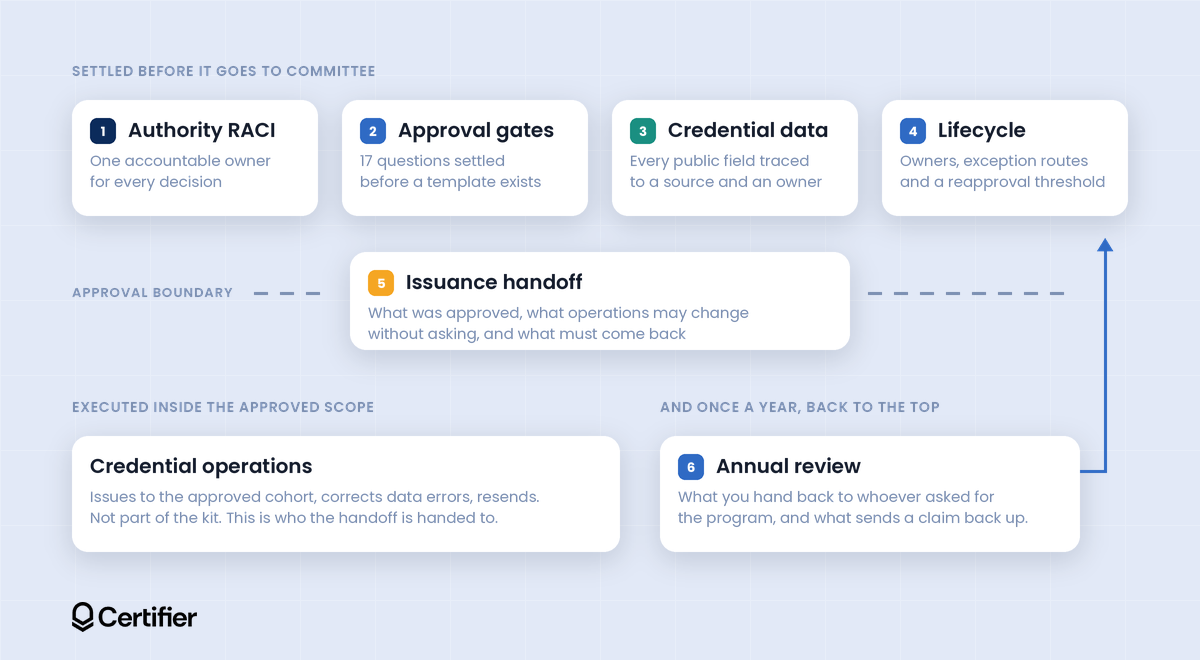
The kit turns the decisions in this article into documents your team can fill in, sign off, and revisit each year.
Make a copy of the kit to save it straight to your Google Drive as a Google Sheet file.
The governance kit includes six assets:
Authority RACI table
Approval-gate checklist by credential type
Minimum credential-data worksheet
Issuance handoff
Lifecycle and exception flow
Annual program review sheet
A governance document only helps if your issuing platform enforces it. Here's how the kit maps to Certifier:
Authority RACI → roles and template access. Give each person a workspace role that matches their RACI row. On the Advanced plan, you can build custom roles and limit each team member to the credential templates they own.
Approval gates → draft vs. issue rights. Draft Credential Managers can prepare credentials but can't issue them. Credential Managers issue them.
Minimum credential data → attributes. Set up the fields from your worksheet as attributes, so every credential from a template carries the same required data.
Annual review → Activity Logs and exports. On Advanced, Activity Logs show who did what, with which role and permission. Logs are kept for 180 days, so export your credential data as CSV before each review to keep a full-year record.
See how Certifier issues higher education credentials within the limits your completed kit sets.
Your existing institutional governance decides this, while the route differs by credential type. Published policies route credit-bearing microcredentials through faculty governance or a graduate council, non-credit student ones through a separate committee, and staff or community ones through other units entirely.
In short, there is no universal approver. You need to identify the approving body for each credential type in your own policy before you build anything.
That depends on your institution's policy and on the claim being made. There’s a key difference between authorization for the claim and permission to execute the issuance.
A department may hold a platform role that lets it send credentials while holding no authority to approve what those credentials assert. Policy and jurisdiction vary, so settle the authorization question in writing before delegating the operation.
This is an institution and registrar decision. For example, Stony Brook's policy requires approved microcredentials to be recorded on the transcript under SUNY requirements, while other institutions record non-credit achievements outside the transcript entirely.
Decide it at approval and record the decision in the credential's data standard.
Closing the program offering, retaining the records, deciding the status of credentials already issued, and communicating with recipients are four different things you need to decide on separately.
That’s why retiring a program doesn’t, by itself, invalidate what learners earned. Before any destructive system action, export the records and confirm the retention owner. Deleting a workspace or account can permanently remove issued credentials and break the links recipients hold, so verify what persists rather than assuming links survive deletion.
The credentialing platform is where an approved decision gets executed: you build the template to the approved design, load the eligible list, issue credentials, and correct data errors.
What a credentialing platform doesn’t do is decide. Holding an issuer seat in Certifier doesn’t make a unit the approver of what the credential claims. A permission level is not a governance decision.

- copywriting
- B2B content marketing
- content strategy
- on-page SEO
- storytelling
Growth Marketer (Freelance)
Anita Coltuneac is a freelance B2B SaaS marketer with 5+ years helping tech companies grow organic visibility, build authority, and support pipeline. She uses storytelling to turn product expertise into useful content.


