
Trusted by:
University of Southern California
Warner Bros.
Volvo
Amazon
Stanford University
Updated: September 28, 2026
14 min read
Get inspired by the best micro-credentials examples from top universities and online platforms. Learn what makes each one credible, and how to issue credentials for your program.
Research with AI:
Micro-credentials went from a niche experiment to a mainstream workforce strategy in under a decade.
Google now issues career certificates recognized by more than 150 hiring companies, and MIT xPRO runs professional programs in data science and AI. In 2022, the European Union established a continent-wide framework for the format.
This guide collects real micro-credentials examples from universities and online platforms, then explains what makes each one credible to employers and regulators. You'll also see how a platform built for issuing digital credentials handles the issuing side once your program content is ready.
If you're benchmarking before you build, the examples below are grouped by type so you can compare credible models side by side.
Micro-credentials are short, assessed proofs of a specific skill, sitting between a single course and a full degree.
The strongest examples of micro credentials come from universities, employer programs, and online learning platforms with real assessment behind them.
The EU's 2022 framework set common standard elements, which is why portability and verification now matter for cross-border recognition.
You can design and issue verified microcredentials at scale on a digital badge platform, often for a fraction of what legacy tools charge.

A micro-credential is a short learning program that demonstrates a learner has mastered a specific area, such as project management or critical thinking. For a deeper primer on the concept, read our explainer on what are microcredentials.
A certificate is a format that may represent a broader achievement than a small unit or module. It can display the learner’s name, the issuer, the program title, the date, and the signatures. The document is more detailed.
For programs that need to scale, a digital badge is often the more useful format. It’s a visual token for gaining a skill. At first glance, it may look simpler than a certificate. But it can carry rich metadata behind the badge, such as the issuer, skills, learning outcomes, earning criteria, and issue date.
However, it's worth stating plainly: a certificate or a badge can be a micro-credential, but not every credential qualifies.
A credible micro-credential record should carry these core fields, most of which the EU framework treats as standard elements.

Holder: the learner who earned and owns the credential
Learning outcomes: the specific knowledge and skills that was assessed
Awarding body: the higher education institution or organization that issued it
Assessment: how the learning was evaluated
Workload and level: the study volume, ideally in ECTS credits where relevant
Verification: a unique ID plus a link anyone can open to confirm it
The examples below show who issues the credential, how it's built, and why it holds up, so you can see what to take inspiration from when designing your own university micro-credential programs.
The table gives you a quick comparison first.
Category | Example Issuers | Format | Delivery | Assessed | Stackable | Recognized By |
|---|---|---|---|---|---|---|
University-issued academic | Tufts, Denver, Maine | Certificate / badge | Online and blended | Yes | Often | Academic and professional bodies |
Platform-hosted university | Coursera, edX, FutureLearn | Certificate / badge | Online | Yes | Often | Global employers, partner universities |
Workforce and community college | CUNY, Maricopa, Seneca | Certificate / badge | In-person and online | Yes | Often | Local employers, labor market |
Professional development | NEA, British Council, DESE | Competency badge | Online | Yes (evidence-based) | Yes | Schools, licensing bodies |
Employer-partnered education | Google, NASH | Certificate / badge | Online | Yes | Sometimes | Employers, hiring consortiums |
EU-aligned | Microcreds, IUA, CIVIS | Micro-credential | Online and on campus | Yes | Yes | EU framework, partner universities |
Education was one of the first sectors to adopt micro-credentials, because teachers already needed proof of professional development hours and licensing-relevant learning.
The organization runs micro-credentials programs in fields like project management and nutrition studies, awarding digital badges and professional certificates.
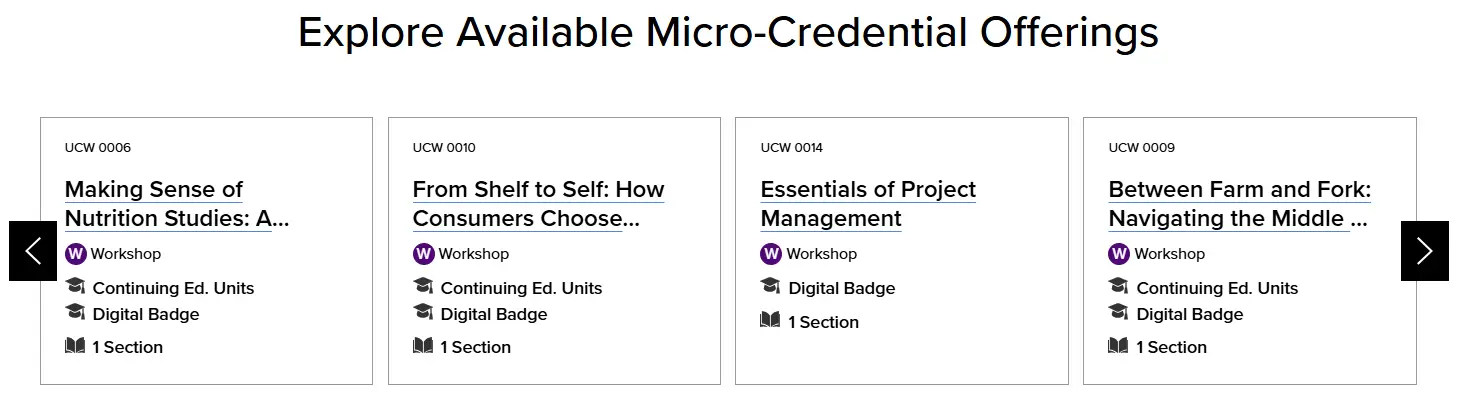
For these programs, Tufts also offers digital badges and certificates.
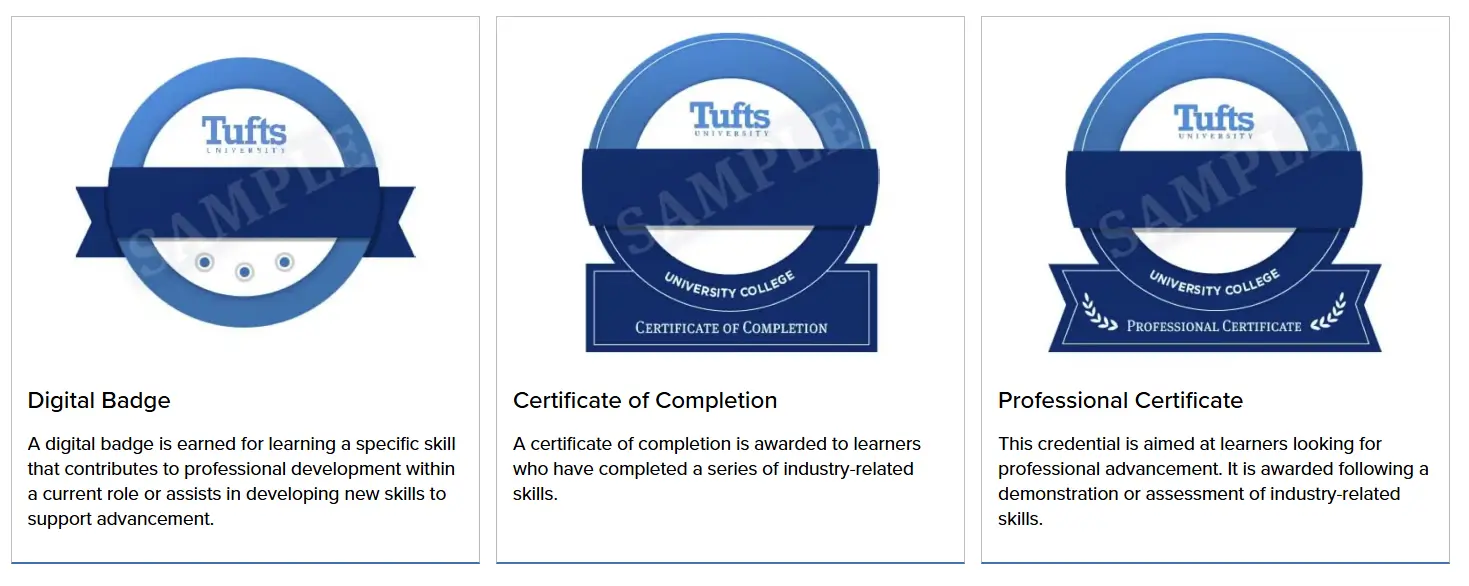
Idea for your microcredential program: Present information about the microcredential on the website in short bullet points: how many sections the program includes, what kind of digital proof recipients will earn, what kind of training/course it is (workshop, lecture, etc.)
This university offers a large catalog of leveled, digital badges for students across its campuses, a useful model if you want a structured ladder. After completing all three levels, the learner earns the full University of Maine System micro-credential.
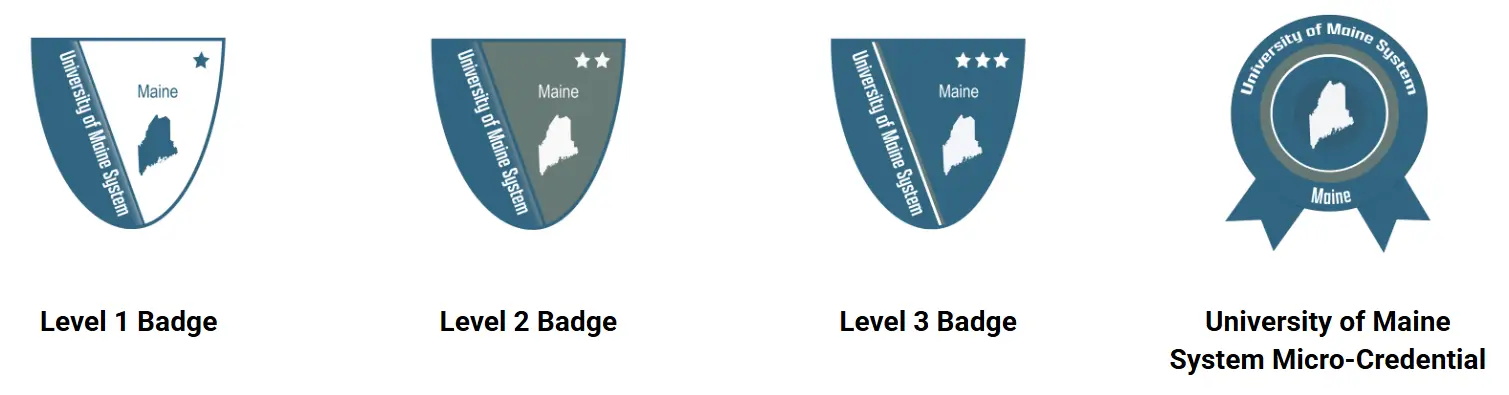
A useful detail is the work-based learning layer. UMS lists internships, co-ops, externships, jobs, apprenticeships, and on-the-job training as possible Level 3 formats.
UMS micro-credentials are open to undergraduate and graduate students, community members, professionals, and adult learners, making them a good benchmark for universities that want a single credential system for both academic and career-focused audiences.
Idea for your microcredential program: Create a training structure by providing the leveled badges. You can make it stack toward larger qualifications. Read more about stackable credentials.
The university issues curricular badges such as its Psychology: Mental Health credential, verified through a public badge link.
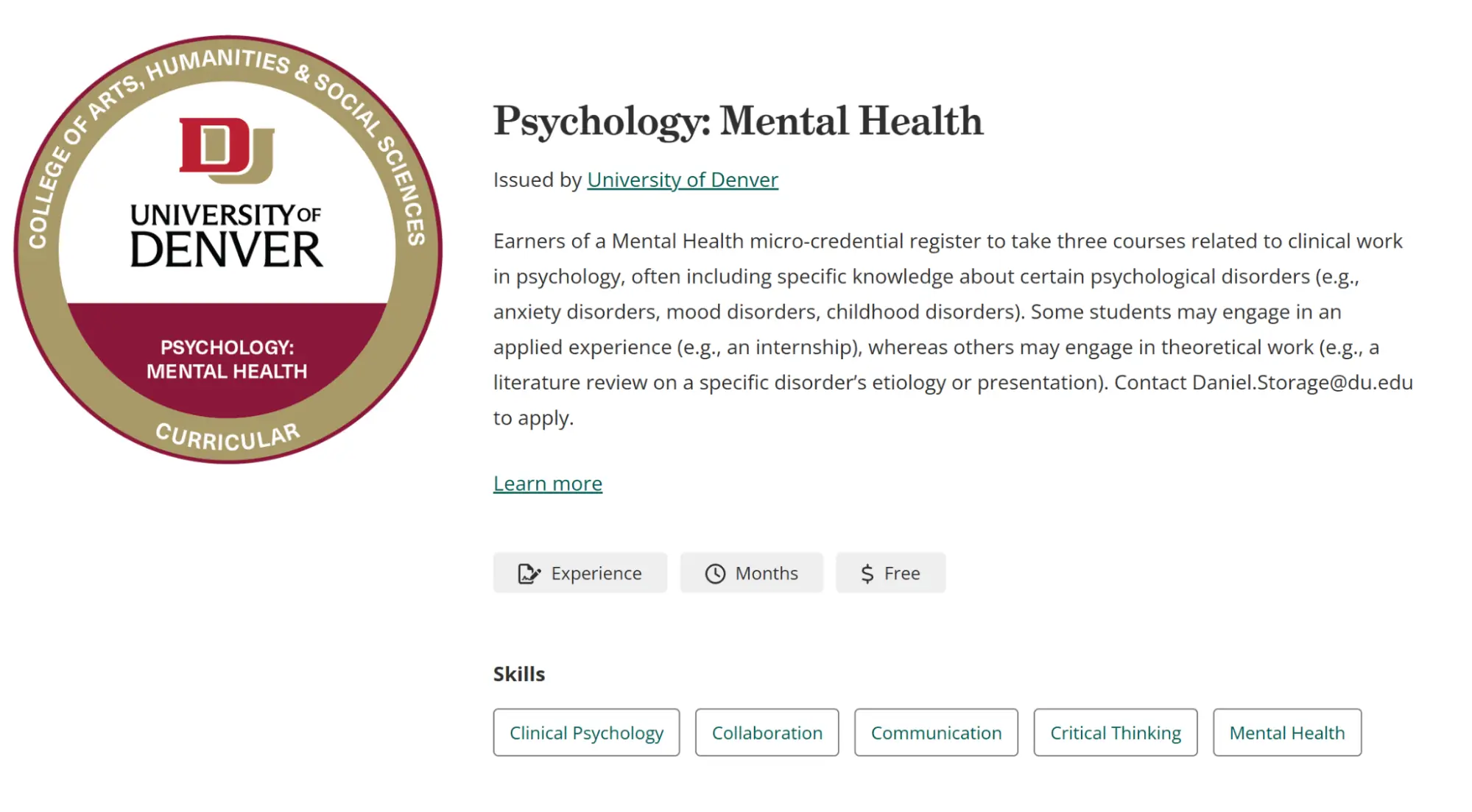
The learner does not earn the badge only by completing a short course. The criteria include three credit-bearing undergraduate courses, a one-quarter experiential project with a faculty sponsor, and an online portfolio.
The listed skills make the micro-credential easy to understand at a glance: clinical psychology, collaboration, communication, critical thinking, and mental health.
Idea for your microcredential program: Provide a verification link for your microcredential so anyone can check its validity.
Platform-hosted programs put a university's name on a course but deliver it through a large online platform, which pairs academic credibility with reach.
Coursera hosts professional certificates from universities and employers, each with a verifiable completion record.
It is a useful benchmark for online microcredentials because it shows how a short learning achievement can be packaged as a verifiable certificate.
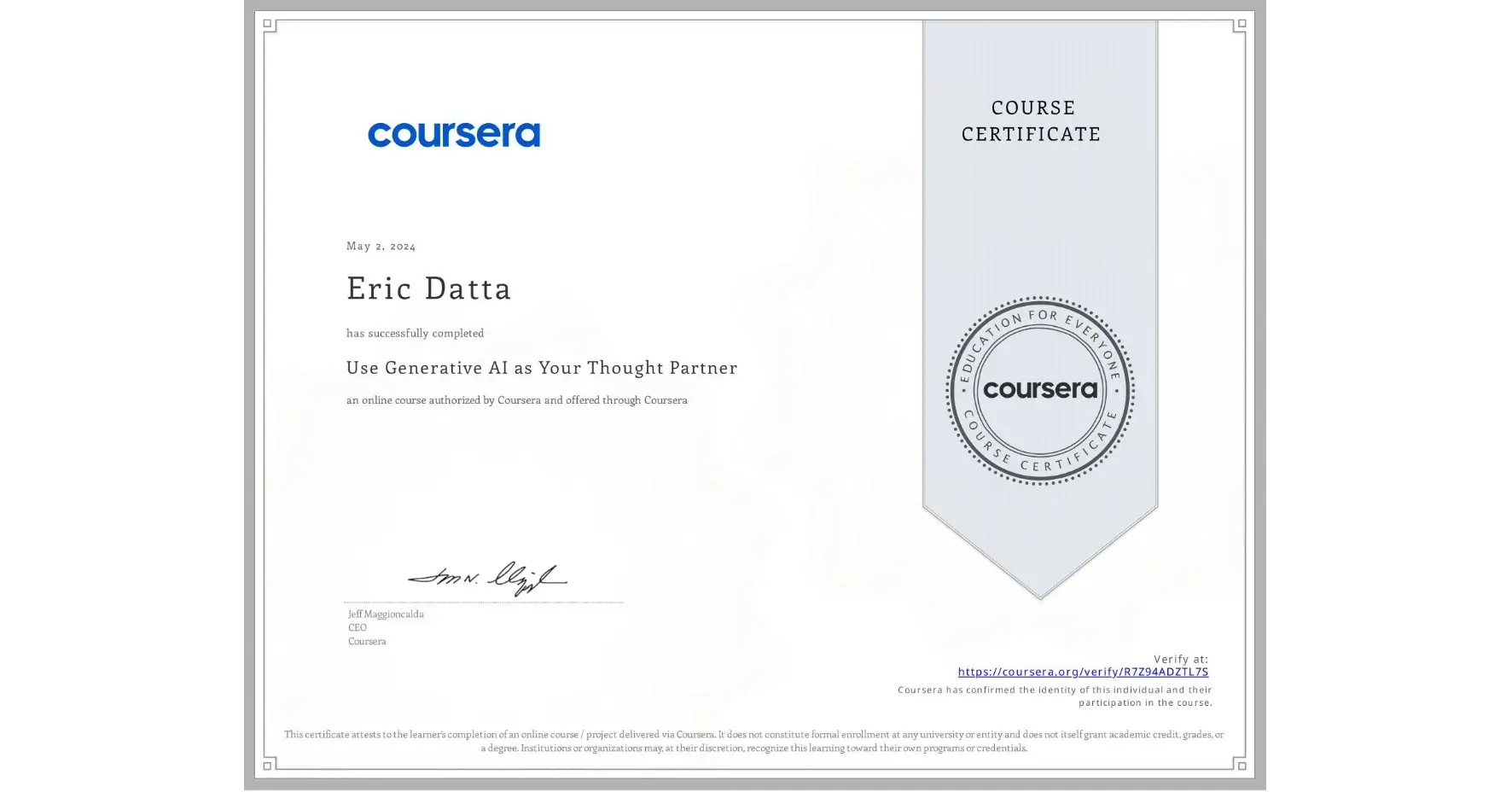
The certificate includes the learner’s name, course title, completion date, issuing platform, instructor or authorized signatory, and a public verification link. That gives employers or institutions a way to confirm the record instead of relying only on a PDF.
To see how one reads in practice, our breakdown of a Coursera certificate sample walks through the structure.
Idea for your microcredential program: If you want to include more information on the credential document, choose a certificate rather than a badge for your microcredential program.
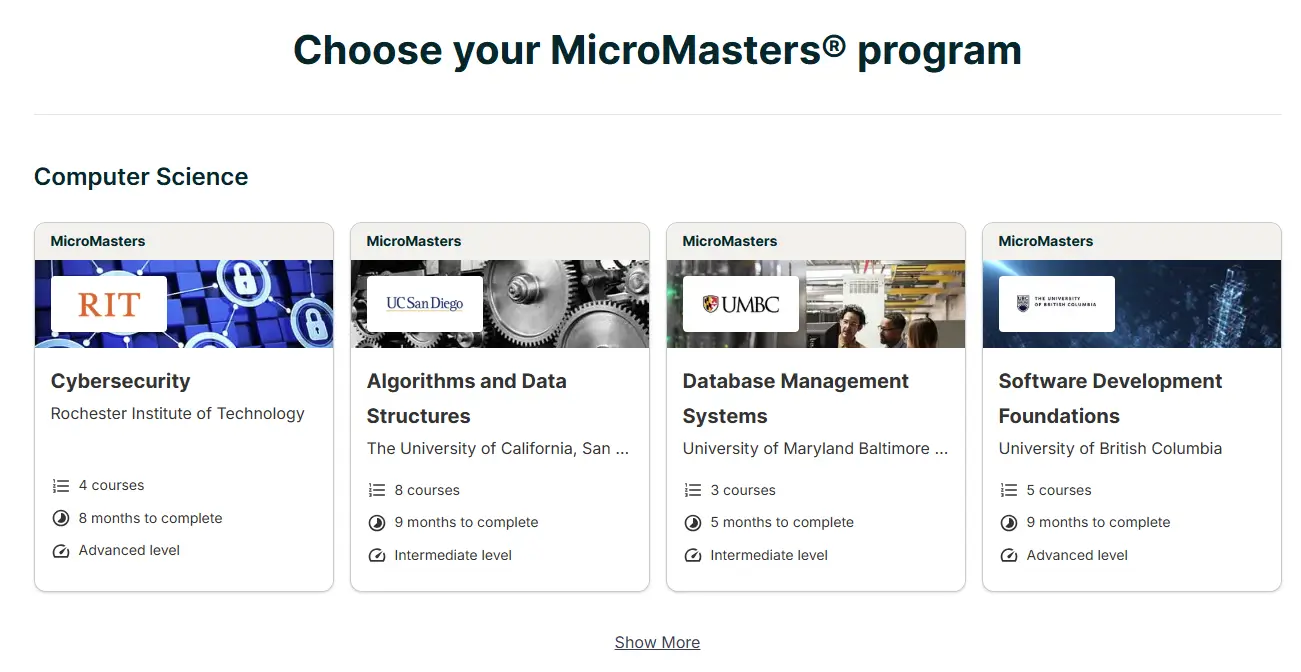
edX runs MicroMasters and MicroBachelors programs from universities, often carrying real academic credit toward a degree program.
Each program card includes the university, subject area, number of courses, expected completion time, and level. That gives learners a clear view of the workload before they enroll.
These examples of micro-credential programs provided by Nottingham Business School are worth 10 UK Level 7 credits, which gives learners and employers a clearer sense of workload and academic level.
That makes it a good example for universities that want to design micro-credentials with transparent value, not just a completion badge.
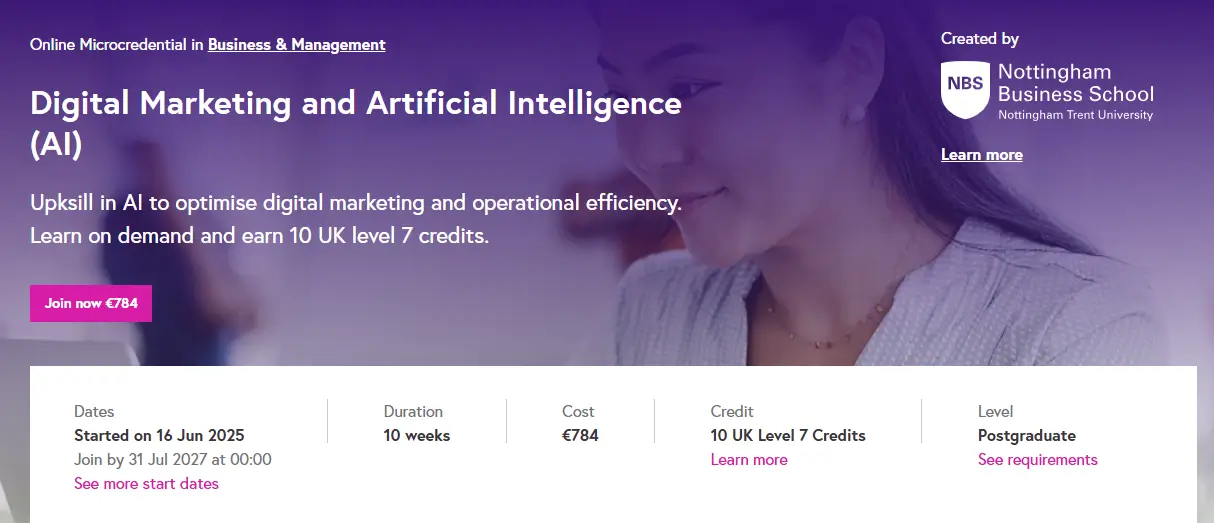
The program connects a practical topic with formal higher education. Learners can upskill in AI for digital marketing, while the credential still carries a postgraduate level and defined credit value.
Workforce and community college credentials are built around local labor market needs, so they prize speed to employment over academic prestige.
CUNY shows how a large public university system can organize microcredentials across many colleges and learner needs.
Its catalog includes credit, non-credit, and degree-linked microcredentials, so learners can choose a path based on their goal: job readiness, professional development, or progress toward a certificate or degree.
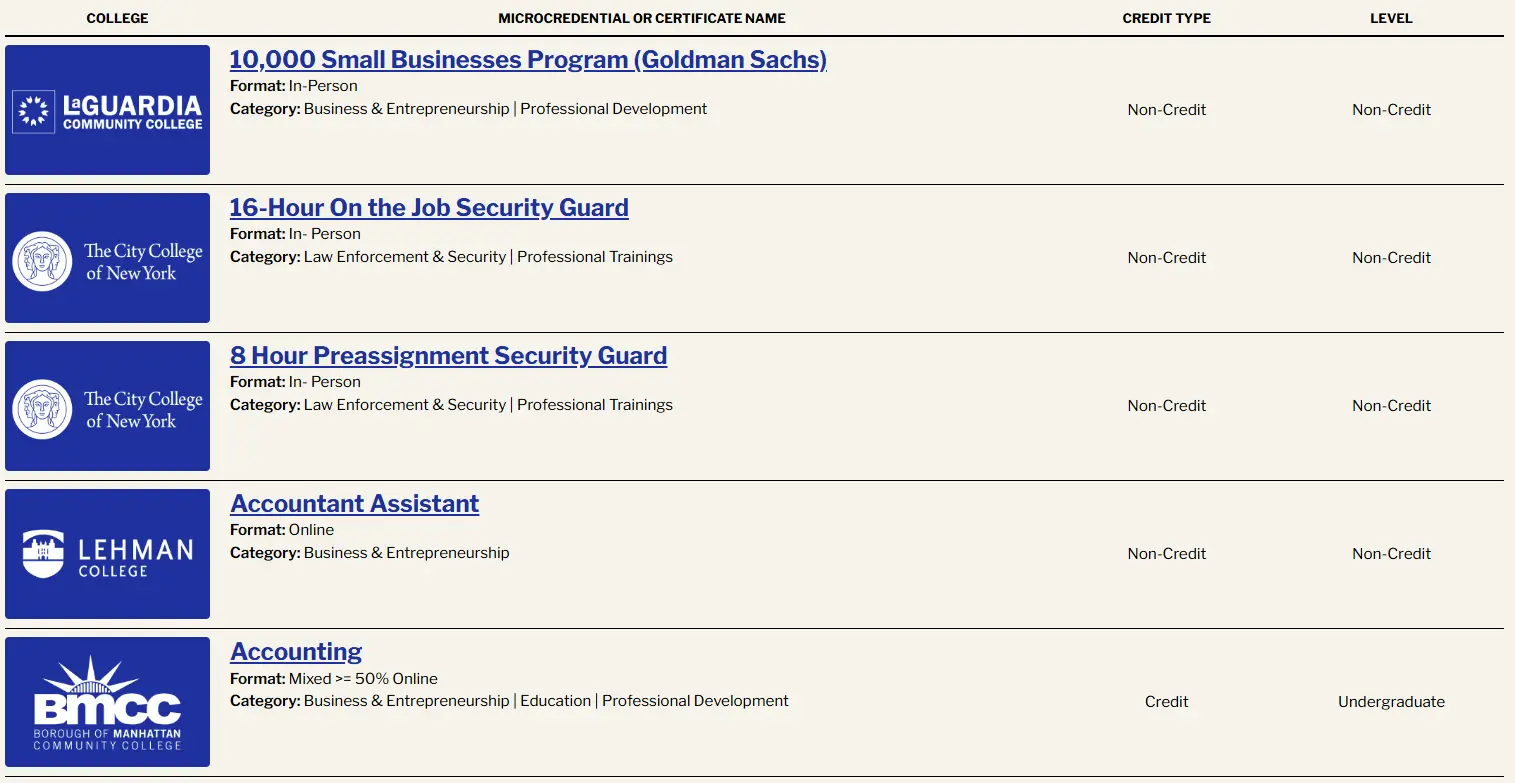
The CUNY model is also strong from a program design point of view. Its microcredential catalog lets users compare options by college, program, format, credit type, and level.
That structure makes the offer easier to understand for learners and easier to manage across a multi-campus system.
Idea for your microcredential program: Present the microcredential programs one next to another, so learners can compare the programs and have a clear overview of your offerings.
Maricopa Community Colleges gives a clear example of a workforce micro-credential that proves job-ready skills.
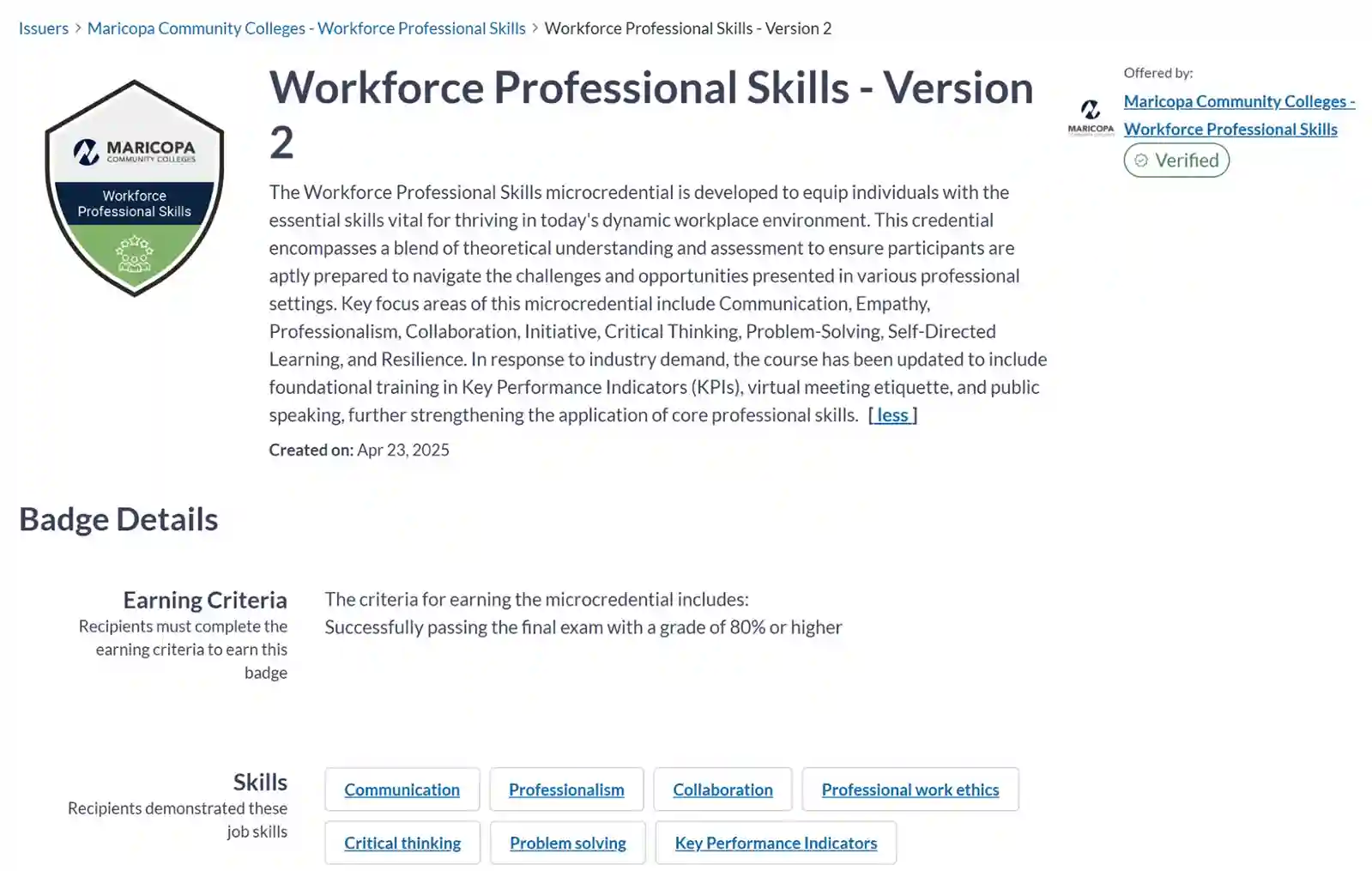
The earning criteria are visible. Learners complete a self-paced online course, go through five modules, and need at least 80% on the final exam to earn the badge.
Its Behaviour Technician microcredential targets people who work in, or want to enter, applied health fields such as behavior therapy and social work.
The structure is clear. The program is online, part-time, and 40 hours long. It was developed in partnership with Autism Ontario, which gives the credential a direct link to a real workforce need.
Learners build practical skills for behavior technician roles, including person-centered planning, behavior change strategies, data recording, communication, and support under supervision.
Idea for your microcredential program: When you present microcredentials in higher education, add a short section called “Microcredential Program Highlights.” Use it to summarize the most important program details in one place.
Professional development examples of micro credentials prove growth in a particular skill. They work well in education, training, healthcare, and regulated fields where a simple attendance certificate may not be enough.
Its model is built around demonstrated competency. Educators choose a micro-credential, review the requirements, collect evidence from their classroom or worksite, and submit that evidence for review.
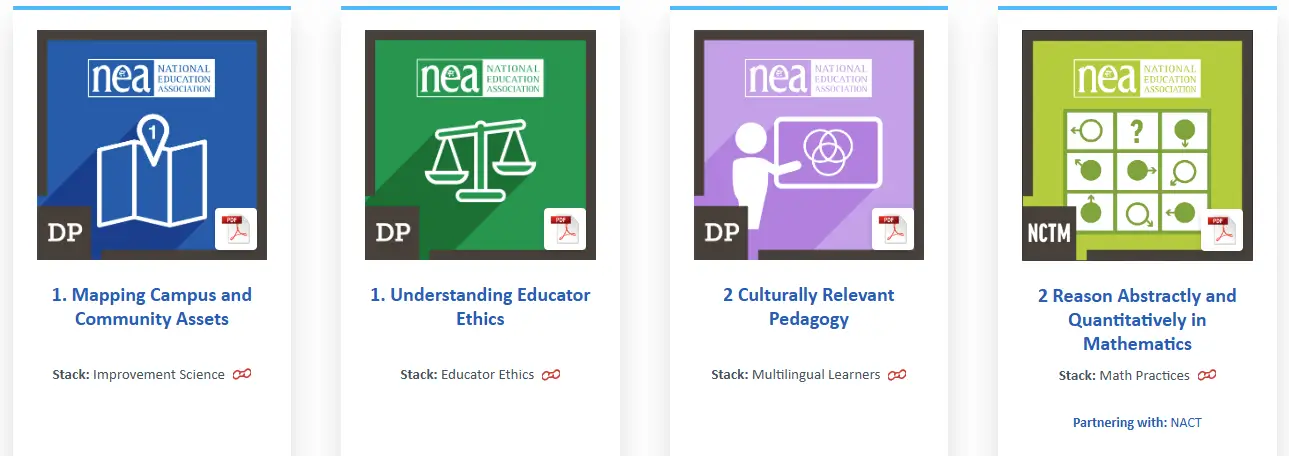
The learner has to prove a skill through practice. For teachers and education support professionals, this is useful because professional development often needs proof that the learning can transfer into daily work.
British Council is the UK’s international organization for cultural relations and educational opportunities.
It provides a good benchmark for professional development micro-credentials by combining short teacher training, CPD credits, digital badges, and downloadable certificates into a single system.
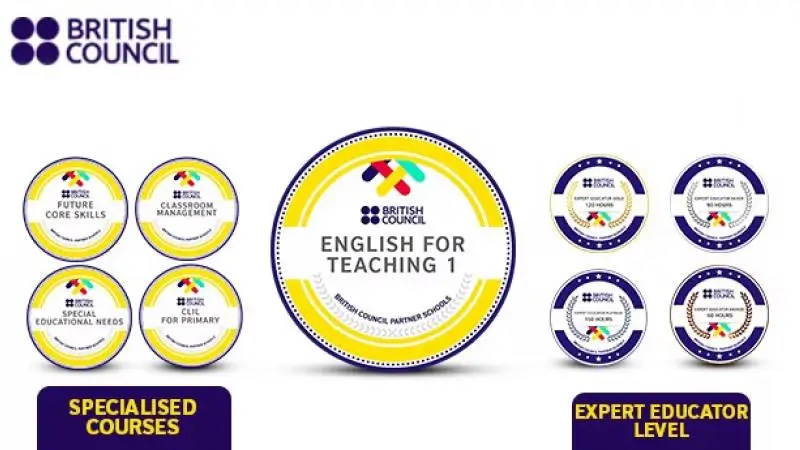
Teachers complete modules through the Online Support for Schools platform. After completion, they can earn course badges, collect credits, and download certificates.
The Expert Educator path also uses badge levels, so teachers can move from individual modules to a stronger CPD record.
Arkansas DESE shows how a state education department can use professional development microcredentials as part of an educator growth system.
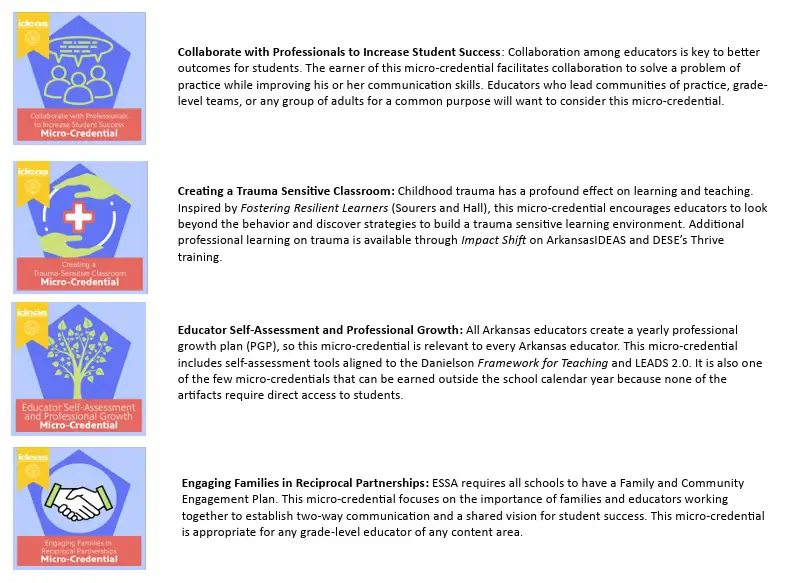
Educators submit artifacts from their professional practice. Trained assessors review those artifacts against a rubric. After successful completion, the educator receives a digital badge that shows consistent and effective use of the target skill.
DESE-approved micro-credentials support teachers across the career continuum and may be used in licensure and district advancement contexts.
This makes the program a strong example of microcredentials in higher education. The badge does not only say that the teacher joined training. It shows that the educator applied a specific skill, met defined criteria, and earned recognition through assessment.
Employer-partnered education credentials connect company-built skill training with public higher education systems or community colleges.
They are useful when learners need job-ready skills, but institutions still want the learning to remain within a trusted educational pathway.
The NASH and Google partnership is a strong example of employer-partnered microcredentials at the system level. NASH works with Google to scale Google Career Certificates, advanced certificates, and AI Essentials content across public higher education systems.
The microcredential program focuses on workforce-aligned learning. Participating systems can embed Google Career Certificates into courses and co-curricular pathways in fields such as cybersecurity, data analytics, IT support, UX design, digital marketing and more.
It connects three things: an employer-recognized credential, public higher education infrastructure, and job-ready skills.
NASH reports that the Community of Practice reached nearly 15,000 learners in its first year and includes 11 higher education systems, 88 institutions, and more than 100 faculty members and leaders.
EU-aligned micro-credentials are designed in accordance with the 2022 Council Recommendation on micro-credentials. T
heir purpose is to make short learning experiences more transparent and easier to understand, compare, verify, and recognize across different institutions, industries, and countries.
MicroCreds is a national Irish initiative for university micro-credentials. Trinity College Dublin uses the MicroCreds platform to present short, accredited learning experiences for professionals and lifelong learners.
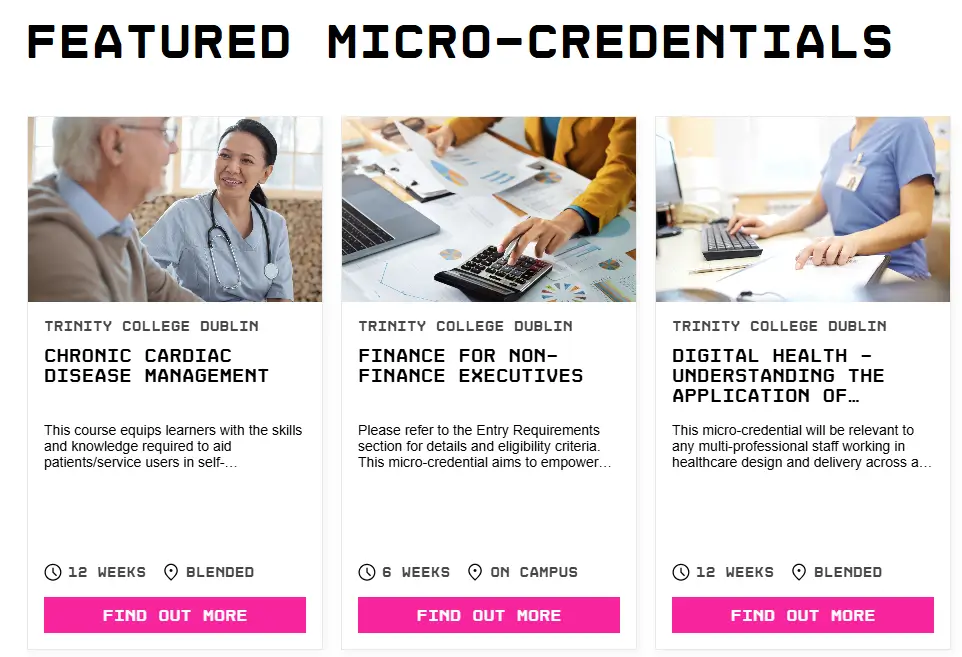
Trinity’s micro-credentials are a good EU-aligned benchmark because they include a clear academic structure.
Trinity micro-credentials offer ECTS credit, which is the EU standard credit system, with a credit range from 5 to 10 ECTS. The courses usually last 5 to 12 weeks and can run face-to-face, blended, or online.
The example also shows how micro-credentials can connect university quality with professional relevance. Trinity’s micro-credentials are delivered by experts, informed by research, and shaped with enterprise input to support responsive skills development.
The Irish Universities Association is a strong EU-aligned example because it shows micro-credentials at the national framework level, not only at one university.
Its MicroCreds project brings Irish universities together around one shared model for quality-assured and accredited university micro-credentials.
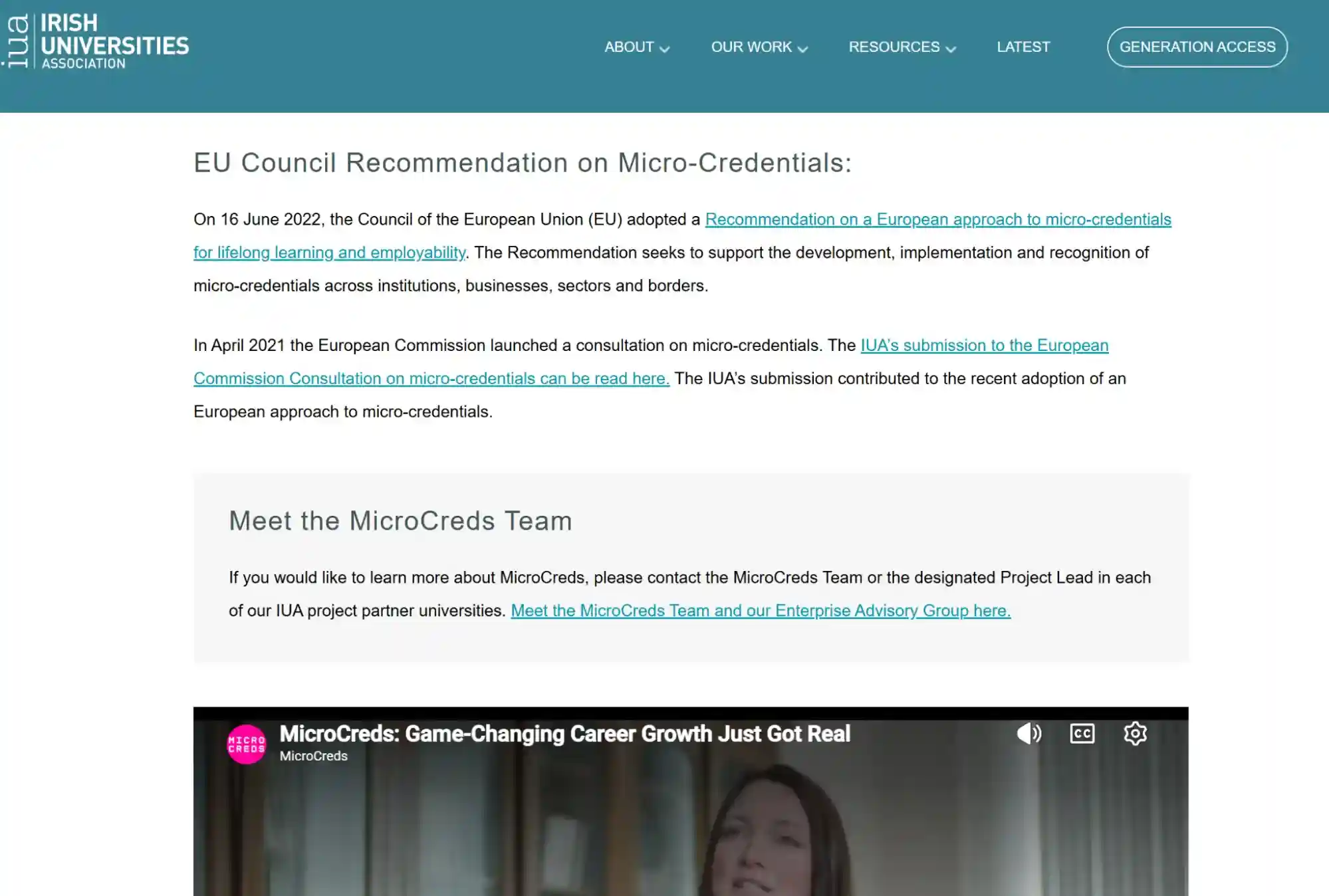
The MicroCreds micro-credential programs are credit-bearing, aligned to Ireland’s National Framework of Qualifications at levels 6–9, and sized from 1 to 30 ECTS. They can stand alone, and some may stack toward a larger award on a defined pathway.
CIVIS is an example of a European university alliance that shows how micro-credentials can support flexible, cross-border learning.
Its model includes micro-programmes, where learners combine several CIVIS courses or modules into one learning pathway, and micro-credentials, which certify smaller skill-based learning experiences.
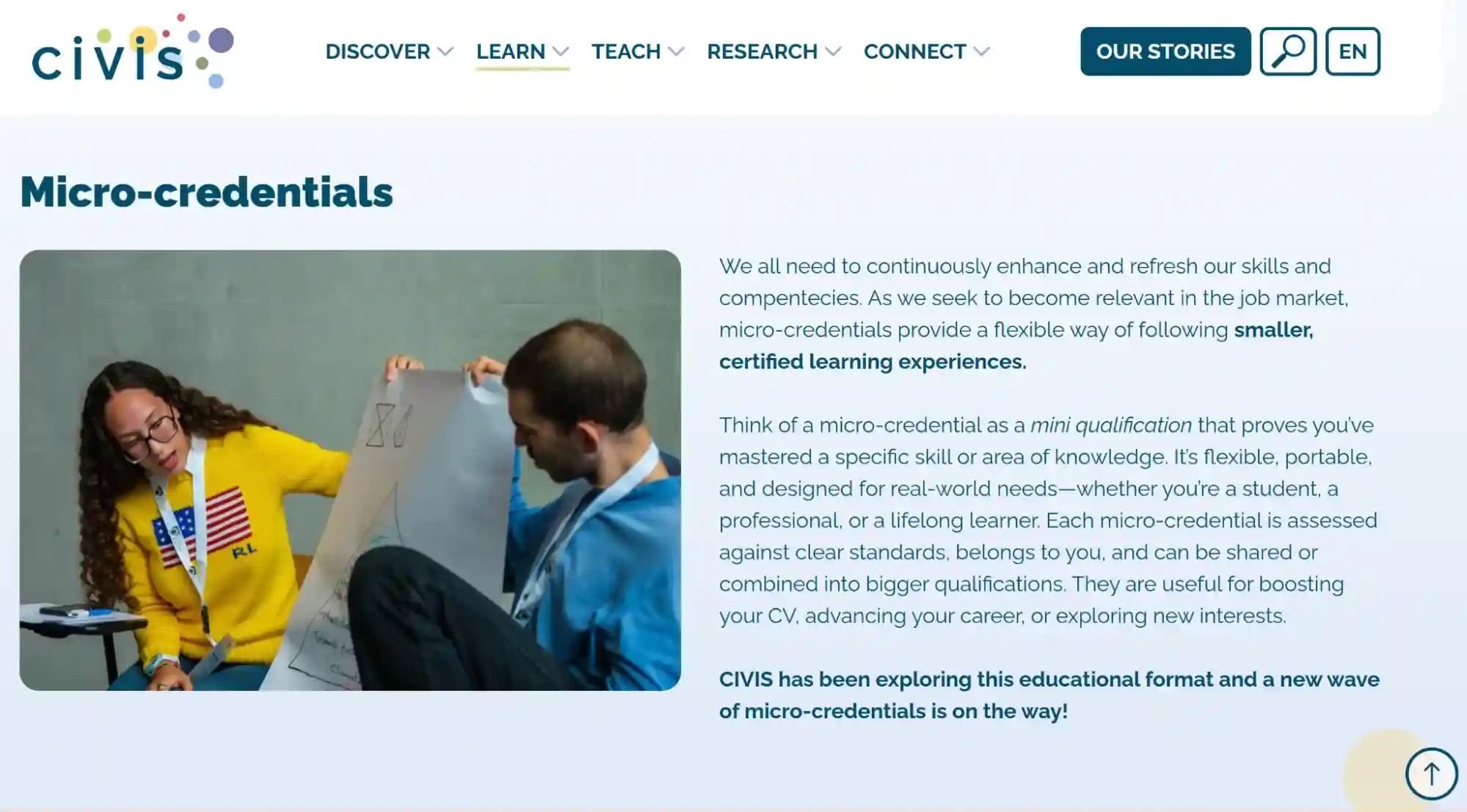
CIVIS describes micro-credentials as assessed against clear standards, owned by the learner, shareable, and possible to combine into larger qualifications. That fits the EU-aligned approach to transparent and portable learning.
The single biggest policy development in this space is the Micro-credentials European Commission initiative, formalized when the Council adopted its Recommendation on a European approach to micro-credentials on 16 June 2022.
The framework matters because it sets the first supranational definition and a common data model.
Under it, a micro-credential is the recorded proof of learning outcomes a learner acquired after a small volume of learning, assessed against transparent criteria. You can read the European Commission's micro-credentials overview for the policy summary, or the full Council Recommendation text for the legal detail.
The framework lists standard elements a compliant credential should describe, including:

Learners’ identity and the credential title
Awarding body and date of issue
Assessed learning outcomes
Notional workload, ideally in ECTS credits
Type of assessment and the quality assurance behind it
European institutions are already issuing against this model, as the EU-aligned programs listed above show. The shared standard elements are what let a credential cross a border without losing its meaning.
Why should a non-EU institution care about the micro-credentials EU rules? Cross-border recognition and GDPR.
If your learners or partners are European, aligning to the framework's portability and quality-assurance principles makes your credentials easier to recognize abroad.
This is where the infrastructure choice becomes practical. Certifier is an EU-based platform with GDPR compliance, and its badges follow the Open Badge 3.0 standard that the framework's data model points toward.
Issuers can record learning outcomes and earning criteria in description fields, add custom attributes for credits or hours, and give every credential a permanent verification URL the holder owns.
For institutions, our overview of digital credentials for higher education shows how that maps to academic programs. Using these standard elements doesn't, on its own, grant official EU recognition, but it does put your records in the format the framework expects.
Strip away the design and the marketing, and credibility comes down to four factors. A credential that's missing any one of them tends to fall flat with employers.
01A recognized issuer. Either a university or a major employer should stand behind it.
02Clear learning outcomes. The credential should name the new skill it proves.
03Independent assessment. Someone other than the learner verified the competency.
04A verifiable record. Anyone should be able to confirm it without contacting the issuer.
That last factor is why verified microcredentials have pulled ahead of plain PDFs. A verifiable digital badge embeds the issuer and criteria in machine-readable metadata, so a recruiter can check it at the source.
Our rundown of the benefits of digital badges goes deeper on the trust side, and if you're still mapping terms, the explainer on digital credentials clears up where badges fit.
A credential platform doesn't replace your curriculum or assessment. What it handles is the infrastructure around the credential: the design, the issuing, the sharing, and the verification.
A good workflow looks like this:
Design a branded credential template once
Import your recipient list as a CSV and personalize every record automatically
Issue in bulk, with each credential carrying a unique verification link
Let recipients add the credential to their profile as a LinkedIn digital badge in one click, then track who shared it
This is the gap Certifier fills. As a platform for scalable microcredential badges built on Open Badge 3.0, it lets universities and training providers issue, manage, and track credentials end to end.
This digital badge platform fits employer-style courses, micro credential programs inside a degree, and teams scaling microcredentials in higher education who need verification to hold up across borders.
Create and Send Digital Credentials
For teams that want a cheaper Credly alternative for issuing micro-credentials, Certifier’s free tier covers your first 250 credentials, which makes it a practical option for piloting a program before you commit budget.
It scales from there, so it works as a platform for issuing microcredential badges at any volume–from ten credentials to ten thousand.
The best micro-credentials examples have one thing in common: they make learning easy to understand, verify, and share.
Use the examples above to define your skill focus, assessment criteria, badge or certificate format, and verification process before you issue your own credentials.
Ready to turn your program into verified microcredentials your learners can actually share? Start issuing with Certifier for free and have your first credentials out in minutes.
A Google Career Certificate in data analytics is a common example, as is a university badge like Tufts' project management credential. Each proves a specific skill through assessment and can be shared as a verifiable badge. You can issue the same kind of credential using Certifier.
A micro-credential is a short, assessed proof of a single skill or competency through clear criteria and assessment. It needs a recognized issuer and defined learning outcomes to count, which is what separates it from a plain attendance certificate.
Often, yes, especially when a known issuer stands behind them. Google's program alone is recognized by more than 150 hiring companies. Verification helps here, so credentials issued as verified microcredentials with a checkable link carry more weight.
It's the European Commission's 2022 Council Recommendation that set a common definition and standard elements for micro-credentials. It aims to make credentials portable and recognizable across borders, and platforms aligned to Open Badge 3.0 help issuers meet its data model.
A degree is a long, broad qualification, while a micro-credential targets one skill and finishes in weeks or months. Stackable microcredentials can sometimes combine toward a larger qualification, but they don't automatically grant one.
Design a template, import your recipients, and issue verifiable badges in bulk on a credential platform. Certifier handles the design, automated issuance, and verification, and recipients can add the result to LinkedIn in one click.
Yes. Google Career Certificates are skills-specific, assessed, and shorter than a degree, which fits the microcredentials definition. They're among the most widely cited micro credentials examples because of their employer recognition.
A microcredential is a digital credential earned after a learner completes a short learning program and proves mastery of a specific area, such as project management, critical thinking, or data analysis.
The micro credentials meaning comes down to focused proof: the credential shows what the learner achieved, how it was assessed, and which skill it represents.

- Product Management
- Customer Research
- Digital Credentials
- Product Strategy
- Design Systems
Product Manager
Uliana leads product management at Certifier, using her UI/UX background to explain platform features and help organizations maximize their credentialing capabilities.
European Commission micro-credentials overview
https://education.ec.europa.eu/education-levels/higher-education/micro-credentialsCouncil Recommendation on a European approach to micro-credentials
https://eur-lex.europa.eu/legal-content/EN/TXT/?uri=CELEX:32022H0627%2802%29Google Career Certificates impact report
https://blog.google/company-news/outreach-and-initiatives/grow-with-google/google-career-certificates-impact-report-may-2025/