

Trusted by:
University of Southern California
Warner Bros.
Volvo
Amazon
Stanford University
Updated: July 02, 2026
10 min read
Not sure if a digital badge is real recognition or just a shiny PNG? Here's what digital badges for employees are, and how to tell a credible one from an empty sticker your team will ignore.
Research with AI:
Digital badges for employees are verifiable online credentials that mark a specific workplace skill or achievement, such as a verified competency or a completed training path.
Unlike a plain badge image, a credible one carries embedded metadata and a verification link. The metadata names the issuer and the exact criteria the employee met, so anyone can confirm the badge is real.
This guide explains what these badges are and how to assess whether one would add value within your organization.
A digital badge for an employee is a verifiable credential, not just a graphic, with the issuer and earning criteria built in.
A badge is the right format when it represents a specific achievement or status worth verifying.
Before issuing, run the badge through a quick five-part value test so it doesn't become an empty sticker.

At the most basic level, a digital badge is a verifiable image that carries metadata about an achievement, so a viewer can understand and confirm what it represents. The open standard behind most badges is Open Badges, maintained by 1EdTech.
Read the guide on what a digital badge is to learn more about badge technicalities.
For employees, the picture gets more specific. The issuer is the employer or a training team, and the holder is the employee. Employee training badges are concrete workplace skills or milestones that the person has demonstrated.
That shift, from a generic badge to an employer-issued credential about a named person, is what makes digital badges for employees useful rather than decorative.

If you already know the skill, achievement, or milestone you want to recognize you want to recognize, you can explore employee badge templates and start free and shape one to your program in minutes.
An employee digital badge is more than its visual design. Behind the badge image is a credential record that identifies who earned it, who issued it, what it proves, and how someone can verify its authenticity.
A credible employee badge usually includes:

Badge title and description: The skill, achievement, milestone, or status being recognized
Recipient: The employee or internal learner who earned the badge
Issuer: The employer, training team, or other organization responsible for the credential and what it represents
Earning criteria: What the employee had to complete or demonstrate
Evidence: An assessment, completion record, work artifact, observed behavior, or documented decision supporting the achievement
Issue and expiration dates: When the badge was awarded and, where relevant, how long it remains current
Verification information: A credential ID or public verification page where others can confirm its authenticity
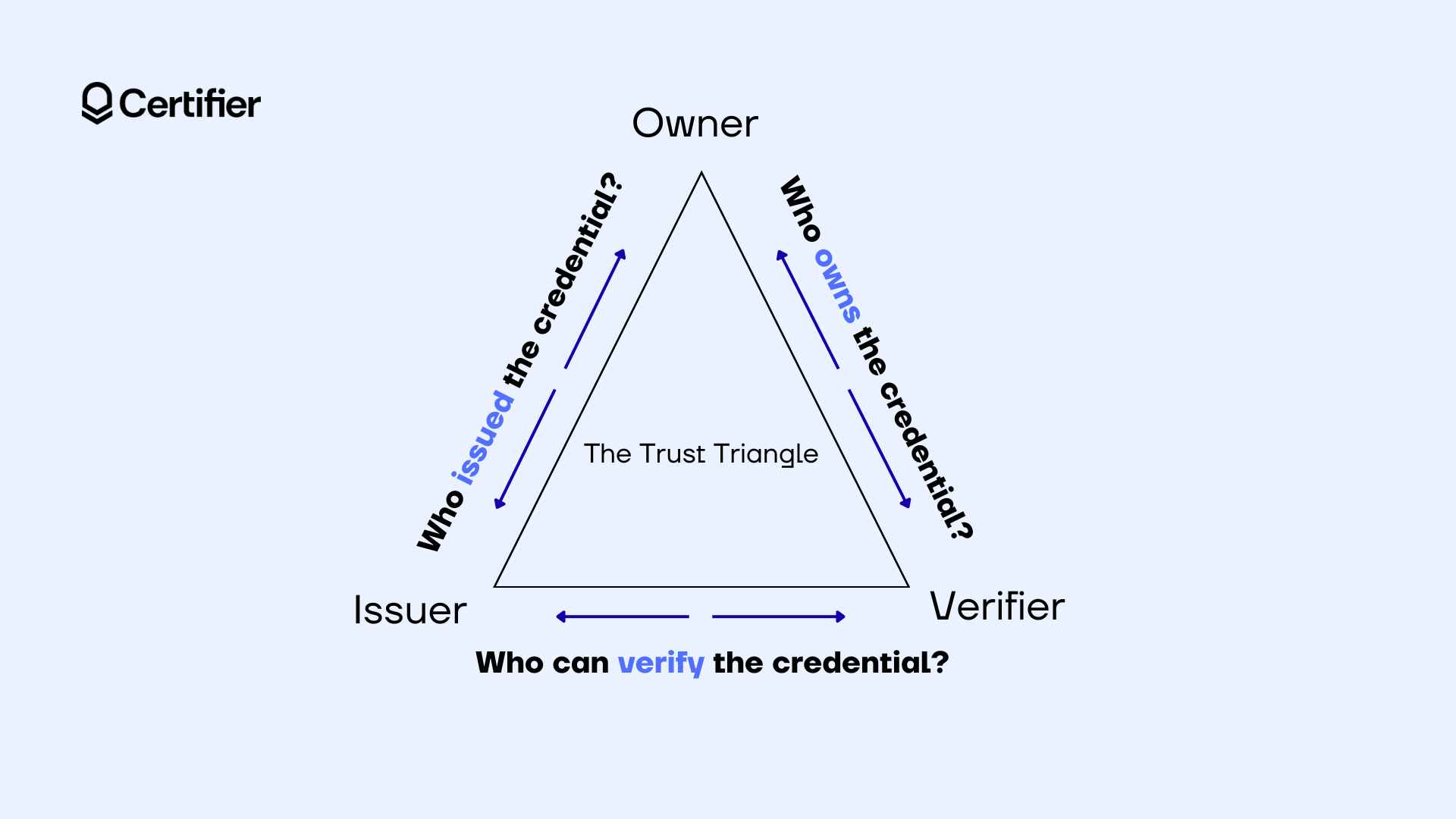
A digital badge works through a relationship between three parties:
Issuer: The employer, training team, or other organization responsible for the credential and what it represents
Owner: The employee who earns and controls the credential.
Verifier: A manager, recruiter, client, or other person who checks whether the credential is authentic and what it proves.
The issuer awards the credential to the employee. The employee can then present it when the achievement is relevant. The verifier opens the linked credential record to confirm the issuer, earning criteria, issue date, and current status.
Trust depends on all three sides of the triangle. The issuer must be credible for the claim being made. The badge must belong to the correct employee, and the verifier must be able to check it without relying only on the badge image.
A badge isn't always the best container for a workplace achievement . Match the format to what you're recognizing.
Format | Best For |
|---|---|
Digital badge | A specific skill or milestone an employee can verify and share |
Digital certificate | Formal proof of completing a broader course or qualification |
Micro-credential | A structured, assessed competency a badge can visually represent |
Paper award | A ceremonial moment where online verification isn't the point |
Frame the decision around the claim and how it will be used. A badge loses its meaning when it's chosen for its looks instead of being the clearest way to show the achievement.
When the learning is a full program rather than a single skill, pairing the badge with a certificate often works better, and you can generate employee training certificates for that case.
Even when a badge is the right format, its value still depends on how it's built. That's what the next section tests.
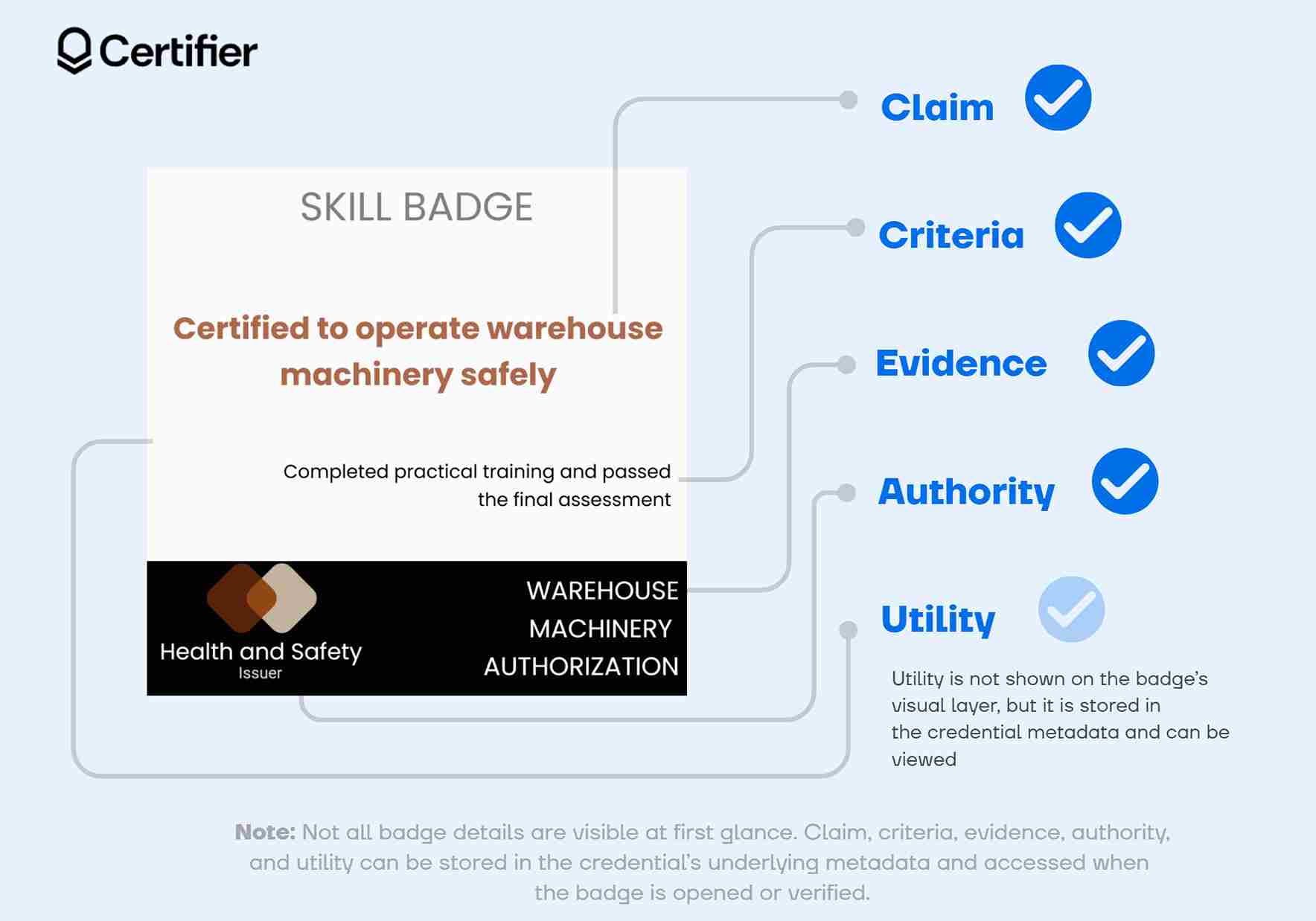
Before you issue employee training badges, put them through five checks. Each one closes a gap that would otherwise turn badges into empty stickers.
The badge should name a specific skill or status the employee holds. Vague titles leave managers and recruiters guessing at what was actually demonstrated.
Claim example: Certified to operate warehouse machinery safely.
Anyone looking at the badge should be able to see how it was earned. Keep the criteria visible and apply them consistently across recipients.
Criteria example: Completed practical training and passed the final assessment with at least 80%.
The claim should be supported by proof that matches its weight, such as an assessment result or a completed work artifact. A high-stakes skill needs stronger evidence than a participation marker.
Evidence example: Assessment score and supervisor-approved practical evaluation.
The issuer should be identifiable and credible in relation to the skill or status being verified. A badge carries more weight when the team issuing it clearly owns the skill or status being verified.
Authority example: Issued by the company’s Health and Safety team.
A useful badge supports a real decision or opportunity, like project eligibility or external visibility. If it changes nothing for the employee, it won't get used.
Utility example: Qualifies the employee for machinery-based warehouse assignments.
A badge that fails this test can still look polished, but it won't function as a credential anyone relies on.
Credibility is what separates a verifiable credential from a PNG with a ribbon on it. A few concrete components do most of the work:
Clear earning criteria: the badge explains what the employee had to do to earn it.
Evidence or assessment details when needed: supporting proof shows that the skill, achievement, or status was properly verified.
An issuer identity: the badge names the organization or team accountable for it.
A verification URL: a public page anyone can open to confirm the badge is genuine.
An issue date and optional expiration: so viewers know the credential is current.
Consistent naming: skill badgers for employees within the same program follow a single convention.
A useful destination: the employee has somewhere relevant to display it after the issue.
Skepticism about digital badges’ credibility is understandable because not every badge carries the same weight. An employee badge becomes useful only when someone can quickly see who issued it, what the employee did to earn it, and how the information can be verified.
Without those details, it functions mainly as a decorative graphic. With them, it can serve as portable proof of a skill, achievement, or current workplace status.
According to a pilot survey of HR directors in Northwest Ohio, verifiable skill badgers for employees may become increasingly relevant in hiring and professional evaluation.
Inside a company, badges tend to cluster around a handful of moments worth marking:
Skill verification: a competency is assessed and confirmed.
Training and course completion: an employee finishes an L&D path or set of learning pathways.
Onboarding milestones: ramp and role-readiness markers in a new hire's first weeks.
Recognition and tenure: service anniversaries or peer and manager recognition. There's more on using digital badges to recognize skills and achievements.
Compliance currency: renewable credentials that expire and prompt a refresh.
These map cleanly onto employee development, which is why People Ops and L&D teams reach for badges as programs grow.
Do you want concrete starting points, browse 20+ employee recognition badge ideas you can adapt this quarter.
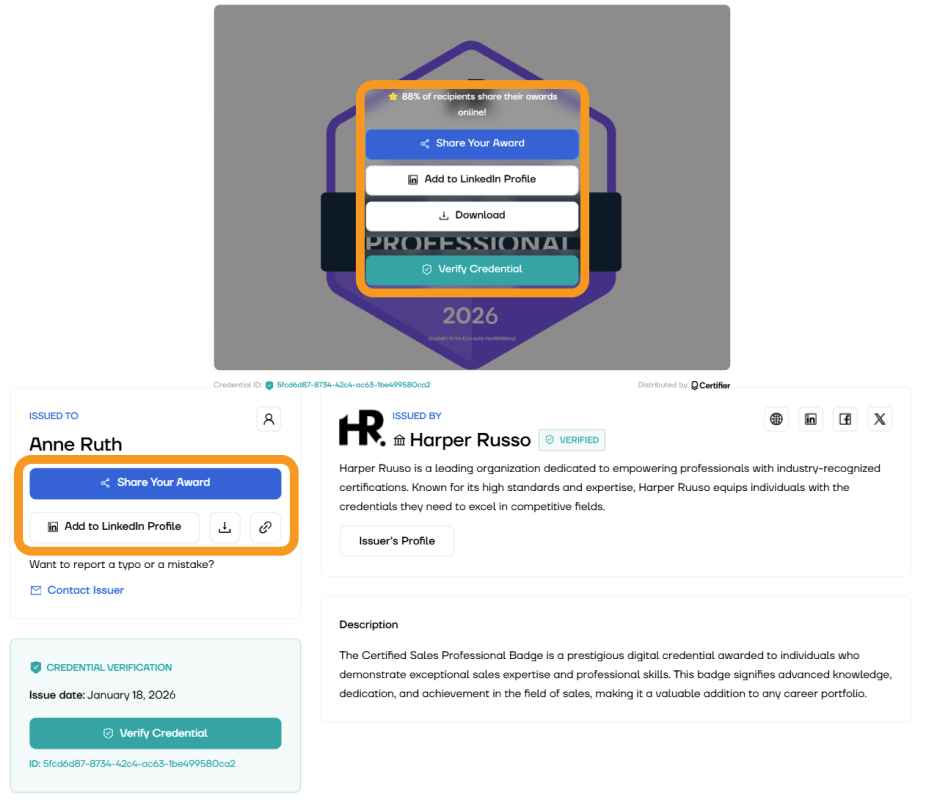
A badge only pays off if it lands somewhere people see it. The strongest destinations are public or semi-public:
LinkedIn profile and posts: the highest-visibility spot, in front of recruiters and a professional network.
Email signature: a linked badge turns routine emails into quiet proof of a skill. Here's how to add a badge to an email signature.
Digital resume or CV: the credential name plus a verification link in the certifications section.
Internal profile or skills directory: so managers can see verified skills across a team.
Performance review or promotion packet: evidence the employee can point to directly.
LinkedIn profiles do the heaviest lifting, since that's where a badge reaches people outside the company.
Badges earn their keep under specific conditions, and they curdle into noise under others.
They work when they're tied to:

An achievement, not attendance. The badge should recognize something the employee completed, demonstrated, or earned.
Visible criteria anyone can check. Viewers should be able to see what was required and how the badge was awarded.
A signal that helps the employee's career or role. The badge should support a practical outcome, such as role readiness, promotion evidence, or project eligibility.
Recognition people are happy to share. Employees are more likely to use a badge when it reflects an achievement they value.
They fail when they're:

Generic “good job” stickers with no criteria. The badge does not explain what the employee did or why the recognition matters.
Too easy to earn to mean anything. If everyone receives it automatically, it carries little value as a workplace signal.
Disconnected from skills or growth. The badge does not support development, progression, or meaningful achievement.
Buried in an internal tool nobody opens. Even a well-designed badge loses utility when employees cannot display or share it.
The dividing line is meaning. A badge that proves something specific gets shared, while one that proves nothing gets ignored.
Running a badge program is lighter than it sounds, but it's more than emailing image files. At a basic level, the workflow starts with issuing the badge and having the employee display it. From there, it's a matter of verifying the badge on demand and renewing it when it expires.
Doing that across a workforce is where a platform earns its place. Tools like Certifier handle the templates and bulk issuance for a whole cohort. They also run the verification pages and analytics, so a program doesn't end up as a folder of unverifiable PDFs.
This is the digital badge implementation and management layer, and it's worth getting right before you scale.
For a fuller look at choosing a tool, see platforms to issue digital badges for employees. Larger organizations weighing security and scale can review what makes a digital badge platform good for enterprise.
An employee digital badge is worth issuing when it provides specific, verifiable proof that benefits the employee who receives it. Get the claim and the criteria right, and the badge becomes a credential people trust rather than a sticker they forget.
When you're ready to build one, you can explore employee badge templates and start free, or look back at the recognition badge ideas if you want concrete examples before you commit.
Digital badges for employees are verifiable credentials that an employer issues to mark a specific skill or workplace milestone. Each one carries metadata, like the issuer and the criteria, so the claim can be checked rather than taken on trust.
An employer or training team defines the criteria, then issues the badge to an employee who meets them. The badge links to a verification page, so a manager or recruiter can confirm it's real.
Most companies issue and track them through a credential platform rather than by hand.
At minimum, it should show the issuer's identity and a statement of the earning criteria. An issue date and a verification link round it out, so the badge stays checkable over time.
Credibility comes from a named, trustworthy issuer and criteria that anyone can inspect. A public verification page seals it, as it allows a third party to verify the badge without contacting your team.
A digital badge usually marks one specific skill or milestone and is built to be shared and verified online. A certificate typically documents completion of a broader course or program. Many companies pair the two, issuing digital certificates for the program and a badge for the shareable skill.
Not quite. A micro-credential is a structured, assessed unit of learning, while a digital badge is the verifiable token that often represents it. In practice, a badge can be the shareable face of a micro-credential.
Yes. Employees can add a badge to the Licenses and Certifications section of their profile. Here's how to add a digital badge to LinkedIn and other social platforms.
They can be, when the recognition is specific and the badge is something employees want to show off.
Asking whether digital badges are worth it usually comes down to one question: does the badge prove something real? Generic participation badges add little, but a badge tied to a genuine skill or contribution gives recognition lasting weight.
Skip badges when there's no clear claim or criteria behind them, or when the recognition is purely ceremonial and a simple thank-you fits better. Badges issued just because they look modern tend to lose meaning fast.

- Content Writing
- On-page SEO
- Localization
- Market Research
- Keyword Research
Content Specialist
Daria creates practical guides and templates that help training providers, educators, and event organizers solve digital credentialing challenges.
Digital Badges: A Pilot Study of Employer Perceptions – Small Business Institute Journal
https://sbij.scholasticahq.com/article/125642-digital-badges-a-pilot-study-of-employer-perceptionsOpen Badges – 1EdTech Consortium
https://www.1edtech.org/standards/open-badges


