

Trusted by:
University of Southern California
Warner Bros.
Volvo
Amazon
Stanford University
Updated: September 28, 2026
10 min read
Is the program you already run a learning pathway, or just a collection of courses? In this guide, we cover what separates one from the other, the eight types you'll encounter, and how to tell where your setup lands.
Research with AI:
Whether you're running a multi-course certification, a product training track for your customers, or an employee upskilling program, you're most likely working with learning paths.
A learning pathway is a structured sequence of learning activities that guides a learner from a starting point to a defined goal, with progress recognized at meaningful intervals — often through certificates, badges, or microcredentials — and a final credential or qualification at the end.
In this guide, we'll unpack what counts as a learning path and what doesn't, the main types you'll encounter, and how to tell whether the program you already run qualifies as one.
A learning pathway is a structured sequence of learning activities, with recognition at meaningful intervals and a final credential at the end.
Every pathway runs on three elements—sequence, recognition, and completion.
Eight main types are: credentialed/stackable, linear, self-directed, adaptive, role-based, skills-based, problem-based, and work-based. Most training programs combine two or three.
Certifier is a credential management platform that handles the credentialing side of a pathway — issuing the right credential at each step, tracking who's earned what, and auto-issuing the completion credential at the end of the training.

Every learning pathway, regardless of type or industry, runs on the same three structural elements: sequence, recognition, and completion. Take any of these away and the structure stops being a pathway and becomes something else ( a course catalog, a playlist, a curriculum).

Sequence is the defined order in which learners move through the content, even if that order is flexible within sections.
Recognition is what marks meaningful progress along the way — a credential, badge, status, or milestone earned at each step.
Completion is the defined end-state that ties the full sequence together — a final credential or qualification that signals the learner has finished something whole.
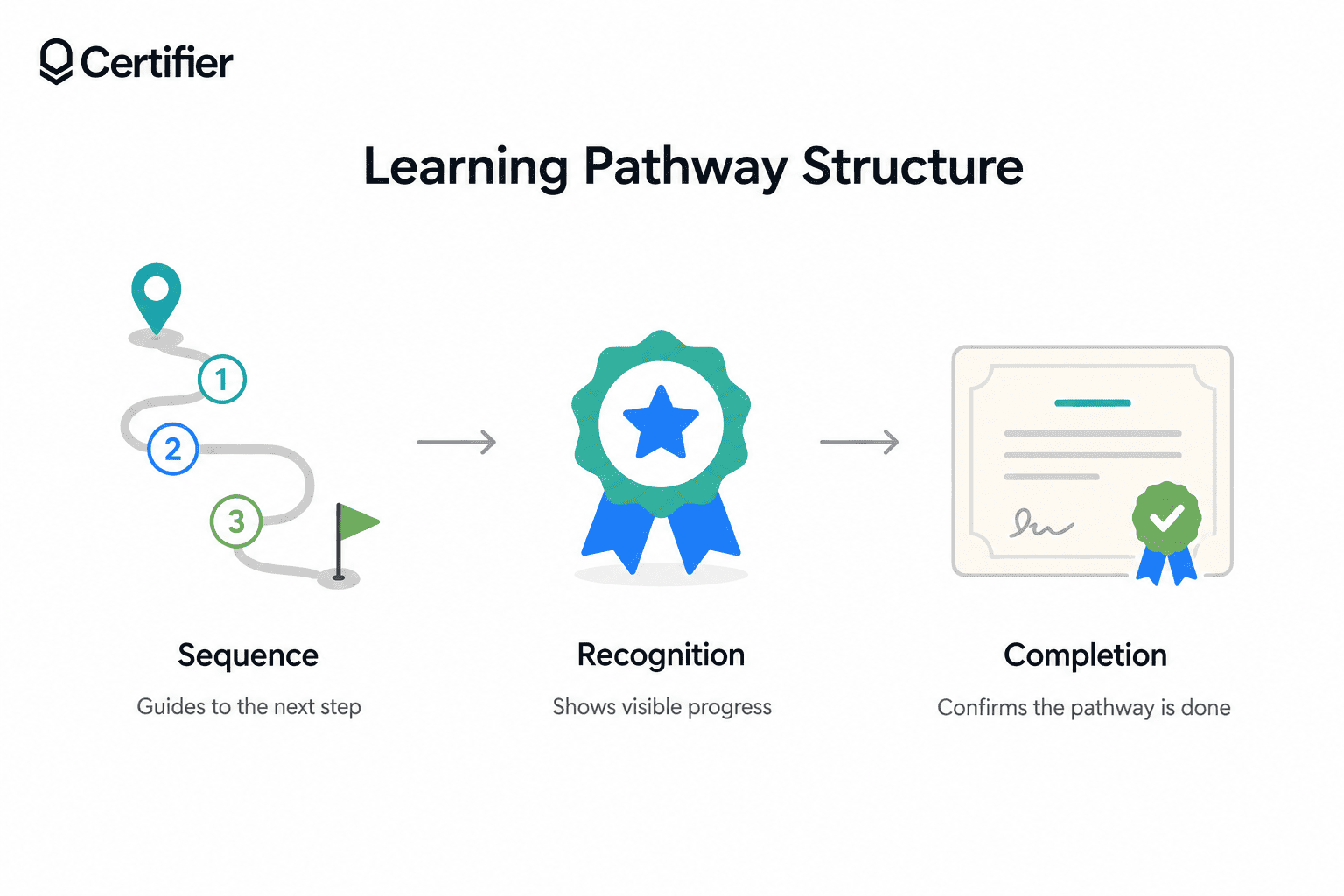
These three elements are what the rest of this guide builds on, from the recognition test below to the comparison with adjacent terms and the types of pathways that follow.
If you'd like to learn more about how to create a learning path, we've got a dedicated guide to that.
For employee development programs, the structure needs one more layer: career movement. See how learning paths for employees connect training paths with retention, visible progress, and stackable credentials.
Before you decide what to build or what to fix, the first thing worth understanding is whether what you currently run is already a pathway, a collection of standalone courses, or something in between.
Use this quick checklist to understand where you stand.
5 Questions to Identify If You're Running a Pathway
Do learners encounter your training in a consistent order, even if it's not strictly enforced?
Do you issue some form of recognition at intervals — a certificate, badge, status, completion marker, or another defined milestone?
Is there a defined end-state — a credential, qualification, status, or formal acknowledgment — that signals "you've completed this"?
Could you describe what someone gains by finishing the full sequence that they wouldn't gain from any single piece of it?
Would you be able to tell a learner where they are in the sequence at any point?
Here’s how to read your answers:

Three or more positive answers → you have a de facto learning pathway. The sequence, recognition, and end-state are already there. What's usually missing is the formal layer: a defined progression learners can see, a completion credential or marker that ties the sequence together. So, what usually comes next is writing down the rules your pathway needs to be easily managed.
One or two positive answers → you have a collection, not a pathway. That can be a deliberate choice (a course catalog, a resource library, or an on-demand training shelf are all legitimate formats), but it's worth naming the structure accurately so you don't describe it to learners or buyers as something it isn't.

Zero positive answers → not a pathway. What you have is closer to a program, a curriculum, or a content library. The disambiguation in the next section will help you find the right term.
Learning path sits inside a crowded vocabulary. Program, curriculum, track, journey, plan, playlist — each term describes overlapping but distinct structures, and the differences only show up when you put them side by side.
Here are the core terms you'll encounter and what each one means in practice:
Term | What It Means | Example | What Learners Earn |
|---|---|---|---|
Learning pathway | Sequenced learning activities with recognition at intervals, building toward a defined completion credential | A new-manager pathway from "first 1:1" to "running a quarterly review" | Credentials at each step (typically Open Badges 3.0–compatible) + a final completion credential |
Learning journey | The full arc across roles, time, or life stage — broader than a pathway | The full employee lifecycle from onboarding through promotion | Multiple credentials across multiple pathways, accumulated over years |
Learning track | A themed sub-route within a larger pathway or program | The "communication skills" track inside a leadership pathway | A credential for the track, contributing to the larger qualification |
Learning plan | The high-level goal and timeline; the "what" and "when" without the sequence | "Develop management skills over the next year" | Nothing inherently — a plan is intent, not delivery |
Training program | The umbrella initiative containing one or more pathways | An annual compliance training program | Varies — programs may include pathways with credentials, or just one-off modules |
Curriculum | The inventory of available content, before any sequencing | The full library of leadership modules in your LMS | Nothing — a curriculum is the menu, not the meal |
Course | A single self-contained unit | "Conflict Resolution 101" | A single completion credential, if you issue one |
Playlist | Curated content without progression logic | A LinkedIn Learning playlist of recommended videos | Nothing structural — playlists are recommendations, not pathways |
Understanding the distinction matters most in the situations the previous section pointed to:

If your self-check came back as "de facto pathway," knowing which adjacent term almost describes what you have helps you see what's missing from a full pathway.
If it came back as "collection, not a pathway," the table above will help you identify the type of learning process you currently have ( a curriculum, a program, a playlist) so you can describe it accurately instead of marketing it as something it isn't.
Let's step out of the definitional theory for a moment and look at what pathways actually produce for the people who run them:
Standalone online courses have a well-known completion problem — peer-reviewed research across 221 MOOCs found a median completion rate of just 12.6%. Pathways change the dynamic by giving learners something to reach for at each step, not just at the end. Recognition along the way keeps the program visible in their mind, and a defined sequence makes the cost of stopping obvious — they'd be walking away from progress they've already earned, not just abandoning a course they hadn't really started
The credential at the end of a pathway says more than a single-course certificate ever can. It tells anyone evaluating it that the recipient moved through a defined sequence, met a clear standard at each step, and reached a defined end-state.
That structure is essentially credential stacking — and stacked credentials measurably outperform single ones in the labor market. A peer-reviewed study from Brown University's Annenberg Institute, analyzing Virginia state employment data, found that learners who earned two or more credentials saw a four-percentage-point increase in employment and a four percent rise in quarterly wages compared to learners with just one. A graduate of your pathway carries a credential built on the same logic.
Standalone courses tend to show you completion as a single yes/no — someone finished the learning, or they didn't, and it's hard to tell where things went wrong. A pathway gives you a data point at every step, so you can see exactly where learners stop. That's a useful signal, since the place where someone drops off usually tells you why:
Stopping in step one or two often points to a setup issue (wrong audience, wrong expectations).
Stopping in step four or five often points to a program issue (pacing, difficulty, time commitment).
In Certifier Pathways, you see those drop-off points at the credential level, so you're working with actual data instead of guessing from a single completion number.
"We offer a certification pathway with credentials at each level" lands differently than "we offer five courses" — it signals continuity, progression, and a recognizable end-state, all of which buyers across the board increasingly look for, whether they're enterprise L&D teams, individual learners comparing certifications, or partners deciding which vendor's enablement to invest in.
The structure pays off in measurable ways. 60% of organizations running curriculum-based education programs report revenue growth from those programs, compared with 43% for education programs overall, which means buyers investing in a structured pathway are more likely to see returns than buyers investing in unstructured training.
Learning pathways come in several recognizable forms. The eight types below are the variations you'll come across most often:
Type | How It Works | Best For | What Learners Earn |
|---|---|---|---|
Credentialed (stackable) | Each step issues a credential or microcredential that composes into a final completion credential | Training providers, certification bodies, customer education, partner enablement | Stackable credentials at each step + a final completion credential |
Linear | Sequential progression — must complete A before B | Compliance, safety, foundational onboarding | One completion credential at the end |
Self-directed | Clear destination, learner picks the route | Experienced learners, voluntary upskilling | Completion credential when criteria are met |
Adaptive | AI- or data-driven branching based on learner performance | Large teams with varied skill levels | Completion credential calibrated to demonstrated capability |
Role-based | Organized by job function | Scaling consistent capability across a team | Role-specific completion credential |
Skills-based | Organized by competency rather than role | Cross-functional capability building in skills-first organizations | One credential per skill, composable across roles |
Problem-based | Learners progress by working through real-world scenarios (rooted in problem-based learning pedagogy) | Applied training where context matters more than content sequence | Credential tied to demonstrated problem-solving |
Work-based | Apprenticeship-style, with competency demonstrated on the job | Vocational or regulated training | Often a formal qualification (license, certificate of competence) |
If you look at the table and think "we're kind of doing three of these at once," that's expected — the types describe different dimensions of a pathway, not different pathways. Most real programs combine two or three of them, for example: a role-based onboarding track delivered in a linear sequence, or a credentialed pathway built on top of a problem-based core.
The three dimensions worth knowing:
How learners move through the pathway — linear, self-directed, or adaptive
How the content is organized — by role, by skill, by real-world problem, or by job-based competency
What learners earn along the way — credentialed, stackable, or a combination of both
Now that the pathway types and terminology are out of the way, the easiest way to make all of this information concrete is to look at three real-world setups.
The examples below come from contexts where paths are already standard practice — a training provider, a certification body, and a SaaS customer education team — and each one shows how the same underlying logic plays out differently depending on what the program is for.
A digital marketing training company already sells four related courses individually: SEO Fundamentals, Content Strategy, Technical SEO, and Analytics. Demand is steady, but the team wants to offer something bigger than four separate certificates — a single recognizable credential that says someone has completed the full discipline.
Sequence. Learners can take the four courses individually or in order. Those who complete all four — in any order — unlock the final credential.
What learners earn. A training certificate or badge after each course they finish, plus a Certified SEO Specialist credential once all four are complete.
Why is it a pathway? The four courses still sell on their own, but the sequence is now named, recognition is structured at every step, and the final credential signals something the individual course certificates couldn't on their own: that the learner has moved through the full discipline, not just one corner of it.
A professional association in project management runs a three-tier certification program. Each tier has its own requirements and represents a different stage in a practitioner's career: entry-level, mid-career, and senior.
Sequence. Associate (coursework and exam) → Professional (exam plus a work-experience requirement) → Expert (portfolio review and peer assessment). Each tier requires the one below it.
What learners earn. A standalone credential at each tier. Each one is usable on its own, and each higher tier carries the weight of the lower ones earned along the way.
Why it's a pathway? This is where the pathway label earns its keep. Candidates read the three tiers as a career progression, not as three unrelated certifications, and the credentials accumulate to show how far someone has come in the discipline.
A SaaS company wants to offer its power users a formal product certification. The team builds a learning track inside the product's education portal — modeled loosely on something like Salesforce Trailhead — so customers can learn at their own pace and end up with a credential they can show their employer.
Sequence. Welcome to [Product] → Core Features → Advanced Use Cases → Implementation Patterns → final certification assessment. Within each section, learners can move through modules in any order; the sections themselves are sequential.
What learners earn. A badge after each module, accumulating in the learner's profile, plus a Certified [Product] User credential once the final assessment is passed.
Why it's a pathway. Learners have freedom in how they move through each section, but the overall progression is defined, recognition shows up at every checkpoint, and the final credential reflects demonstrated mastery of the product — not just exposure to it.
We started this guide by asking whether what you already run qualifies as a pathway. Now it's worth flipping the question the other way: even if the structure fits, is it the right answer for the specific training you're working on?
Here are the situations where a dedicated learning path usually isn't the answer and where a simpler format does the job better:
One-off compliance refreshers. Annual training that just needs to happen, get logged, and move on. A single module with a completion record covers it.
Reactive, in-the-moment learning. When someone needs to know “how do I do X right now”, they're not really looking for a sequence — they want a direct answer. Documentation, a knowledge base, or a short video will get them there faster than a pathway.
Continuous values or culture reinforcement. Culture gets built through repetition, ritual, and example. A pathway tends to flatten the kind of work that holds culture together.
Individualized coaching relationships. Coaching is built around one person, one goal, and the conversations that come out of working toward it. A pathway is designed for the opposite job: repeating the same structure across many learners.
Programs without a clear end-state. If you can't say what someone walks away with at the end ( a credential, a qualification, a capability, a status) a pathway doesn't really have anything to build toward.
None of the cases above are reasons to avoid pathways generally — they're just reasons to pick a different format for those specific kinds of training. The rest of the time, the pathway structure is worth the time and effort.
Whether you're already running a pathway or building one from scratch, the same operational question shows up: how do you actually run the thing without being buried in spreadsheets and manual issuance work?
For that, you have Certifier — a credential management platform that handles the back end of running a pathway. You define the sequence of credentials that make up the pathway, and Certifier takes care of the rest: tracking who's earned what, automatically enrolling learners into the pathway as they go, and issuing the completion credential the moment a learner finishes the sequence.
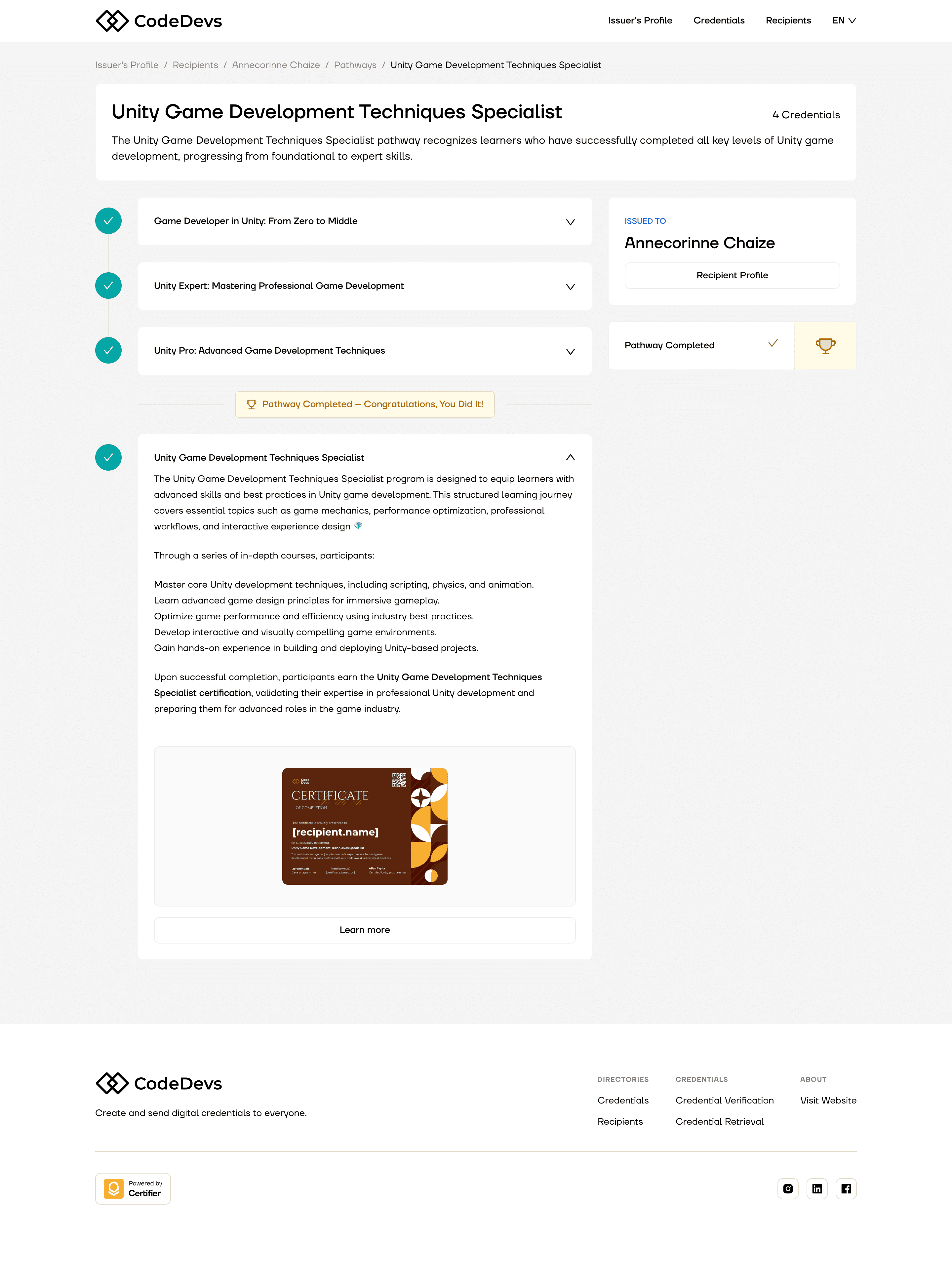
The result is a pathway that runs itself on the credentialing side, with an analytics view that shows exactly where each learner is in the sequence at any moment.
If you'd like to see what your pathway would look like with the credentialing part automated, start building your learning pathway with Certifier.
You can customize and automate learning pathways even for apps with rigid native workflows. Connecting Certifier to Mini Course Generator, for example, lets you issue different certificates for separate courses, not just standard collections.
Most teams already have the raw ingredients for a learning pathway: a set of courses, credentials they're already issuing, and a rough sense of what order things should happen in. The piece that turns those ingredients into a path is the structural layer that connects them.
If you're ready to put that layer in place, our guide to building certification programs is a useful next read — it covers how to design the sequence, define what each step recognizes, and turn a set of related courses into a program learners can actually progress through.
A learning pathway is a structured sequence of learning activities that guides a learner from a starting point to a defined goal, with progress recognized at meaningful intervals. In credentialed programs, that recognition usually takes the form of certificates, badges, or microcredentials along the way, and a final credential or qualification at the end.
A common one is a multi-course certification: a training provider sells four related courses (say, SEO Fundamentals, Content Strategy, Technical SEO, and Analytics), issues a credential after each, and awards a final "Certified SEO Specialist" credential to learners who complete all four.
Other examples include tiered professional certifications (Associate → Professional → Expert) and product certification tracks like Salesforce Trailhead.
In most cases, none. The two terms are used interchangeably across the L&D and credentialing industries to describe the same concept — a structured sequence of learning activities with a defined goal.
A certification program is the broader initiative — it can contain one or more pathways, plus standalone exams, recertification requirements, and other components. A pathway is the structured learning sequence inside that program. Most certification programs include at least one pathway; not every pathway sits inside a formal certification program.
Yes. An LMS hosts and delivers the learning content, but a pathway is defined by its structure, not by the platform serving the content. Many credential-active programs run pathways using a credentialing platform layered on top of existing tools — webinar software, video courses on YouTube, in-person workshops, or course platforms outside the traditional LMS category. What matters is the sequence, the recognition at each step, and the end-state credential.
To know if your current setup is a pathway, run it against these five checks:
Learners encounter your training in a consistent order
You issue some form of recognition at meaningful intervals
There's a defined end-state that signals completion
Completing the full sequence gives learners something they wouldn't get from a single piece of it
You can tell a learner where they are in the sequence at any point
Three or more positive answers mean you're running a pathway, possibly without having named it one. Fewer than three means it's closer to a collection.
At a high level, building a pathway comes down to three decisions:
Map the sequence. What comes first, second, third — and why that order
Define what each step recognizes. A credential, badge, or completion marker, with clear criteria for earning it
Decide what the final credential signals. The end-state that the full sequence builds toward
From there, the build process expands into sequence design, criteria definition, credentialing logic, and analytics setup, but the three decisions above are where every pathway starts.
There are eight main types worth knowing:
Stackable
Linear
Self-directed
Adaptive
Role-based
Skills-based
Problem-based
Work-based
Most real-world programs combine two or three of these rather than fitting cleanly into one, since the types describe different dimensions of a pathway — how learners move through it, how content is organized, and how progress is recognized.

- Content Writing
- On-page SEO
- Localization
- Market Research
- Keyword Research
Content Specialist
Daria creates practical guides and templates that help training providers, educators, and event organizers solve digital credentialing challenges.
Jordan, K. (2015). Massive Open Online Course Completion Rates Revisited: Assessment, Length and Attrition. International Review of Research in Open and Distributed Learning
https://oro.open.ac.uk/43566/Meyer, K. E., Bird, K. A., & Castleman, B. L. (2020). Labor Market Returns to Stackable Credentials. EdWorkingPaper 20-317, Annenberg Institute at Brown University
https://edworkingpapers.com/sites/default/files/ai20-317.pdfIntellum — Employee Training Statistics
https://www.intellum.com/resources/blog/employee-training-statisticsOpen Badges 3.0 — 1EdTech
https://www.imsglobal.org/spec/ob/v3p0


