
Language Program Certificate
Customize this language program certificate for students who complete a course and reach a new level. Add the program, level, and hours, then issue to the whole class.
Customize this template for free
Email and export in bulk
Track recipient engagement
Download in
Don't have Certifier account? Sign up
Formal blue language program certificate template
This free language program certificate records that a student completed your program and reached a stated level. It suits language schools and university language centers that teach toward CEFR levels and issue a certificate at the end of each course.
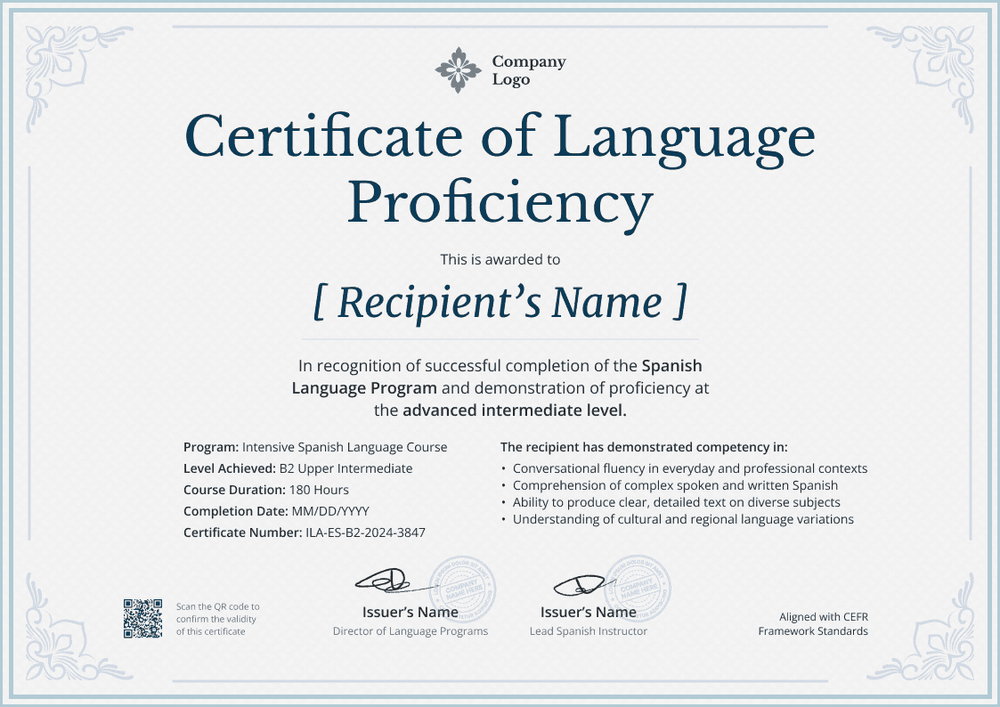
The design is a pale page with light blue ornamental corners and a fine blue frame. A large navy serif title sits under your logo, followed by the student's name and a statement of the program and level reached. Two columns hold the program details on the left, including level achieved, course hours, and certificate number, and a list of competencies on the right.
At the end of term, import your class list from a spreadsheet or connect your LMS to issue every certificate at once. Each student receives a credential page with a verification link they can add to a CV or application.
What is a language program certificate?
This type of certificate shows that a named student completed a language program and reached a stated level on the Common European Framework of Reference for Languages. Schools use it to mark progress from one level to the next.
The CEFR runs from A1 for beginners to C2 for highly proficient users, grouped as basic, independent, and proficient. The level on your certificate should come from an assessment your school has mapped to the CEFR, not from course hours alone. A school certificate isn't an official exam result such as DELE or DELF.
This template is laid out on A4 landscape (29.7 x 21 cm). Sign up for a free Certifier account to edit the design and start issuing certificates with this template.
What should a language program certificate include?
A language certificate should show who completed the program, which level they reached, and how much study it took. Use the online builder to edit and customize the following fields:
Static fields
- Organization block: Your school's name and logo at the top.
- Certificate title: The award type (e.g., Certificate of Language Proficiency).
- Competencies list: What students at this level can do (e.g., conversational fluency, understanding complex texts).
- CEFR alignment note: A short line stating the level is aligned with the CEFR.
- Signature and role areas: Two signature lines (e.g., Director of Language Programs and Lead Instructor).
Dynamic fields (automatically populated by Certifier)
- Recipient name: The student's full name.
- Program: The course completed (e.g., Intensive Spanish Language Course).
- Level achieved: The CEFR level reached (e.g., B2 Upper Intermediate).
- Course duration: The hours of study (e.g., 180 hours).
- Completion date and certificate number: When the course ended and a unique identifier for your records.
This list describes the template design, but it's not a fixed standard. You can rename, add, or remove fields in Certifier's design builder until the layout matches your course records.
How to issue a language program certificate
Follow these four steps to issue certificates to every student who completed the program:
- Edit the design to match your brand: Upload your logo and signatures, then update the competencies list for the level you teach.
- Upload student data: Import your class list from a spreadsheet, with the program, level, and hours for each student, or connect your LMS through native integrations or Zapier.
- Issue the certificates: Certifier emails each student their personalized certificate with a verification link.
- Track and keep records current: Use the Credential Repository to see who opened, viewed, downloaded, or shared their certificate, and correct a misspelled name without reissuing.
Available language program certificate template formats
Edit and issue the template online with Certifier
Reuse one design for every level by mapping the level and competencies, then send each class's certificates together.
Download the template in Microsoft Word
To get copies for a school's own archive, add an email address and you’ll receive the landscape .docx versions for A4 and Letter paper.
PDF document export
Students can download the PDF from the delivery email and print it for their portfolio.
Who issues language program certificates?
Language schools and academies
Schools that teach toward CEFR levels issue a certificate each time a student completes a level, so progress is easy to show.
University language centers
Centers that teach languages to students and staff issue level certificates at the end of each semester or intensive course.
Corporate language programs
Companies that run language training for staff can record the level each employee reached.
Frequently asked questions
Yes. Certifier's free Starter plan covers it, since program, level, hours, and completion date fit inside Starter's 5 custom attribute limit.
Use the level your end-of-course assessment shows. Course hours alone don't determine a CEFR level, so base the level on the student's results.
Yes. Change the program name and competencies or map them to spreadsheet columns, then use one design for every language you teach.
They can open the certificate's verification link, or scan its QR code on paid plans, to reach the student's credential page on Certifier. That page shows the issuer, the recipient, the issue date, and the certificate number.
No. This language program certificate records your course and the level the student reached in your assessment. Students who need an official exam result should contact the relevant exam board.
The student can request a correction from their Certifier credential page after verifying their email. You then review the request in your dashboard and update the field. The public page updates right away, with nothing to reissue.
Certifier templates are provided for general informational and design purposes only. They do not constitute legal, regulatory, or compliance advice and are not guaranteed to satisfy the requirements of any regulator, auditor, standard, insurer, or jurisdiction. The issuing organization is responsible for the content of its training program and for verifying that its records meet the requirements that apply to it.