

Trusted by:
University of Southern California
Warner Bros.
Volvo
Amazon
Stanford University
Updated: October 02, 2026
7 min read
Design a customer AI literacy program that teaches each role the right skills, tests the evidence that matters, and issues credentials that stay accurate as your product and its AI risks change.
Research with AI:
The quickest program to launch is one overview course with one completion certificate.
That program is easy to run while telling you or anyone reviewing the credential very little. A completion record proves someone finished the modules, but not whether they can spot an unsupported claim in a generated answer, keep sensitive data out of a prompt, or configure AI access for their team.
An AI literacy training framework closes that gap by mapping each customer role to the AI-assisted tasks it performs, the risks those tasks carry, and the evidence a learner must show before you issue a credential.
The framework below gives you a Role-Risk-Evidence Credential Matrix, a four-level credential ladder, a worked example, and a one-cohort pilot plan you can brief this quarter.
Build customer AI literacy training around the learner's role, the AI-assisted task they perform, and what happens if they get it wrong.
Decide what each role must demonstrate before you choose a credential or write its claim.
Use a completion certificate only when completion is the claim. Skill or competency claims need proportionately stronger assessment evidence.
Connect approved learning or assessment results to issuance, verification, renewal, and exception handling before scaling the program.

Customer AI literacy training helps customers use and evaluate your AI-enabled product responsibly, within their role and the tasks they're permitted to perform. The learner is outside your company, while the content is tied to your product, your data rules, and your permission model.
The best-known frameworks, from the DOL, UNESCO, and Digital Promise, were written for workforce and education audiences, so they fit customer programs only partly.
Program Coordinates | Customer Ai Literacy | Employee Ai Literacy | Education Ai Literacy |
|---|---|---|---|
Learner | End users, reviewers, admins, partners, and champions of your product | Your own staff | Students and teachers |
Scope | Your product's AI features, data inputs, permissions, and failure modes | Internal tools, policies, and job tasks | General concepts, ethics, and future readiness |
Who sets the requirement | Your Education, Product, Legal, and Customer Success teams | Employer, HR, and compliance | Schools, education systems, and frameworks such as UNESCO's AI competency frameworks |
What makes content stale | Product releases, model changes, and data-policy updates | Internal policy and tool changes | Curriculum review cycles |
What the credential usually records | Completion or a demonstrated product task | An internal training record | A course or program result |
The U.S. Department of Labor's AI Literacy Framework (TEN 07-25) names five foundational content areas. They translate well into customer education when you tie each one to your product:
Dol Content Area | What It Means In A Customer Program |
|---|---|
Understand AI principles | What the product's AI can and can't do, and why outputs vary |
Explore AI uses | Which product tasks AI supports, and which it shouldn't be used for |
Direct AI effectively | How to give the product clear inputs, context, and constraints |
Evaluate AI outputs | How to check generated content before it's used or sent |
Use AI responsibly | Data handling, escalation paths, and your acceptable-use rules |
Digital Promise's AI literacy framework adds a useful split: learners understand, evaluate, and use AI. That split helps later, when you decide what a credential can claim.
Use these frameworks to shape content. None defines what your customer credential must require, as that decision belongs to you.
A single course and a single certificate treat every customer as the same learner with the same risk. Customer roles differ in permissions and consequences, so they need different learning and different proof.
An end user drafts content with an AI assistant. A team lead approves what others generate. An admin decides who gets AI access, what's logged, and which defaults apply to everyone on the account.
Each role needs a different slice of the same product knowledge. An admin who only took the end-user course hasn't learned the controls they're responsible for.
A low-risk awareness path can rest on completion evidence. A task where a bad output reaches a customer, exposes data, or changes settings for a whole account needs more. That usually means a scenario-based assessment, a practical task, or observed performance with a named reviewer.
The NIST AI Risk Management Framework treats AI risk as context-dependent for the same reason. The same capability carries different risk in different hands and tasks.
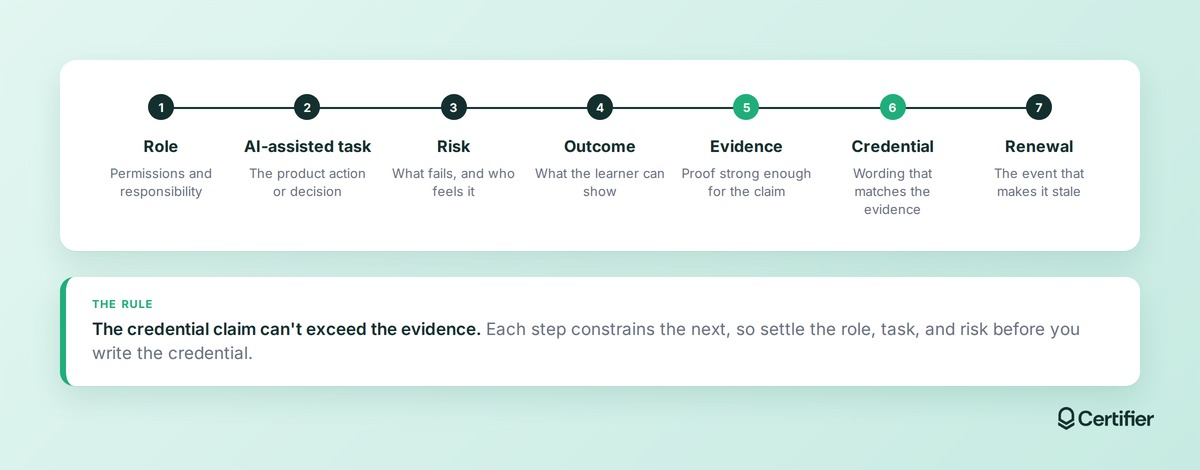
A credential makes a claim about the person who holds it. If the only evidence is attendance, the honest claim is "completed." Words such as certified, proficient, or competent need assessment evidence to back them up.
A credential that claims more than its assessment established misleads the recipient, their employer, and anyone who verifies it.
A single baseline course is sometimes the right first layer. If the AI feature is low-risk and your goal is awareness of limits and acceptable use, one course with a completion certificate may be the fastest responsible start.
Some customer training shouldn't carry a credential at all. The framework below helps you decide when a role needs more.
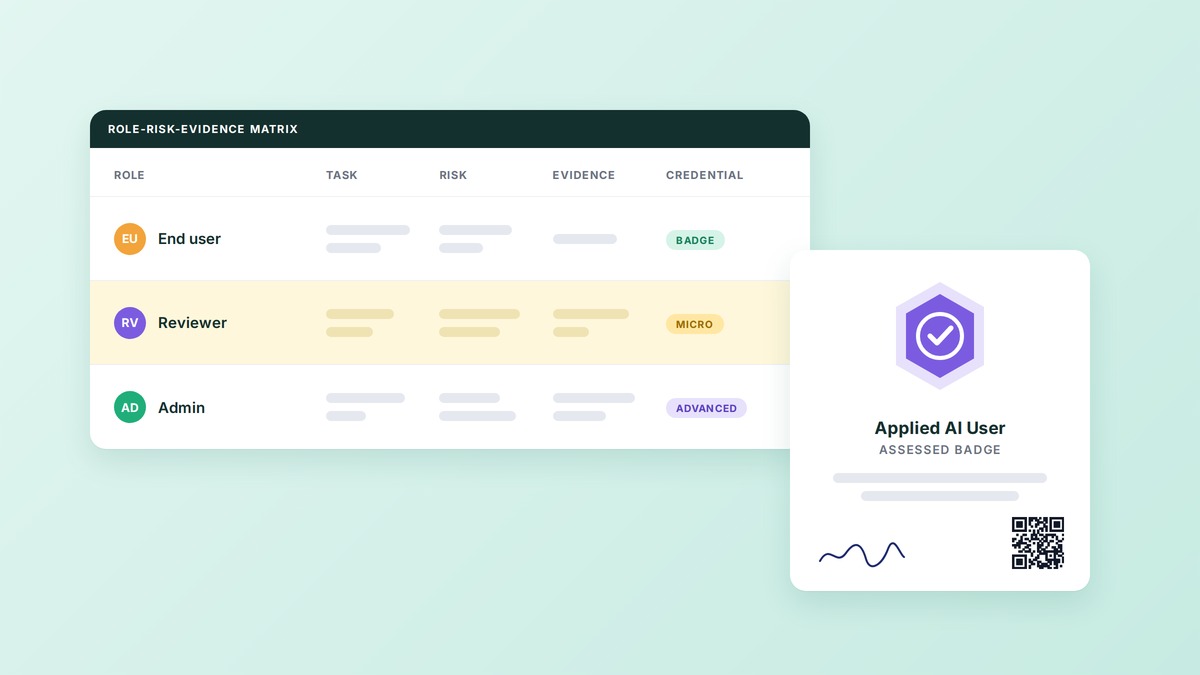
This Role-Risk-Evidence Credential Matrix turns AI literacy content into a program decision: who learns what, what they must prove, and what the credential may claim. Fill one row per role and AI-assisted task.
Field | What To Write | Question To Answer |
|---|---|---|
Customer role | The learner's permissions and responsibilities | Is this person an end user, reviewer, admin, partner, or program champion? |
AI-assisted task | The actual product action or decision | What will the learner use AI to produce, assess, configure, or approve? |
Risk and failure condition | What can go wrong and the consequence | Could a poor output expose data, mislead a customer, or lock in a decision that's hard to reverse? |
Required competency | The knowledge, judgment, and task capability needed | Must they understand limits, evaluate outputs, protect data, or configure controls? |
Observable learning outcome | What the learner can demonstrate | Can they identify an unsafe input and choose the correct escalation path? |
Assessment and evidence | Proof strong enough for the claim | Is attendance enough, or do you need a scenario, practical task, review, or capstone? |
Credential and wording | Exactly what the credential represents | Does it record completion, knowledge, applied use, review authority, or advanced administration? |
Validity and refresh trigger | Why and when the knowledge can go stale | Product release, policy change, model change, incident, role change, or scheduled review? |
Issuance source | The authoritative event and system | LMS completion, assessment pass, admin approval, spreadsheet review, or API event? |
Owner and exception path | Who approves, reviews, and corrects records | Who handles failed assessments, duplicate identities, role changes, appeals, or early expiry? |
Pick one role and one task. "Workspace admins who turn on the AI assistant and set data-retention defaults" is specific enough to design for. If a role performs three AI tasks, give each task its own row.
Write down what goes wrong when the task is done badly and who feels it. Then write the outcome as an action the learner takes. The failure condition tells you how strong the evidence must be, while the outcome tells you what the assessment must test.
With the outcome fixed, choose the lightest assessment that can actually prove it. Write the credential title and criteria so they don't claim more than that assessment shows.
Then name the event that would make the credential inaccurate, such as a feature change or a new data policy, and make that your refresh trigger.
How this framework was built: We adapted concepts from official education and workforce AI literacy frameworks (DOL, Digital Promise, UNESCO) and risk principles from NIST, then combined them with credential-evidence practice for customer education.
Limits: This is a planning model. It isn't a legal standard, an accreditation scheme, or a validated universal competency taxonomy. High-stakes or regulated use cases need domain experts, legal review, and stronger validation than this guide can provide.
A credential can only claim what an outcome describes and an assessment tests. Instructional designers write outcomes while the credentialing layer requires them to be observable, under stated conditions.
External frameworks name competencies, such as the DOL's "Evaluate AI outputs." Before a competency can appear in credential criteria, it has to become something a learner does in your product:
Too vague to credential: Understands hallucinations.
Specific enough to credential: Identifies unsupported claims in a product-generated response and selects the approved verification or escalation step.
We map the Digital Promise split of understand, evaluate, and use onto three kinds of outcomes.
Outcome Type | Example | What The Credential Can Claim |
|---|---|---|
Knowledge (understand) | Identifies situations where the assistant's answer must be checked against a source | Demonstrated defined knowledge at a stated threshold |
Judgment (evaluate) | Identifies unsupported claims and selects the approved escalation step | Applied judgment to representative cases |
Task performance (use) | Configures AI access for two user groups in a test workspace | Performed a defined task under stated conditions |
Record the conditions behind each outcome, including permissions, product version, data set, and tools. They become the boundary of the credential's claim.
The assessment decides what the credential can honestly claim. Use this table to check every credential before you write its title.
Evidence Collected | Defensible Claim | Avoid |
|---|---|---|
Attendance or module completion only | Participated in or completed the learning experience | Certified, proficient, expert, or competent without assessment |
Knowledge quiz | Demonstrated defined conceptual knowledge at the stated threshold | Claiming reliable task performance |
Scenario-based assessment | Applied judgment to representative cases | Claiming performance in every live context |
Practical task or observed performance | Demonstrated a defined task under stated conditions | Generalizing beyond the tool, role, data, or conditions assessed |
Multi-part pathway or capstone | Completed and demonstrated the defined program sequence | Treating the credential as permanent when product or policy changes can invalidate it |
The four-level ladder below is a planning example. Not every program needs four levels, plus yours may use different names.
Level | What It Recognizes | Minimum Evidence | Credential Direction | Wording Boundary |
|---|---|---|---|---|
1. AI awareness | Exposure to core concepts, limits, acceptable use, and support paths | Verified completion; optional knowledge check | Completion certificate | Don't claim proficiency or competence |
2. Applied AI user | Ability to complete a bounded product task and evaluate the output | Scenario or practical task with defined pass criteria | Skill badge or assessed certificate | Name the task and criteria; avoid broad "AI expert" language |
3. Responsible reviewer or operator | Ability to review outputs, identify risks, apply policy, and escalate | Case-based assessment plus review or decision evidence | Assessed badge or microcredential | State the role and responsibility boundary |
4. Administrator or champion | Ability to configure, govern, teach, or oversee the customer implementation | Practical configuration, capstone, or accountable approval | Advanced credential or pathway completion | Avoid implying legal authority, professional licensure, or universal AI governance expertise |
A completion certificate fits when completion is the claim. That's usually level 1, when the learner saw the core limits, the acceptable-use rules, and where to get help.
It's also the right choice when you haven't built an assessment yet. Issue the honest credential now and add an assessed level later.
Use an assessed badge when the learner has shown a specific skill against defined criteria, such as completing a practical task. Use a microcredential when the claim covers a bounded role responsibility with several assessed parts, such as reviewing outputs and escalating risk.
If your team uses these terms loosely, settle definitions first. Our guide on how to choose between certificates, badges, and microcredentials covers the full taxonomy.
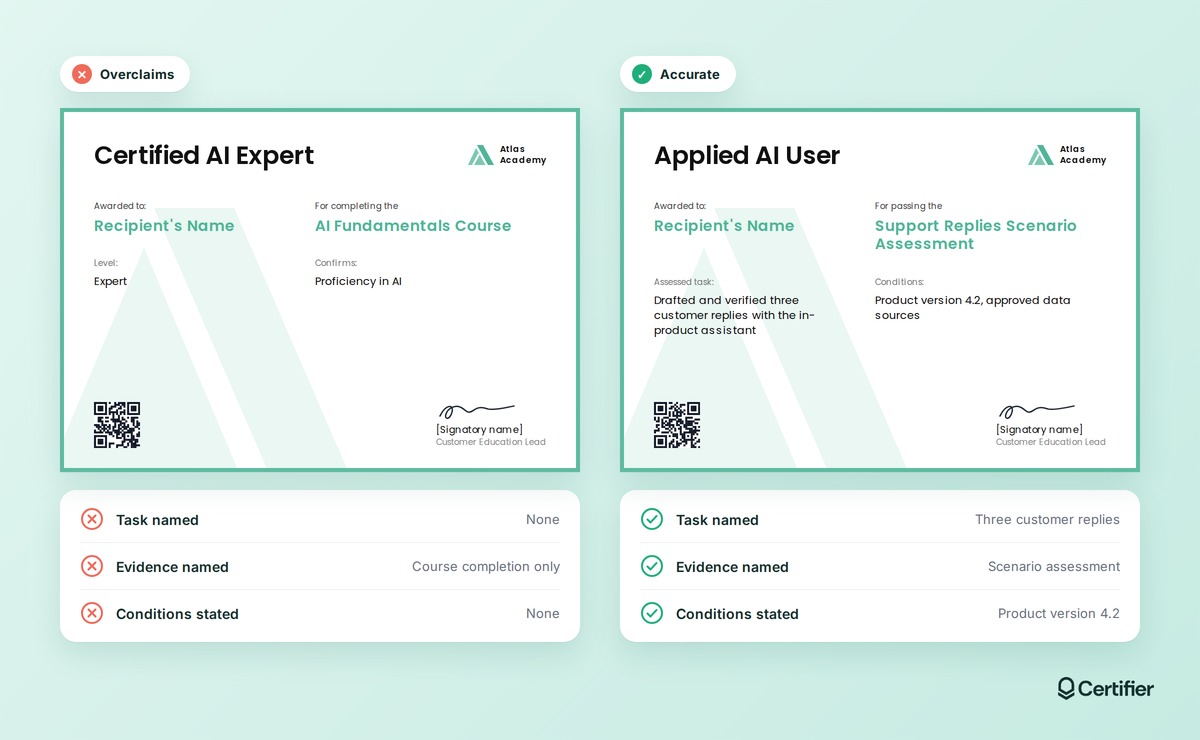
Good criteria name the task, the evidence, and the conditions. Compare:
Overclaims: Certified AI Expert. The holder is proficient in AI.
Accurate: Applied AI User, Support Replies. The holder drafted and verified three customer replies with the in-product assistant in a scenario assessment, using approved data sources. Assessed on product version 4.2. [example version; replace]
Set expiry to match how fast the claim can go stale, such as a major release or a policy review. Don't add an expiry date only to create urgency.
A B2B customer support platform adds an AI assistant that drafts ticket replies. Three customer roles touch the feature, and each gets a different path.
Role | Aiassisted Task | Main Risk | Learning Outcome | Evidence | Credential | Refresh Trigger |
|---|---|---|---|---|---|---|
End user | Draft a customer response with the AI assistant | Sensitive data entered; unsupported statements passed on | Uses approved data, identifies uncertain output, and verifies key facts before sending | Scenario plus practical task | Applied AI User badge | Major product or policy change, or a failed quality review |
Reviewer or team lead | Approve AI-assisted customer outputs | Harmful, biased, or inaccurate output reaches a customer | Applies review criteria, documents judgment, and escalates high-risk cases | Case-based assessment | Responsible AI Reviewer microcredential | Review-policy or risk-control change |
Administrator or champion | Configure AI access, templates, or governance settings | Incorrect access, logging, or default behavior affects many users | Configures the approved workflow and explains controls and exceptions | Practical configuration or capstone | AI Product Administrator credential | Major feature or control change, role change, or periodic revalidation |

Applied AI User badge: the holder passed a scenario and practical task on drafting replies with approved data. It says nothing about reviewing others' work or configuring the product.
Responsible AI Reviewer microcredential: the holder applied the review policy to representative cases and escalated the right ones. It builds on the end-user badge but doesn't cover configuration.
AI Product Administrator credential: the holder configured the approved workflow and explained its controls in a capstone signed off by a named reviewer. It doesn't imply AI governance expertise beyond this product.
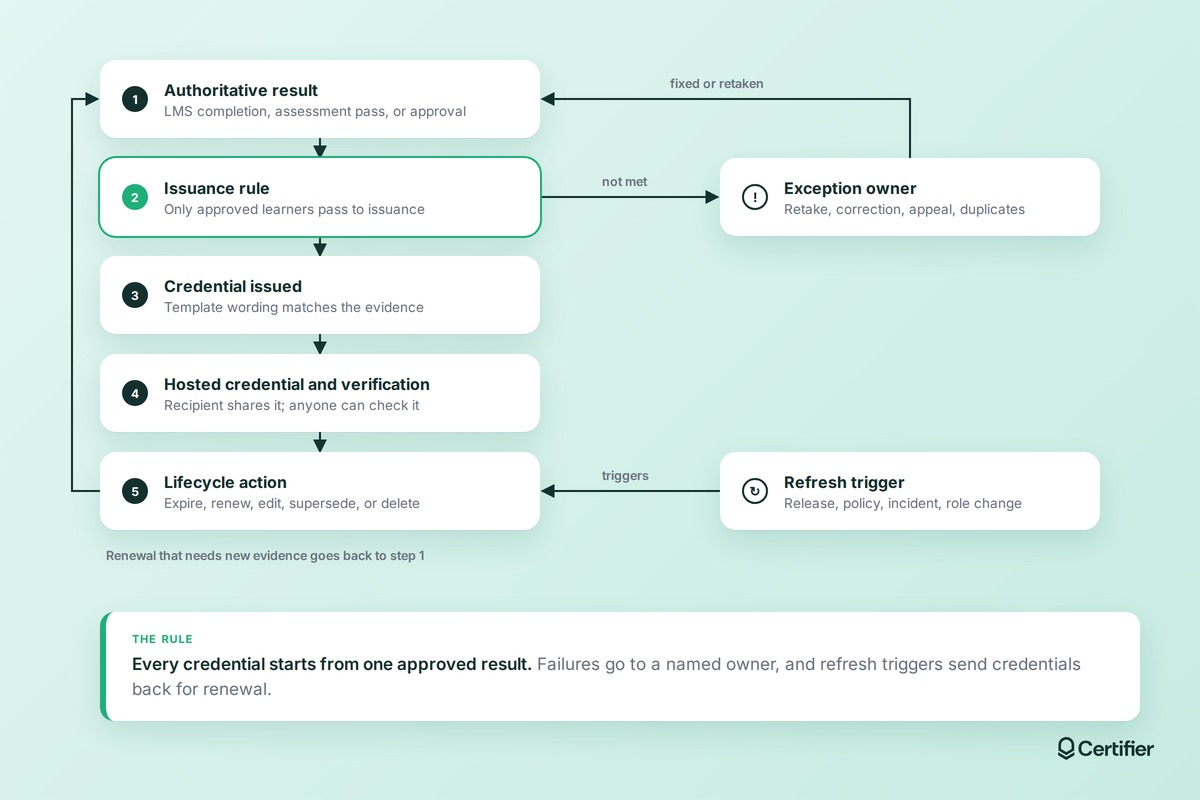
A credible program stays accurate after the course ends. And this depends on whether a credential is issued only from an authoritative learning or assessment result and whether every credential has an owner who can renew, correct, or retire it.
Name one system of record per credential. For an awareness certificate, that might be the LMS completion event. For an assessed badge, it's the assessment pass, not the course completion. For an admin credential, it may be a reviewer's approval recorded in a spreadsheet or form.
If two systems disagree, the one you named wins, and your exception owner resolves the gap.
Once the event is fixed, you can issue AI training certificates from it through an LMS integration, an automation, a spreadsheet upload, or an API call.
Base review timing on events. One universal interval can't track every change that makes a credential inaccurate.
Trigger | Why Review Is Needed | Program Response |
|---|---|---|
Product or model capability changes | Tasks, outputs, or limitations may change | Review outcomes and assessments; retrain only affected roles where possible |
Data-handling or security policy changes | Previously acceptable inputs or workflows may become restricted | Update policy scenarios and retire superseded guidance |
Legal or regulatory guidance changes | Obligations and wording may change by role and jurisdiction | Get legal review; don't turn guidance into a universal training requirement automatically |
New incident or failure pattern | Existing training may not address a demonstrated risk | Add the scenario, revise controls, and decide whether targeted retraining is required |
Learner role or permissions change | The old credential may no longer represent the learner's responsibility | Route the learner to the new role path and update or supersede credentials |
Scheduled validity review | Fast-moving product knowledge can go stale without a public incident | Revalidate the program and evidence before renewing the credential |
Decide who handles each of these before anyone is issued a credential:

Failed assessments and retake rules
A learner placed on the wrong role path
Duplicate identities, such as one person with two email addresses
Corrections to names or details
Appeals against an assessment result
A learner who loses product access before the credential expires
Expiry, renewal, and role changes
For multi-level programs, sequencing belongs in a pathway design. See how to structure role-based learning pathways before you add levels.
A pilot turns a broad program idea into an experiment leadership can inspect. Run one cohort through one role path, then decide what to scale.
Choose one customer segment, one role, and one AI-assisted task.
Define the failure conditions and accountable reviewers.
Write three to five observable outcomes, using authoritative source concepts where relevant.
Select an assessment that can actually prove those outcomes.
Write the credential criteria and title so they don't exceed the evidence.
Map the authoritative completion or assessment source to the issuance workflow.
Define failed assessment, duplicated record, correction, appeal, expiry, and role-change handling.
Run one cohort, review assessment quality and operational friction, then decide what to scale.
Assign an owner to each part before launch:
Area | Typical Owner | Accepts The Pilot When |
|---|---|---|
Curriculum and outcomes | Customer Education or Academy lead | Outcomes are observable and tied to the matrix row |
Assessment | Instructional designer | Items test the outcome and pass criteria are written down |
Product truth | Product manager | Tasks, permissions, and failure modes match the current release |
Data and legal wording | Legal, Privacy, or Security | Credential criteria and data statements are approved |
Issuance and exceptions | Operations or IT | The issuance source is fixed and each exception has an owner |
Learner experience | Customer Success | Learners know which path to take and what they'll receive |
Keep these outcome families separate, as each comes from a different system and proves something different.
Outcome Family | Example Measures | Source And Caution |
|---|---|---|
Reach and participation | Eligible learners, enrollment, start rate | LMS or academy; doesn't show learning |
Learning and evidence | Completion, pass rate, retry rate, item performance, practical-task success | Assessment system; validity depends on assessment quality |
Credential operations | Credentials issued, delivery status, corrections, time from pass to issuance | Credential platform; an operational signal, not competence |
Credential engagement | Email opens, credential opens, PDF downloads, social shares, LinkedIn profile adds, link copies | Credential platform; engagement isn't business impact |
Close the pilot with one of four decisions:
Scale when the assessment worked, issuance ran cleanly, and product owners trust the outcomes.
Revise the assessment when pass rates or item results suggest it doesn't test the outcome.
Narrow the credential wording when the evidence supports less than the title claims.
Stop when the task or risk doesn't justify a credential. Keep the training without one.
Certifier is the credential issuance layer that comes in after your AI training program has defined who earns what, on what evidence. It doesn't write your curriculum, run your assessments, host your courses, or establish legal compliance.
A credential issued with Certifier doesn't prove that training changed behavior.
Create and Send Digital Credentials
Once a learner meets the rule you set, the workflow looks like this:

Authoritative result. A completion or assessment pass is recorded in your LMS, form, or spreadsheet.
Issuance rule. A route you choose passes approved learners to Certifier:
Native LMS integrations. Moodle, LearnDash, Teachable, and Thinkific issue a credential when a learner completes the course. See all integrations.
Data and CRM sources. Native integrations with Google Sheets, Excel, Airtable, HubSpot, and Salesforce, or an Automation that issues a credential when a new row is added.
Automation platforms and code. Zapier, Make, or Pipedream, or the REST API, which can create, issue, and send a credential in one call. Webhooks report when a credential is created, updated, issued, or deleted.
Spreadsheet upload. A CSV or XLSX file for a whole cohort.
Credential design. Certifier builds each credential from a reusable certificate template. Built-in attributes such as recipient name and credential ID fill in automatically, and custom attributes can carry track, cohort, score, or product version.
Pathways. Link the awareness, applied, and admin credentials into one learning pathway. Recipients are enrolled automatically, then a completion credential is issued when they finish all milestones.
Verification page. Each recipient gets a hosted credential page with a public verification page. On Professional and Advanced plans, you can also add a QR code that links to the verification page.
Engagement analytics. Track email opens, credential opens, PDF downloads, social shares, LinkedIn profile adds, and link copies. Treat that as delivery and engagement data. It isn't proof of adoption, competence, or retention.
Expiry and reminders. Set an expiration date on the credential template, in bulk, or per recipient. Certifier emails the recipient two weeks before the credential expires and again on the expiration date.
Corrections. Edit an issued credential and the change applies to its live page without resending. Resends don't count toward your credential limit. Deleting a credential is permanent, so when a credential becomes inaccurate, set it to expire instead.
Ready to run your pilot? Create a free Certifier account and issue your first cohort's AI training credentials.
Still settling program ownership, logistics, or launch steps? Build the wider certification program first.
A useful baseline for AI literacy training is the five DOL content areas:
understanding AI principles
exploring AI uses
directing AI effectively
evaluating AI outputs
using AI responsibly
In a customer program, the learner's role, task, and risk determine how much weight each area gets and how much evidence you collect.
Match the assessment to the claim:
Completion: supports a completion certificate
A knowledge quiz: supports a claim about conceptual knowledge at a stated threshold
A scenario-based assessment: supports a claim about judgment on representative cases
A practical task or observed performance: supports a claim about a defined task under stated conditions
Choose the format that fits the achievement and the evidence. A completion certificate suits awareness training, an assessed badge suits a demonstrated skill, and a microcredential suits a bounded role responsibility with several assessed parts.
Update it when an event changes the claim: a product or model change, a data or security policy change, new legal guidance, an incident, a learner's role change, or a scheduled validity review.
The European Commission's AI literacy Q&A says Article 4 of the AI Act doesn't require a certificate and that organizations can keep an internal training record instead. Article 4 applies to providers and deployers of AI systems, including their staff and other people who operate or use those systems on their behalf.
The Commission notes that this group can include clients, depending on the situation. Whether your customers fall within it depends on your role and how they use the system, so check your situation with legal counsel. This article isn't legal advice.
An AI literacy credential can prove competence only as far as the assessment, criteria, identity checks, conditions, and evidence support the stated claim.

- copywriting
- B2B content marketing
- content strategy
- on-page SEO
- storytelling
Growth Marketer (Freelance)
Anita Coltuneac is a freelance B2B SaaS marketer with 5+ years helping tech companies grow organic visibility, build authority, and support pipeline. She uses storytelling to turn product expertise into useful content.


