

Trusted by:
University of Southern California
Warner Bros.
Volvo
Amazon
Stanford University
Updated: September 11, 2026
18 min read
You want the best? We’ve got the crème de la crème. This guide lists the best tools to create certificates—how they work, what they cost and where they shine (or fall short). We get to the point, with clear expert takes to guide your decision.
Research with AI:
If you’ve been searching for the best tools to create certificates, you’ve probably realized one thing—there’s no shortage of options, but not all of them deliver what you need. Some tools shine at design, others nail automation or bulk delivery and a few try to cover it all.
That’s why we’ve put together this expert-reviewed roundup of the crème de la crème.
Inside, you’ll find honest insights into each tool’s strengths, limitations, pricing and expert take.
We’ve included everything from full-featured certificate management platforms to simple editors, AI-powered tools and everything in between. This toolbox will help you find a tool that fits and scales.
Let’s start right off the bat.
We’ve rounded up the best tools to create certificates, from all-in-one platforms to simple editors. Each tool includes pros, cons, pricing and our expert verdict.
We also benchmarked three different workflows: a design tool with manual delivery, a spreadsheet mail merge, and a full-blown credential platform. The test job was creating and delivering 100 personalized certificates, with a 5% correction rate.
Based on the comparison and benchmark results, Certifier stands out as the top pick for flexible and scalable certificate creation workflows.

Certifier is one of the best tools to create certificates at scale—designed for course creators, HR teams, training providers and educators.
It’s a comprehensive certificate management platform that supports both certificate and digital badge creation with deep customization and automation options.
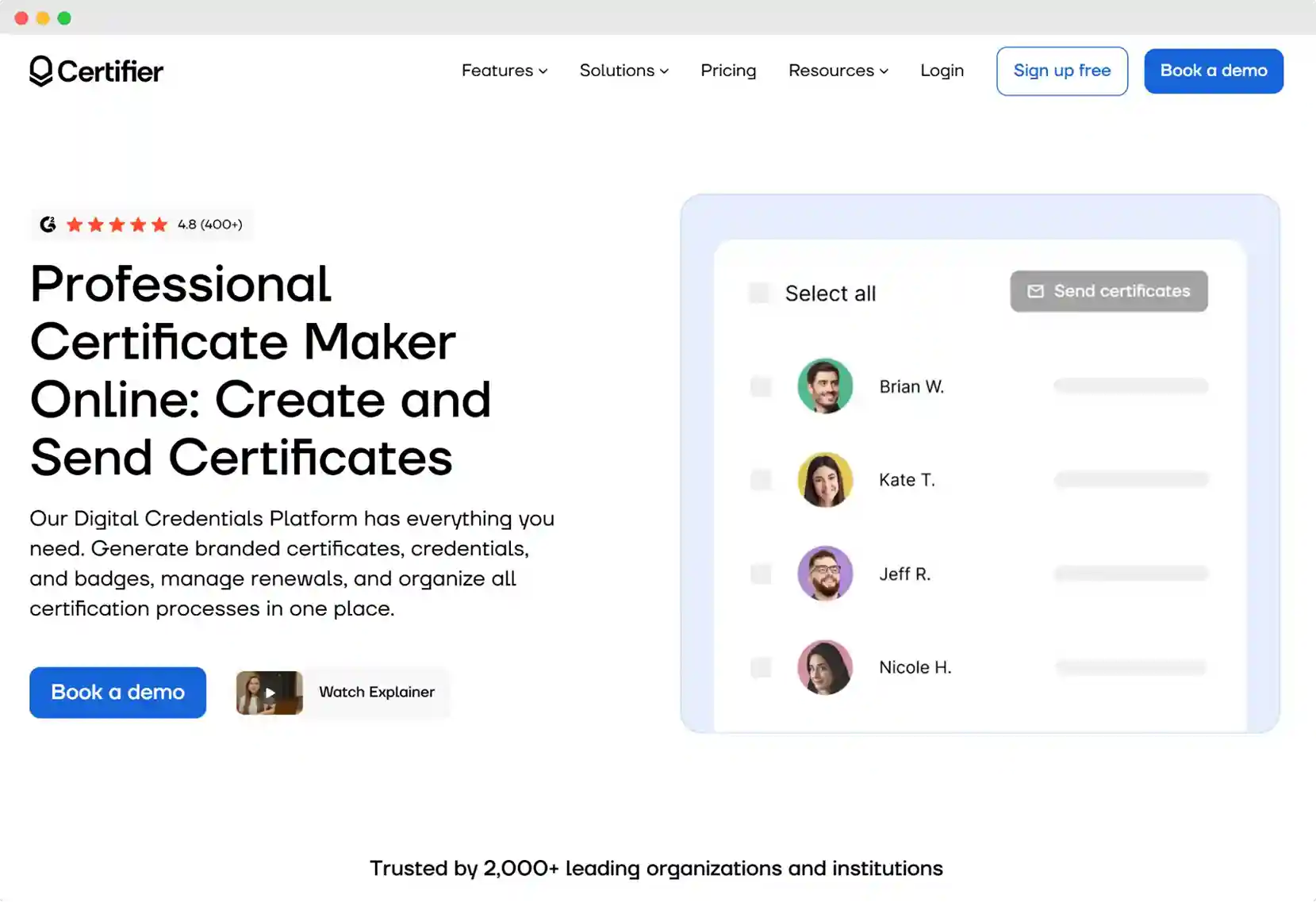

Customizable certificate templates: A gallery of 2,000+ templates that are free, editable, white-label and professionally designed.
Drag & drop certificate editor: Easily update any design element. Upload your own logos, custom fonts or graphics.
Digital certificate wallet: Recipients can store and access certificates in a secure wallet, all in one place.
Automated reminders: Set automatic notifications for renewals or expirations and track them.
Branded Issuer’s Portal: Manage, track and download reports from a dedicated dashboard. Includes a certified members directory and a credentials directory.
Pathways for the learning process: Guide learners through structured steps. Pathways show progress and unlock new credentials.
Real-time credential updates: Fix a typo after issuing and the live credential page updates automatically. No resend, no second email, no confused recipient.
Built-in QR code certificate verification: Add a scannable QR code so anyone can instantly verify the certificate’s authenticity.
Free AI Certificate Generator: Instantly create a professional certificate from a simple text prompt and download it as a PDF.
Certifier MCP: Connect Certifier to AI assistants that support the Model Context Protocol, so issuing can be triggered from the tools your team already works in.
What makes Certifier stand out is the balance between AI speed and full-scale certificate management. The free AI Certificate Generator is handy when you need a single, well-designed certificate. It's a perfect tool for testing copy or sharing a quick award.
The AI certificate generator is great for one-off certificates, but if you need bulk sending, tracking, and management, you’ll want to switch to the full Certifier platform. Save the AI design to your account, add dynamic placeholders like names or dates and bulk-send to hundreds of recipients with just a few clicks.

The free plan allows you to customize and issue 250 certificates. Compared to other tools to create certificates, that’s quite a lot, but for more, you need to upgrade to a higher plan.
Some branding controls, including branded recipient view, custom domain, verified issuer status, are add-ons on lower tiers rather than included features.
Free forever on the Starter plan, with a 250 certificate/badge annual limit and no credit card required. Paid plans scale by annual issuing volume: Starter from $49/month billed annually at 1,000 credentials, Professional from $76/month billed annually ($89 monthly) and Advanced from $339/month billed annually ($399 monthly). Enterprise is quoted.
Add-ons include branded recipient view ($49/mo), custom domain ($99/mo) and verified issuer status ($19/mo). Nonprofits get a 15% lifetime discount. See Certifier pricing to compare tiers.
10/10
It’s the best program to create a certificate if you’re looking for automation, verified credentials and a professional setup. Great for scale and control.
Tip: Before you commit, see how Certifier stacks up against other popular tools in the market. Check out our detailed Certifier vs. CertifyMe comparison to see which workflow fits your team best.
ChatGPT is an AI content assistant that helps with writing and brainstorming. It’s a powerful tool to generate certificate text, create course descriptions or even plan layouts when used alongside design platforms. However, it’s not a dedicated certificate tool.
Fast content generation
Smart rewriting and proofreading
Prompt-based customization
Easy tone/style adjustments
Brainstorming partner for certificate wording
No certificate-specific features
Needs manual copy-paste into design tools
It generates visuals, but it’s very imprecise, tending to detail hallucination
No recipient list, no delivery, no verification
Free tier available. Paid consumer plans run Go at $8/month, Plus at $20/month and Pro at $100 or $200/month, with Business at $25/seat/month. Plus is the entry point for the current flagship ChatGPT model.
5/10
It’s one of the best tools to create certificate text, not full certificates. Pair it with the best tools to create certificates to streamline your workflow.
Sertifier is a digital credentialing platform made for educators and training programs. It lets users send digital certificates and badges in bulk.
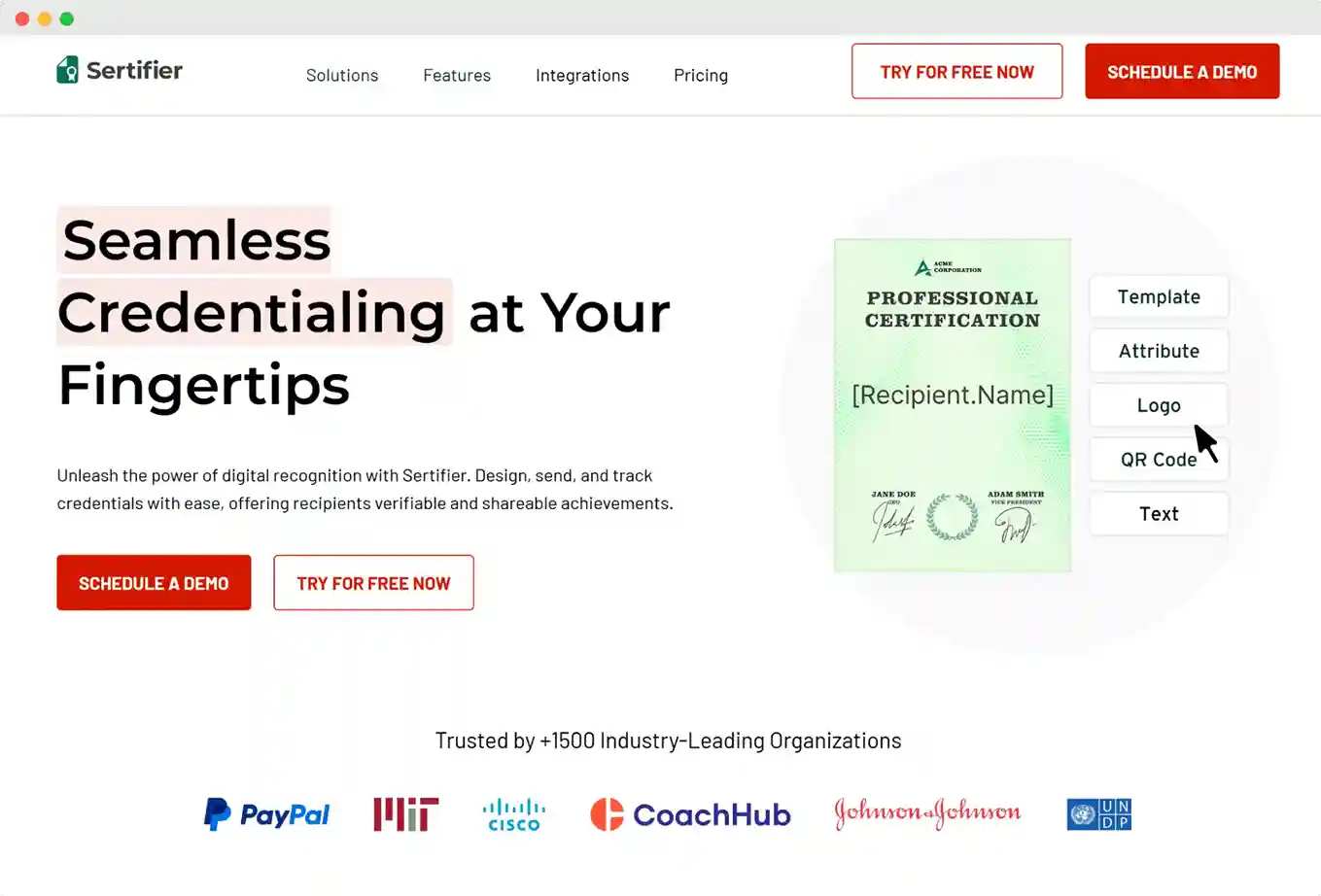
Editable certificate and badge templates
Recipient tracking and email delivery
Integration with LMS and automation tools
Analytics dashboard
White-labeling options, but you need to pay extra
Fewer design options compared with other Sertifier alternatives
Limited font and layout flexibility
Less intuitive UI for beginners
No mid-tier between free and $75/month, which is a jump for small programs
A free, limited plan is included. Basic starts at $75/month for up to 1,000 recipients and Pro at $167/month for up to 5,000. Enterprise is quoted. Nonprofits get 20% off for life while startups get 25% off the first year. An advanced support add-on runs $100/month.
7.5/10
A solid choice for formal training and bulk issuing, but not the best program to make a certificate if visual design and creative control matter to you.
Canva is a graphic design platform known for drag-and-drop simplicity. It’s a go-to choice for beginners creating single-use certificates or small-batch designs. However, remember that it doesn’t come with certificate management features.
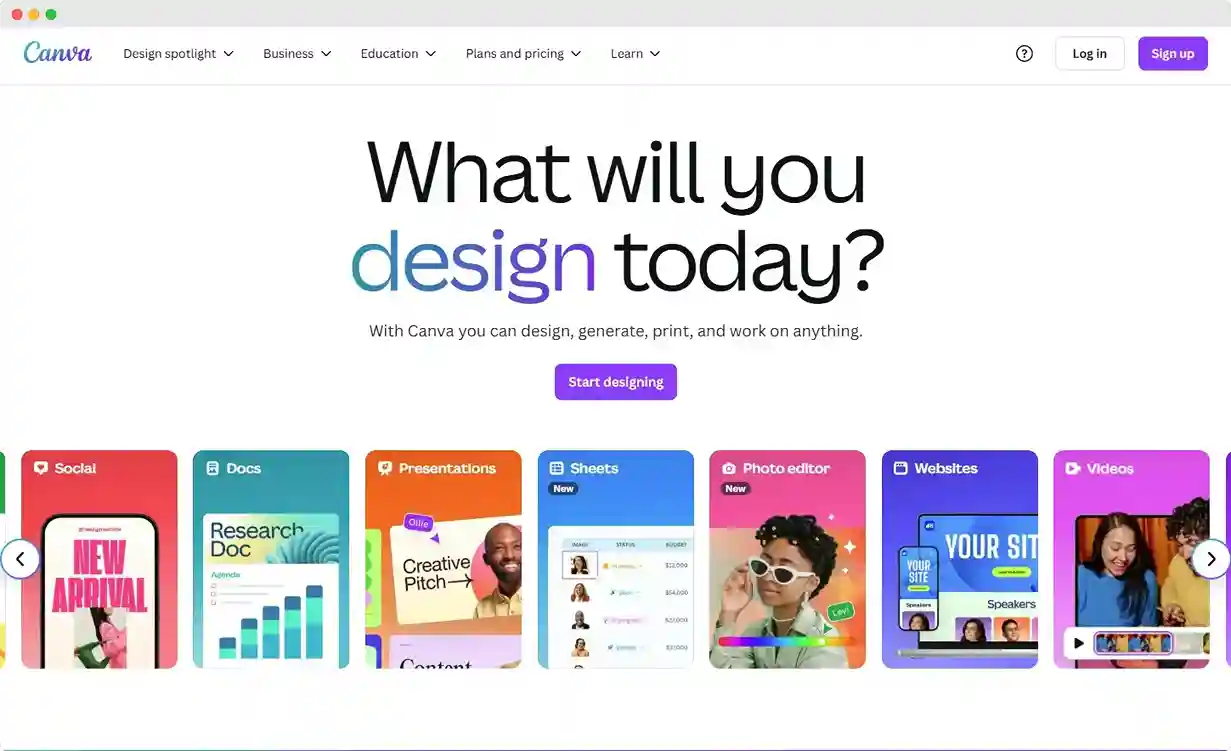
Thousands of certificate templates
Easy-to-use design editor
Real-time collaboration
Logo and brand kit upload
Bulk Create for merging a CSV into a multi-page design (Pro and above)
Export options (PDF, JPG, etc.)
No certificate analytics, tracking or issuing
Manual delivery only
No built-in credential verification, revocation or expiry
No way to correct an issued certificate after it has left your outbox
Not sure if you can handle manual certificate creation? Check out how to create a certificate in Canva.
Free plan available. Canva Pro starts at $15/month. Canva Business is priced per user.
8/10
One of the best tools to create certificates in a small batch. Perfect for minor projects, but not ideal for issuing or managing certificates at scale.
Edraw AI is an online diagramming tool that also markets itself as a certificate maker. It lets users create certificate layouts through an intuitive interface and offers smart formatting for text and visuals.
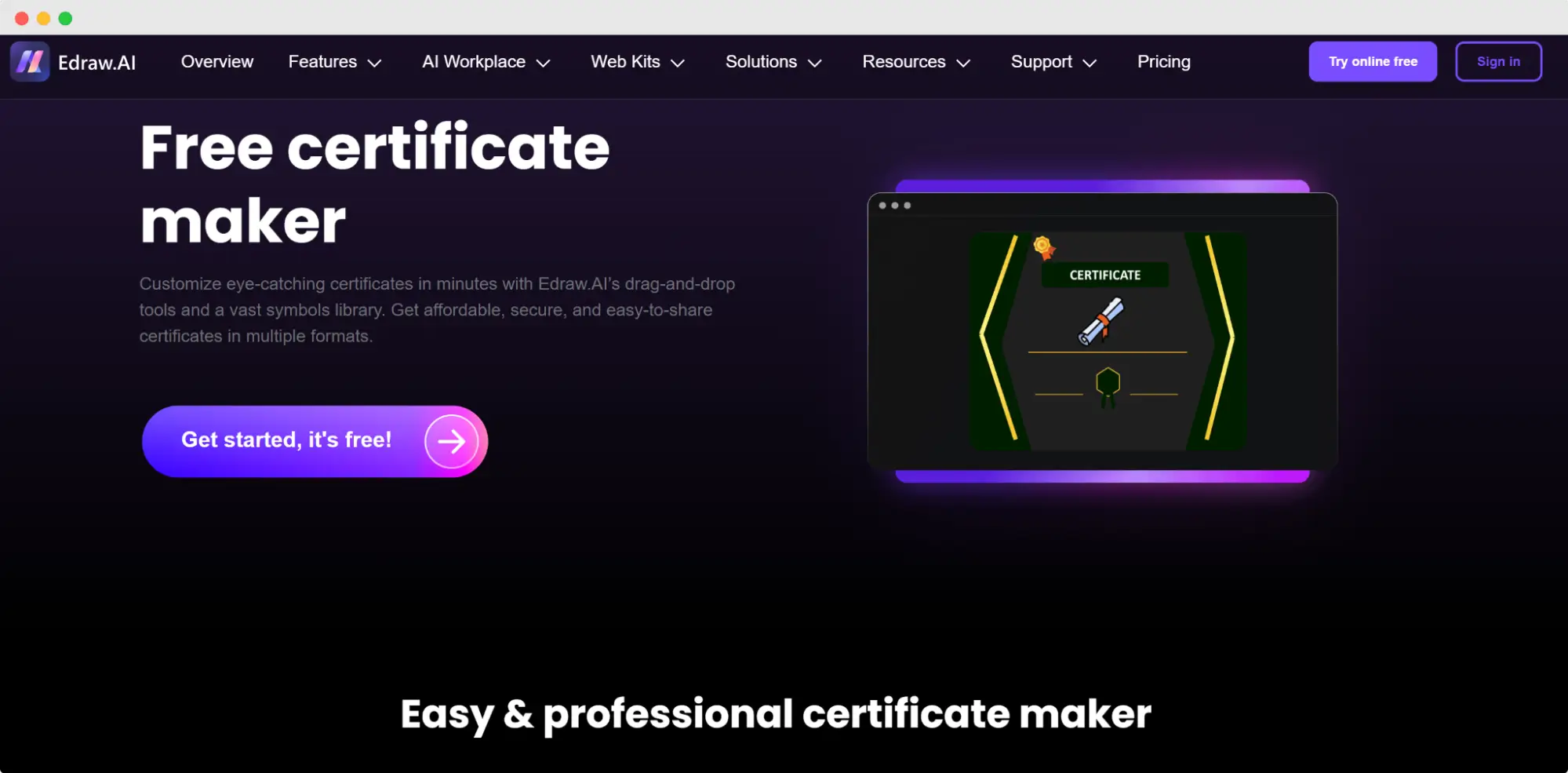
Drag-and-drop interface
AI-assisted layout suggestions
Export in multiple formats
Real-time co-editing
No bulk issuing
Lacks automation tools
No certificate templates
Hardly any certificate-related graphic elements
Free tier with a limited monthly token allowance. Paid plans start at $11.9/month with 10,000 AI tokens while annual bundles reach $99 for an unlimited AI token pool.
7/10
Edraw.AI works well for diagram design, but it's not built as a certificate maker. You can technically create certificates using its editor, but you'll need to design them from scratch. Unlike other platforms, which offer ready-to-edit certificate templates, Edraw.AI doesn’t support certificate creation out of the box.
It’s a decent choice for a one-off certificate, but for issuing to larger groups, it’s better to look at other tools.
Venngage AI is a visual design platform that uses AI to turn plain content into branded certificates, infographics and more—suitable when you want an aesthetically pleasing certificate design with minimal effort.
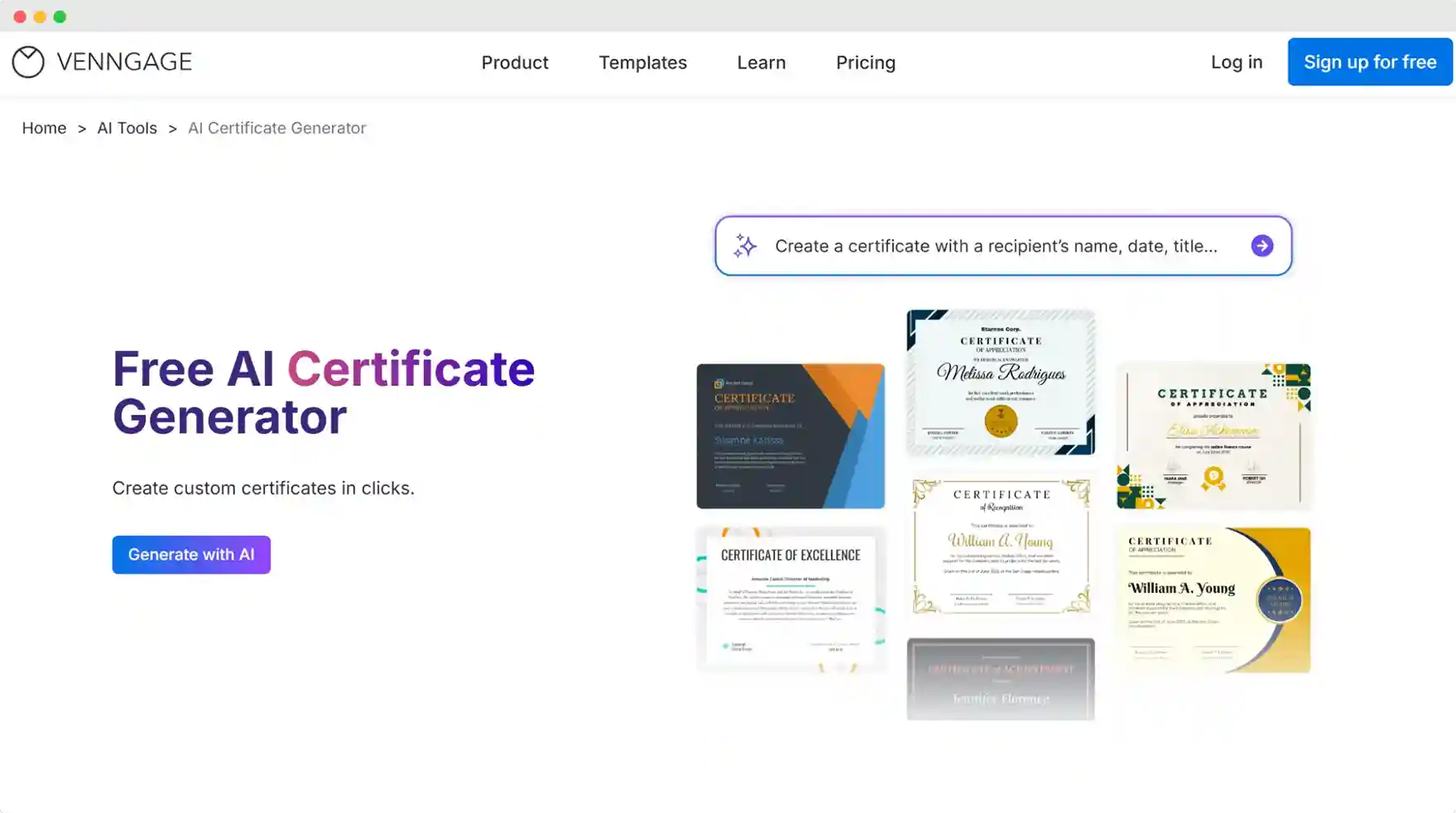
AI‑powered design suggestions
Vast template library
Brand Kit support (logo, colors, fonts)
Export to PNG, PDF, PPT
Collaboration features
Not focused on certificate issuance or tracking
Exports are manual, with no delivery automation
The free tier restricts high-resolution downloads and export formats
The certificate maker from Venngage is completely free to use. Premium starts at $19/user/month and Business at $49/user/month, with Enterprise from $499/month.
8/10
A strong option for visually-led certificate design. Not ideal for automated delivery and issuance, but still one of the best tools to create certificates when design is the priority.
CertifyMe is a credentialing platform for secure creation and issuance of digital certificates and badges, with recipient tracking, customizable branding and LMS integration.
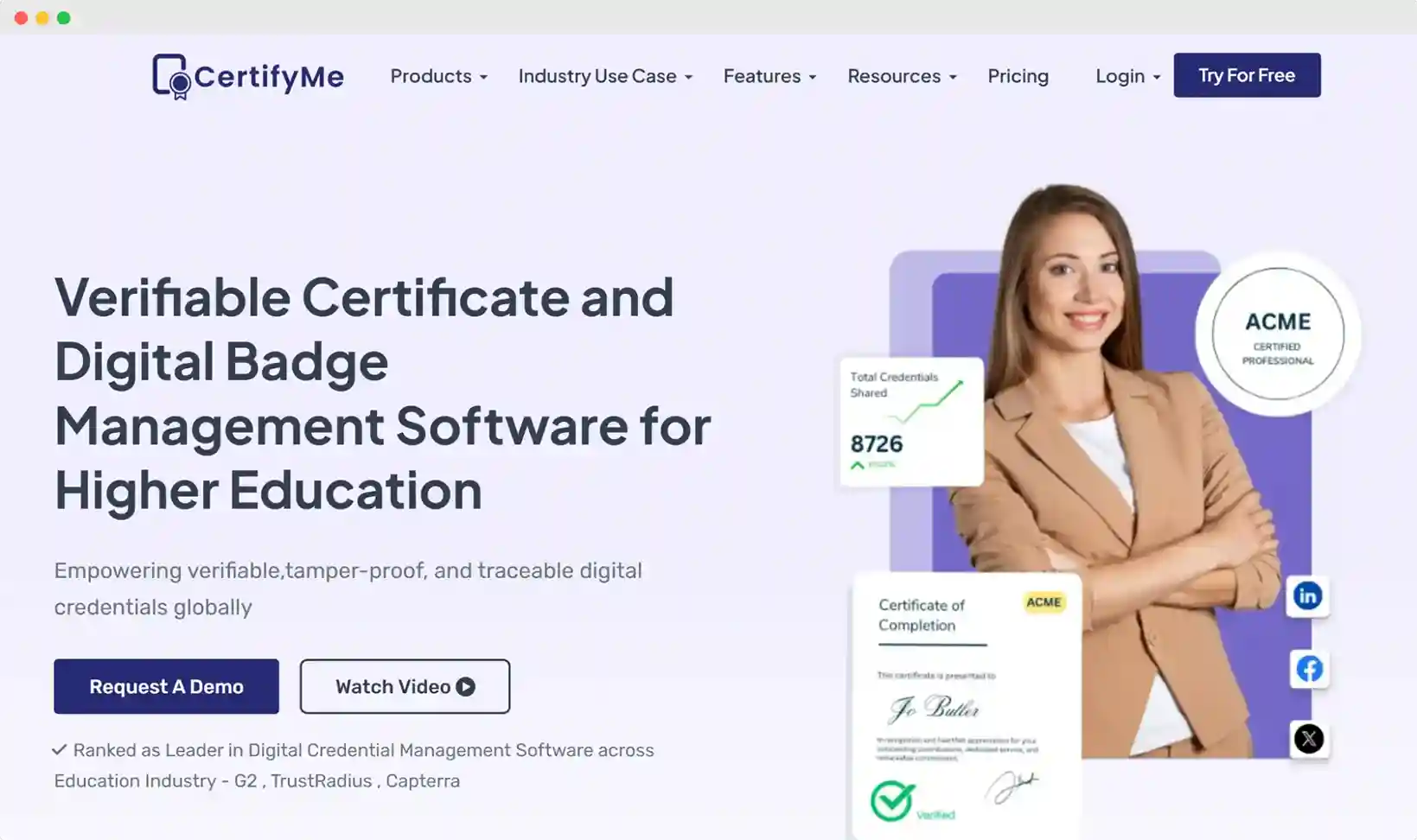
Bulk issuance and CSV uploading
White-label options
Real-time analytics
Social media sharing features
LMS and API integrations
Some advanced features (like advanced API) require the Enterprise plan
Setup may be complex for one-off users
Pricing is not fully transparent upfront
The trial gives you 10 credentials, enough to click around but not enough to test a real batch
No public pricing. Three plans—Startup, Signature and Enterprise—all quoted on request and priced by recipient count, normally on an annual subscription. Sign-up gets you 10 free credentials to test with.
8/10
One of the best programs to create a certificate with solid credentialing features. Worthwhile for institutions issuing at scale.
The quote-only pricing makes it hard to compare against anything else without booking a call, and a 10-credential trial isn't enough to properly stress-test a workflow. That costs it half a point since our last review.
Accredible is a full-featured credentialing platform for issuing beautiful certificates and badges at scale. Many universities, corporations and training providers rate it the best program to create a certificate.
Is it true for you?
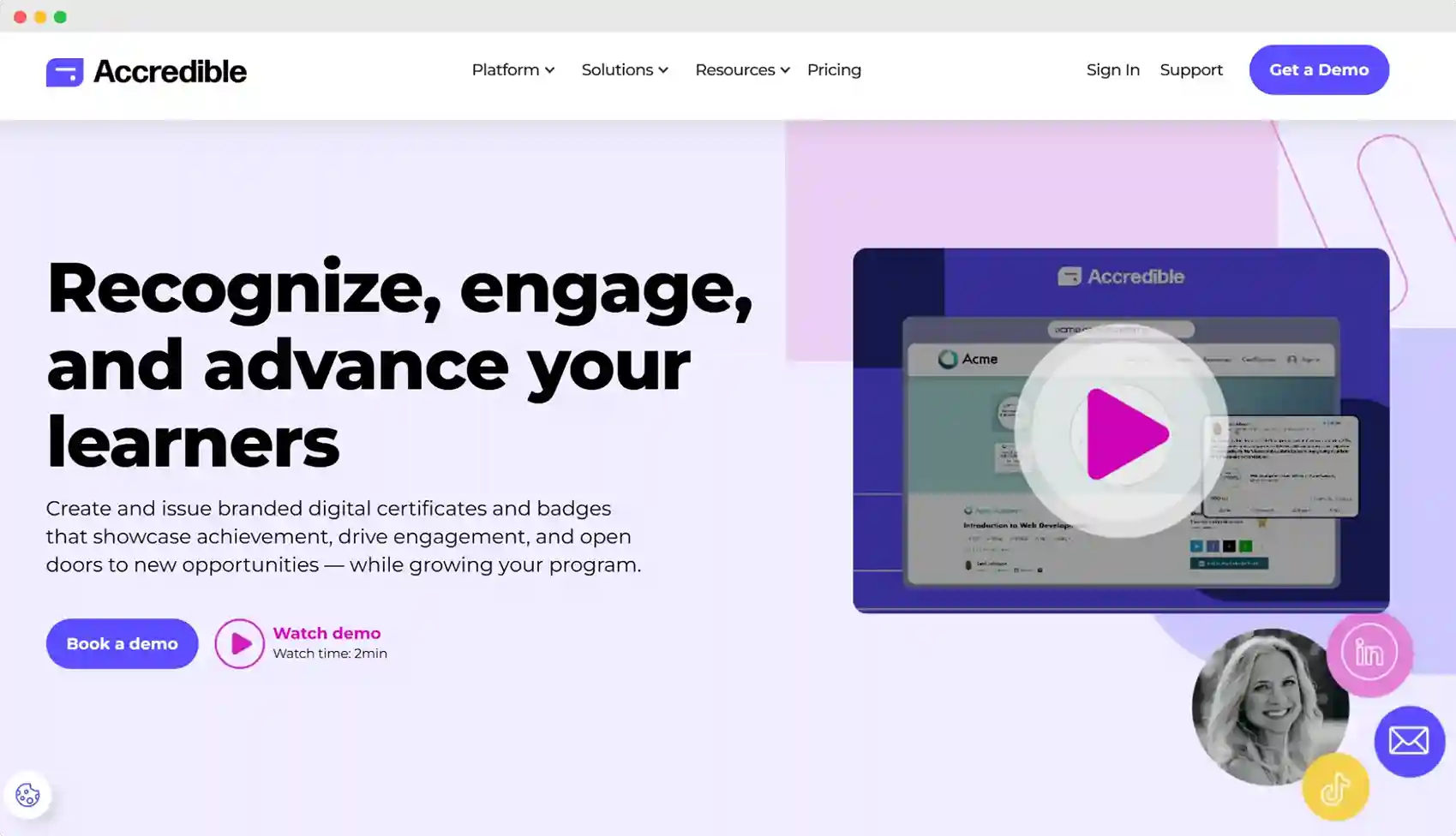
Visual certificate and badge builder
Real-time verification and credential revocation
Analytics and recipient dashboards
White‑labeling and branding
API and automation features
Unlimited credentials per recipient, per year
Priced by unique recipients, which punishes programs with many people and few credentials each
Most features require annual contracts
Learning curve for full functionality
Higher tiers are quote-only
Primarily designed for medium-to-large teams
Free trial available. The Launch plan starts at $45/month on a 12-month term (about $540/year) and covers 50 unique recipients per year. Connect and Growth tiers are custom-quoted.
Note the pricing model: you pay per recipient, not per credential, and you can issue unlimited credentials to each one. That's excellent value for recertification-heavy programs and poor value for one-and-done events.
8.5/10
One of the best tools to create certificates and badges at scale with full branding and verification. However, the 50-recipient cap on the starting tier is tight.
Tip: Are you hesitating between Accredible vs Credly? Or maybe there are also some other tools in the game? Use free trials to check how templates work, how easy it is to issue PDF certificates, and whether the platform fits your real workflow before committing to a paid plan.
Certificate Magic is a free certificate maker focused on simplicity. Users can select from various preset designs (formal, sports, kids, fun) and instantly download print-ready certificates.
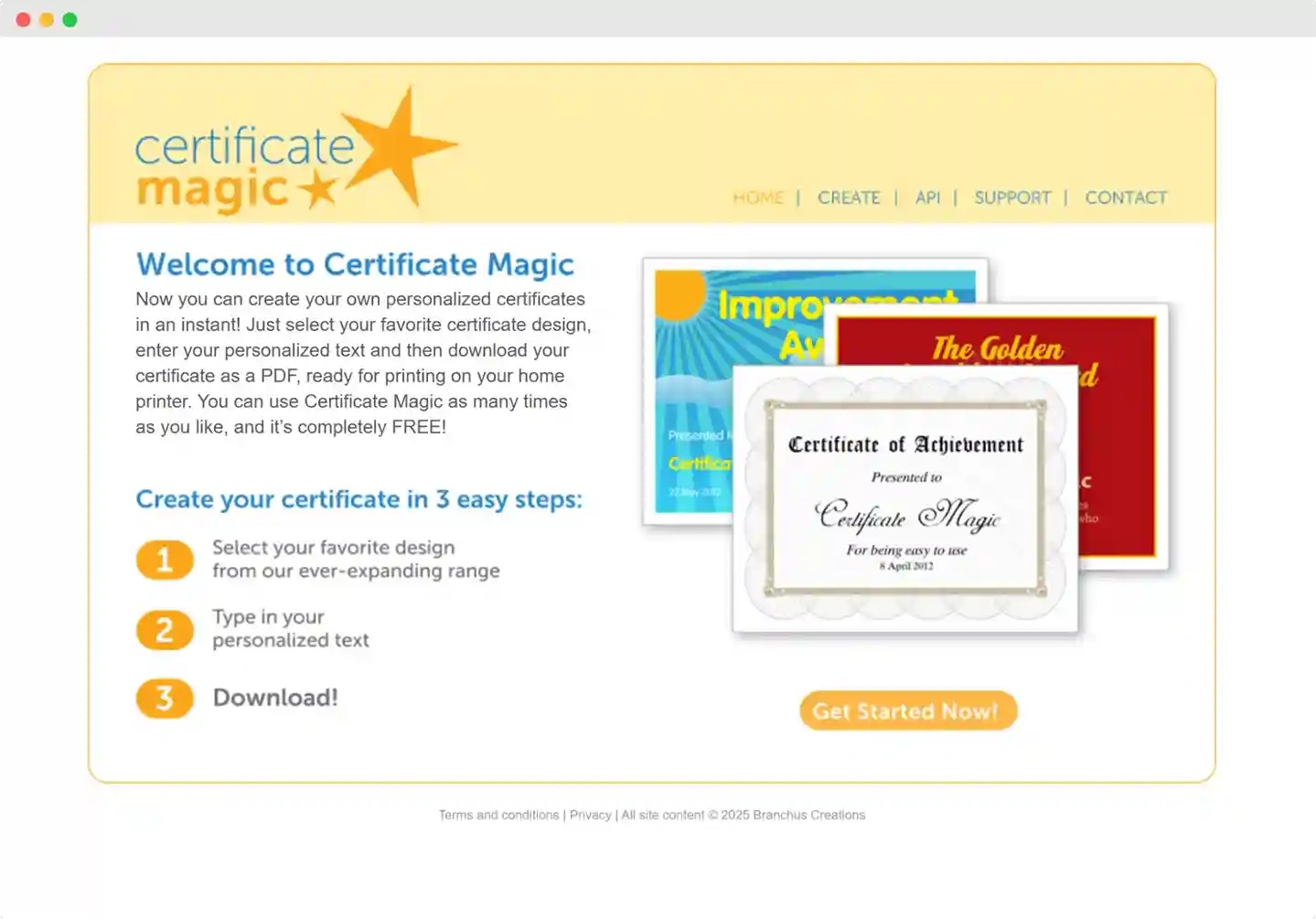
100% free for unlimited certificates
No registration required
Fast personalization and download
Simple, ad-free user interface
Limited design customization compared with pro tools
No digital issuing or verification
No batch generation and no automation
No analytics, integrations or credential tracking
No upgrade options if your needs grow
It’s one of the tools to create certificates that’s completely free for all users.
7/10
If you want a fast, ultra-simple certificate to print or send as a PDF, CertificateMagic can’t be beat for value. However, it lacks digital delivery, automation, verification and the customization found in real credentialing platforms. As a free tool with no commercial model behind it, it's not something to build a recurring program on.
SimpleCert is a streamlined certificate management system that lets you design custom templates, upload recipient lists and send certificates via email. It includes analytics and integrates with tools like Google Forms.
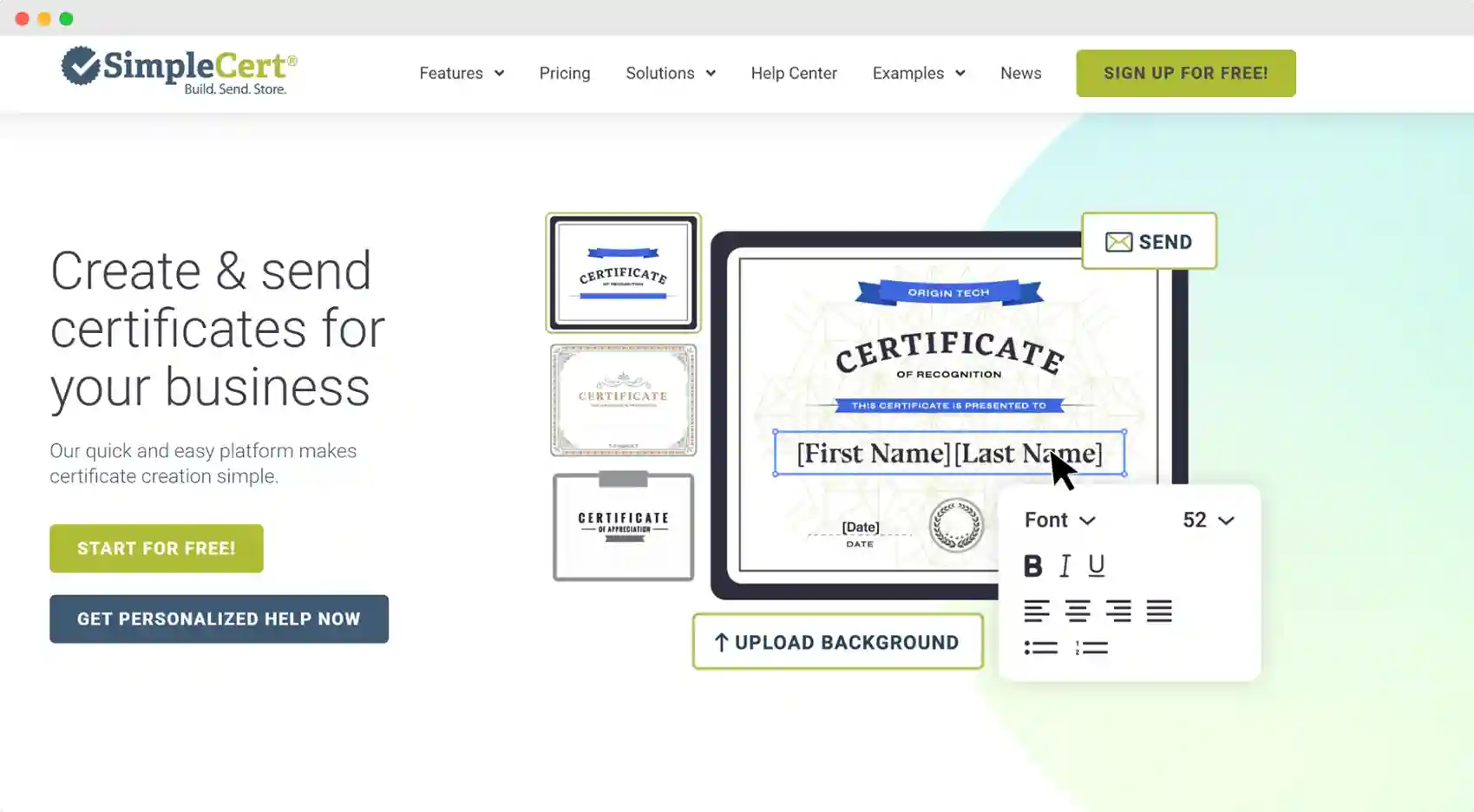
Full online management system
Custom certificate and email templates
Bulk sending and CSV uploads
Delivery tracking and recipient portal
API integration (e.g. Google Forms)
QR codes and LinkedIn integration on paid plans
Editor can be clunky and occasionally freeze
Only one free template included; extras cost $29 each
Compared with SimpleCert alternatives, email customization is limited—some fields are locked
No digital wallet for recipients to store their certificates
Lacks post-send engagement tracking (like open or click rates)
No built-in integrations—only available through Zapier
Free plan includes up to 50 certificate credits per year. A $19/month subscription adds 150 credits per month plus QR codes, custom fonts, the recipient portal and LinkedIn integration. Pay-as-you-go credit packs run $29 for 150, $39 for 250, $69 for 500 and $119 for 1,000, with no expiry. Extra templates are $29 each.
7.5/10
Simplecert is a good tool to create certificates for occasional needs, but template costs and a slightly outdated editor may slow you down. Great for small programs, not ideal for growing teams or complex workflows.
Credly is a popular choice for large organizations that need to issue digital badges and certificates. It’s trusted by a vast network of training providers and certifying bodies.
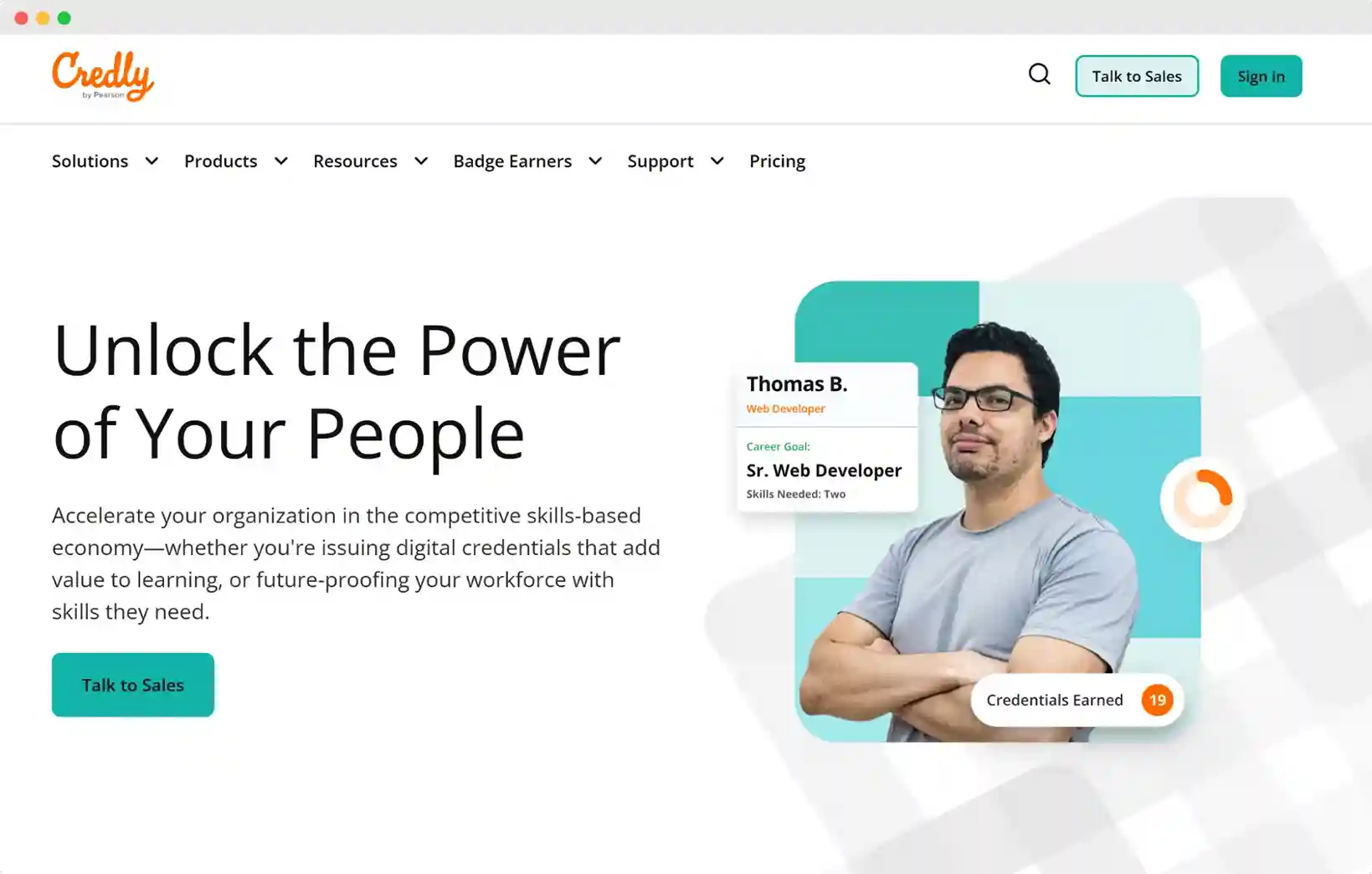
Intuitive badge and credential builder
Secure credential verification
Real-time analytics and performance tracking
LinkedIn sharing functionality
Integrations with major LMS platforms (Moodle, Teachable, SumTotal)
Issuer dashboards for full credential program control
High pricing that may not work for smaller teams
Bulk issuing and reporting can be complex to manage
Setup requires time and guidance
No flexible plans for low-volume use
No free tier or self-serve trial
There’s no free trial or plan. Credly doesn’t publish pricing on its website. Third-party benchmarks put entry pricing at roughly $3,000/year, rising with credential volume at about $8,500 for 2,500 credentials (onboarding fee included). Check our full Credly pricing breakdown.
8/10
Trusted by top-tier brands and institutions, Credly offers deep integrations and strong analytics. But for smaller teams or low-volume programs, it may feel too complex—and too expensive.
Even though the name highlights badges, Virtualbadge.io also helps you issue digital certificates. It’s a user-friendly platform built for small and medium-sized teams.
Are you looking for a quick setup and a clean recipient experience? It's a strong contender.

Built-in certificate and badge editor
Batch generation via CSV upload
Automated email delivery
QR code verification
Analytics and engagement tracking
Social media sharing
Simple API and Zapier integration
Editor has limited built-in design elements, so you may need to prep custom visuals ahead of time
Custom sending domain and validation page only on the Enterprise plan (pricing not transparent)
Basic white-labeling only removes their footer—deeper branding features cost extra
Analytics are fairly basic—no expiration controls or real-time tracking
Customer support may respond slowly, sometimes taking up to a day even via live chat
There’s a free trial to test this tool out. Lite plan starts at $35/month for 25 certificates per month and Growth at $75/month for 50 credentials per month. Annual Growth pricing runs from roughly $420/year for 300 credentials up to about $3,948/year for 15,000. Enterprise is quoted.
Keep in mind the monthly cap. If you run four events a year and issue 100 certificates each time, a monthly allowance of 25 doesn't fit your shape of demand. If that happens, look at the annual tiers instead.
7.5/10
Virtualbadge.io is a solid choice for teams that want simple and shareable credentials. The automation and social features are helpful, but design limitations, monthly caps and higher costs may be deal-breakers for users who need scale, speed or advanced customization.
Most people don't choose between Canva and Certifier, they choose between three fundamentally different ways of working and the tool follows from that.
So we modeled the same job through each one: 100 certificates, personalized with a name and completion date, delivered by email, with a 5% correction rate (five certificates need a fix after issuing—a misspelled name, a wrong date, a bounced address). The correction rate we chose is deliberately conservative.
The three workflows are as follows:

Design tool + manual delivery — Canva Pro for the design and your own email for sending the certificates
Spreadsheet mail merge — Google Sheets for the data, Google Docs for the template, and a free add-on like Autocrat to merge and send the certificates via email
Complete credential platform — Certifier, which does all of it in one place
Stage | Design Tool Manual Delivery | Spreadsheet Mail Merge | Credential Platform |
|---|---|---|---|
1. Initial setup | 25 min — pick and brand a template | 70 min — build a merge template, install and configure the add-on, debug the first run | 30 min — brand a template, define attributes, and set up the email |
2. Personalization | 20 min — connect a CSV to Bulk Create | 15 min — prepare and clean sheet columns | 10 min — upload CSV, map dynamic attributes |
3. Generation | 55 min — export, then split one 100-page PDF into 100 named files | 10 min — run the merge, including one re-run | 2 min — bulk generate |
4. Delivery | 75 min — attach and send 100 emails by hand | 5 min — automated, monitored | 3 min — mass send |
5. Verification | 20 min — and you still don't get verifiable credentials | 15 min — same problem | 0 min — built in and on by default |
6. Correction / reissue | 30 min — 5 fixes × redesign, re-export, re-email | 15 min — 5 fixes × edit row, re-run, clean up old files | 5 min — 5 fixes, live credential updates without resending |
Total time | 3 h 45 min | 2 h 10 min | 50 min |
Manual touchpoints | 205 | 15 | 5 |

We got to these estimates by breaking each workflow into its discrete actions and assigning a realistic duration to each (e.g., save and rename one exported PDF: 30 seconds, write and send one email with an attachment: 45 seconds) then multiplying it out.
We define a touchpoint as a human action tied to one specific recipient such as saving their file, sending their email, fixing their name. It's the number that best predicts where mistakes come from because every touchpoint is a chance to attach the wrong PDF to the wrong person.
Setup cost is not the whole story and it can mislead you. The spreadsheet with mail merge has the highest setup cost of the three, reaching 70 minutes of fiddling with merge tags and add-on configuration. Judged on setup alone it looks like the worst option, but it isn't. Setup is paid once, while delivery is paid every single time. That's why the second run matters more than the first. The design-tool route barely improves on repeat because almost none of its cost was setup. It was all per-recipient labor and per-recipient labor comes back every time.
Column1 | Design Tool | Mail Merge | Platform |
|---|---|---|---|
First run (100 certs) | 3 h 45 min | 2 h 10 min | 50 min |
Every run after that | 3 h 20 min | 1 h 5 min | 22 min |
Verification is where the first two workflows stop working. Neither a design tool nor a spreadsheet with mail merge can produce a credential that a third party can independently check.You can email a PDF. However, you cannot prove that PDF is real, revoke it if the certification lapses, or expire it on schedule. For an association issuing CPD credits or an employer verifying a safety qualification, that’s the wrong workflow, regardless of speed.
205 touchpoints is a quality problem before it's a time problem. Three and a half hours is extremely time-consuming. That’s also about 205 chances to attach Sarah's certificate to Simon's email.
Finally, the correction row is the one nobody plans for. In a design-tool workflow, fixing a certificate means redesigning it, re-exporting it, and sending an awkward second email. On a platform where credentials live at a live URL, you edit the record and the credential updates in seconds.
Volume changes the answer completely. Here's where each workflow makes sense, using the repeat-run rates above.
Certificates | Design Tool Manual Delivery | Spreadsheet Mail Merge | Credential Platform | Our Call |
|---|---|---|---|---|
1 | ~15 min | ~70 min (all setup) | ~12 min, or 3 min with an AI generator | Design tool or AI generator. Automating one certificate costs more than doing it. |
10 | ~35 min | ~75 min first run, ~38 min after | ~20 min | Design tool. Unless you need verification, then choose the platform. Too small for the merge setup to pay back. |
100 | ~3 h 20 min | ~1 h 5 min | ~22 min | Platform. This is the crossover. Manual delivery stops being a reasonable use of anyone's afternoon. |
500 | ~13 h 40 min | ~3 h 5 min | ~50 min | Platform. The design-tool route is now most of two working days per batch. |
1,000 | ~26 h 35 min | ~5 h 35 min | ~1 h 25 min | Platform and it isn't close. Manual delivery is over three working days of clicking. |
First, the 1 and 10 rows are hand-adjusted, not model output. Nobody builds a verification log or cleans a spreadsheet for a single certificate, so the fixed costs in our model don't apply at that end. From 100 upward the linear model holds well.
Second, the "Our call" column weighs time and capability, not license cost alone. On pure cash, a mail merge often wins as it's free software. We're recommending the platform from 100 upward because that's the volume at which certificates usually start carrying consequences, and a mail merge cannot verify, revoke or expire anything. If your certificates genuinely are just nice PDFs, then the spreadsheet mail merge column is the honest answer.
Around 30–50 certificates per batch, manual delivery stops making sense. Below that, the setup cost of anything automated outweighs the saving. Above it, you're paying per-recipient labor that you never get back.
Around 100 certificates, the spreadsheet mail merge stops being the smart shortcut. It's genuinely good at generation and delivery and the 65-minute repeat run is respectable. What it can't do is verify, revoke, expire or update a credential after it's sent. At small volumes that's not a significant issue. Yet, at 100+ recipients with a compliance obligation attached, it's the reason that workflow gets replaced.
Sending caps: Sending by hand from the Gmail interface, a free account reaches 500 recipients a day and Google Workspace 2,000. An add-on like Autocrat sends through Google Apps Script, which carries a far tighter quota of 100 recipients a day on a consumer account and 1,500 on Workspace. So a 100-certificate merge on a personal Gmail account spends the entire daily allowance in a single run, and 1,000 certificates takes ten days. On Workspace, the same job fits comfortably.
The six-minute execution ceiling: Apps Script halts any single run at six minutes, on consumer and Workspace accounts alike. Large batches have to be chunked and a timeout mid-run leaves you reconciling which rows actually went out. Consumer accounts are further capped at 90 minutes of total trigger runtime a day while Workspace gets six hours.
No revocation path: Once a PDF is in someone's inbox, it's theirs forever. If a certification lapses or is withdrawn, a design-tool or mail-merge workflow gives you no way to reflect that.
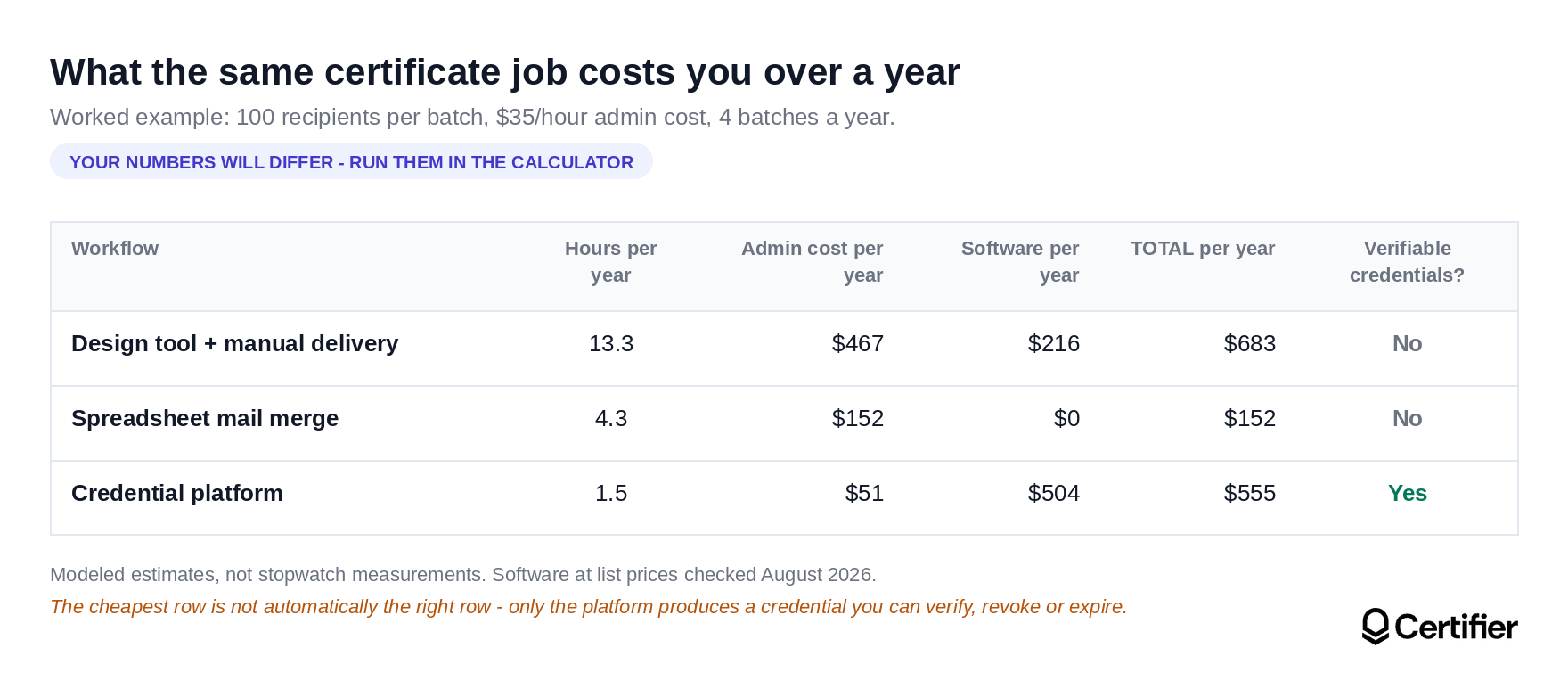
Use our certificate workflow calculator to put your own recipient count, admin cost and issuing frequency in, and see what each workflow costs you over a year. The link opens a copy in your own Google Drive and your edits stay private to you.
The calculator uses the same model as the benchmark above and shows its assumptions in a panel you can expand. Two things worth trying: bump the batch frequency from 4 to 12 and watch the labour costs separate, then push recipients past 250 and watch the software column wake up.
That’s our list of the best certifcate creation tools you can find online. Each platform brings something different to the table from sleek design and automation to analytics or simplicity. Whatever your priorities, there’s a tool here that fits.
Still, the benchmark points to something the tool list alone can't tell you. The biggest cost in certificate issuing is the manual work the software fails to remove.
A free design tool that costs you three and a half hours per batch is not free. At a modest $35/hour and four batches a year, it's roughly $470 a year in admin time, on top of the subscription.
How to choose the right tool? Think about what you need now, but leave room to grow. Once your audience expands or your process shifts, flexibility makes all the difference and the workflow you can't scale is the one you'll be replacing at the worst possible moment.
Certifier covers the full journey. From free certificate templates and custom designs to bulk generation, automation, verification and secure delivery—it’s built for small starts and big scale.
Sign up for Certifier, our pick for the best program to create a certificate, and see how easy it is to issue professional certificates without limits.
Learn more to choose the best program to make a certificate that covers your needs 100%.
Certifier is one of the best tools to create certificates that look professional and feel personal. It’s a full-featured certificate management platform.
You can start with free certificate templates, customize them fast and download instantly as PDF certificates or send it in bulk via email. Whether you're acknowledging students, employees or course completions, the platform handles the details and keeps things organized.
The best way is to use Certifier, best program to make a certificate that handles both design and delivery. You choose a template, add your style and details and generate eye-catching certificates without extra software.
Certificates can be downloaded or issued automatically. It’s quick, clean and works well for education, events or team recognition.
Digital certificate generation is simple when you use the right platform. Certifier is the best program to make a certificate, which lets you create and send professional looking certificates online, without needing to design them from scratch.
You upload your list, pick a template and certificates are issued automatically. Recipients can view, verify or download documents in one click.
To automate the process and still make it personal, get yourself the best program to make a certificate. Certifier gives you:
Free templates that match different use cases like awards, courses or employee projects
Auto-filling fields for names, achievements and issue dates
Tools to upload recipient data for fast certificate generation
One-click automation to issue personalized PDF certificates
A digital wallet for recipients to access and store their documents
It’s the easiest way to recognize people at scale automatically.
Choose one from the template gallery that fits your occasion. In Certifier, you can customize free certificate templates with names, dates and logos—no design skills needed.
Once your certificate is ready in Certifier, just click to download it as a PDF. You can also send it directly to recipients who can download their PDF certificate instantly.
Yes, with Certifier’s free plan, you can generate and issue up to 250 certificates at no cost. Perfect for small projects, events or test runs.

- B2B SaaS marketing
- Digital Credentials
- Content Strategy
- On-page SEO
- Lead Generation
Chief Marketing Officer
Aksen leads marketing at Certifier, bringing 7+ years of experience with global brands to position digital credentialing as a trusted solution for training providers and educational institutions.


