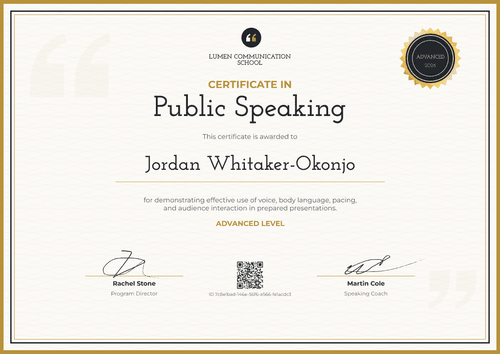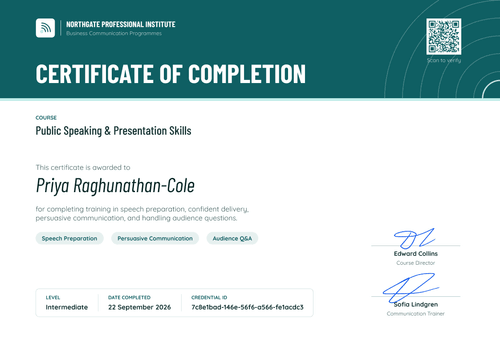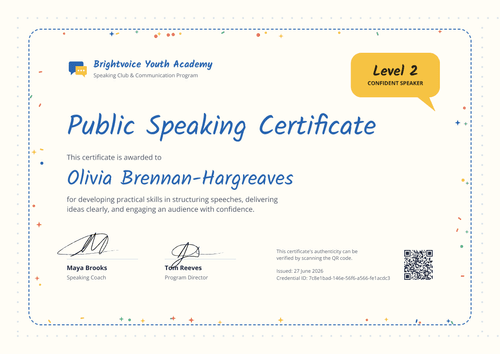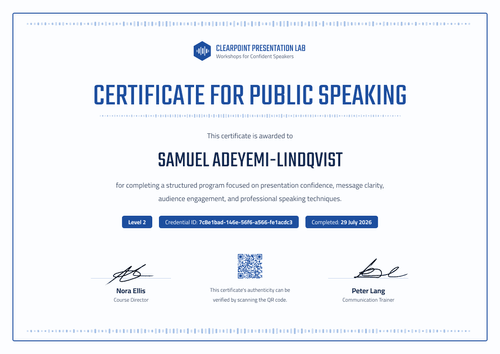

University Public Speaking Certificate
Formalize your school of communication's public speaking course with an academic-style certificate. An academic director and a course director sign each one, and each links to a verifiable record.
Customize this template for free
Email and export in bulk
Track recipient engagement
Download in
Don't have Certifier account? Sign up
Professional lavender university public speaking certificate template
This free university public speaking certificate confirms that a learner completed a public speaking course run by your school of communication or continuing education unit. It suits universities, colleges, and continuing studies departments that offer non-credit speaking courses to students and working adults. Professional schools with executive communication programs can use it too.
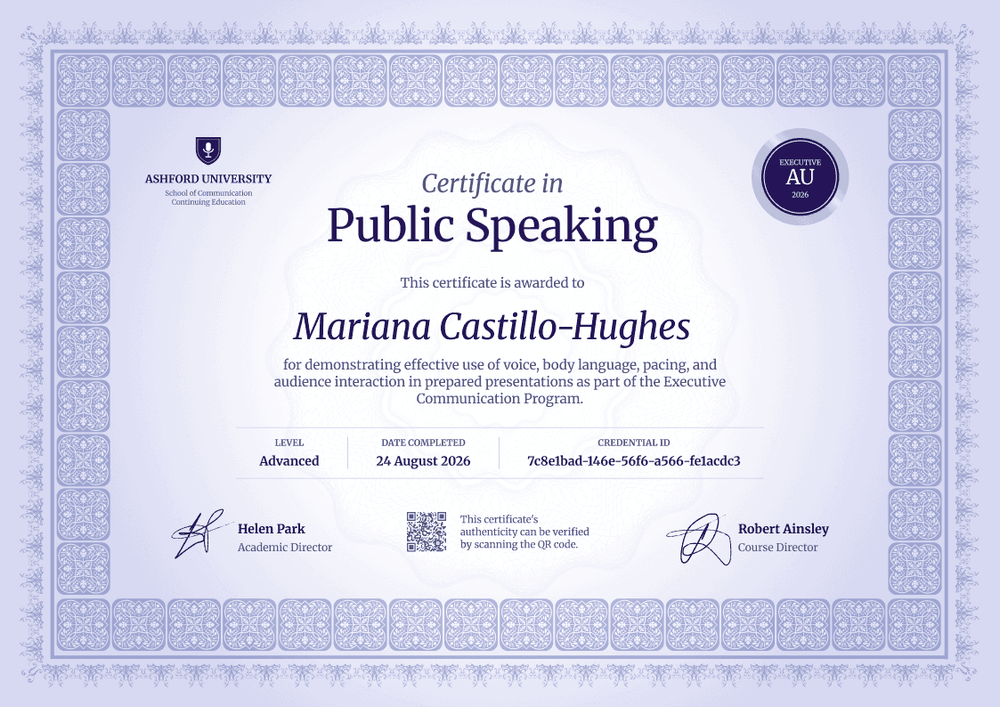
The design follows a traditional academic style. An ornate lavender border with repeating tile patterns frames a pale lavender page, and a faint guilloche rosette sits behind the text. The title pairs an italic "Certificate in" with a large deep purple serif "Public Speaking." A purple seal with a silver rim sits in the top right and a shield logo with a microphone sits in the top left. A row under the description shows the level, completion date, and credential ID.
When the term ends, connect your LMS or upload the class list, and every learner gets their certificate in one run. Employers can check each learner's credential page through its verification link on every plan.
What is a university public speaking certificate?
A university public speaking certificate is a certificate a university or college department issues when a learner completes a public speaking course, often through continuing education or an executive program. Departments use it to recognize non-credit study and to give adult learners a record they can show employers.
A public speaking course is one way students build communication skills. The certificate records course completion, but it doesn't award academic credit unless your institution decides it does.
This template is laid out on A4 landscape (29.7 x 21 cm). Sign up for a free Certifier account to add your department's crest and start issuing.
What should a university public speaking certificate include?
An academic certificate should name the institution, the department, and the people who stand behind the course. These fields are on the design.
Static fields
- Institution block: Your crest, university name, and department (e.g., Ashford University, School of Communication, Continuing Education).
- Certificate title: The award name (e.g., Certificate in Public Speaking).
- Seal: A round seal in the top right (e.g., Executive AU 2026).
- Signature and role areas: Two signature lines (e.g., Helen Park, Academic Director, and Robert Ainsley, Course Director).
Dynamic fields (automatically populated by Certifier)
- Recipient name: The learner's full name (e.g., Mariana Castillo-Hughes).
- Description: What the learner showed and the program name (e.g., effective use of voice, body language, pacing, and audience interaction in prepared presentations as part of the Executive Communication Program).
- Level: The course level (e.g., Advanced).
- Completion date: When the course ended (e.g., 24 August 2026).
Swap the seal for your department's seal in Certifier's design builder.
How to issue university public speaking certificates
Use these four steps at the end of each term:
- Add your institution's identity: Upload your crest and seal, and add signatures from the academic director and the course director.
- Connect your learning platform: Pull completions from your LMS or export the class list with names, emails, and levels.
- Issue the class: Certifier emails each learner their certificate with a link to their credential page.
- Answer verification requests with a link: When an employer asks whether a learner completed the course, point them to the credential page. There's no need to look up records by hand.
Available university public speaking certificate template formats
Edit and issue online with Certifier
Edit the design in your browser, add learners, and issue a whole class from one place. Each certificate has a credential page anyone can open.
Download in Microsoft Word
Enter your email to receive a ZIP with editable Word files.
PDF document export
Learners can download a print-ready PDF from their credential page.
Who issues university public speaking certificates?
Continuing education departments
Non-credit speaking courses for working adults end with a certificate that carries the university's name. That gives learners something to show at work.
Schools of communication
Alongside degree programs, schools of communication offer public speaking courses. A certificate recognizes students who complete a short course outside their degree.
Executive education units
In communication programs for professionals, the level field marks advanced or executive runs of a course.
Frequently asked questions
Yes. You can customize the design and issue it on the free Starter plan, which allows up to 5 custom attributes. This template's custom fields (description, level, and completion date) fit within that limit. The QR code needs the Professional or Advanced plan; on Starter, each certificate still links to its credential page.
Yes. Upload a signature image for each person and set their names and titles under the lines. Design changes carry through to credentials already issued, so if a signatory changes next term, duplicate the design for the new term instead of editing the old one.
Yes, on the Advanced plan. Multiple workspaces let each department keep its own designs and records.
No, a university public speaking certificate doesn't carry academic credit on its own. Credit is set by your institution's policies. The certificate records that a learner completed the course; add credit details to the description only if your institution grants them.
Certifier templates are provided for general informational and design purposes only. They do not constitute legal, regulatory, or compliance advice and are not guaranteed to satisfy the requirements of any regulator, auditor, standard, insurer, or jurisdiction. The issuing organization is responsible for the content of its training program and for verifying that its records meet the requirements that apply to it.