
Language Proficiency Assessment Certificate
Customize this language proficiency assessment certificate with an overall score, CEFR level, and component scores. Issue it automatically when a learner finishes your test.
Customize this template for free
Email and export in bulk
Track recipient engagement
Download in
Don't have Certifier account? Sign up
Simple purple language proficiency assessment certificate template
This free language proficiency assessment certificate records a learner's result in your online language test, with an overall score, a CEFR level, and a score for each component. It suits online language platforms and assessment providers that test learners remotely and issue results straight after the test.
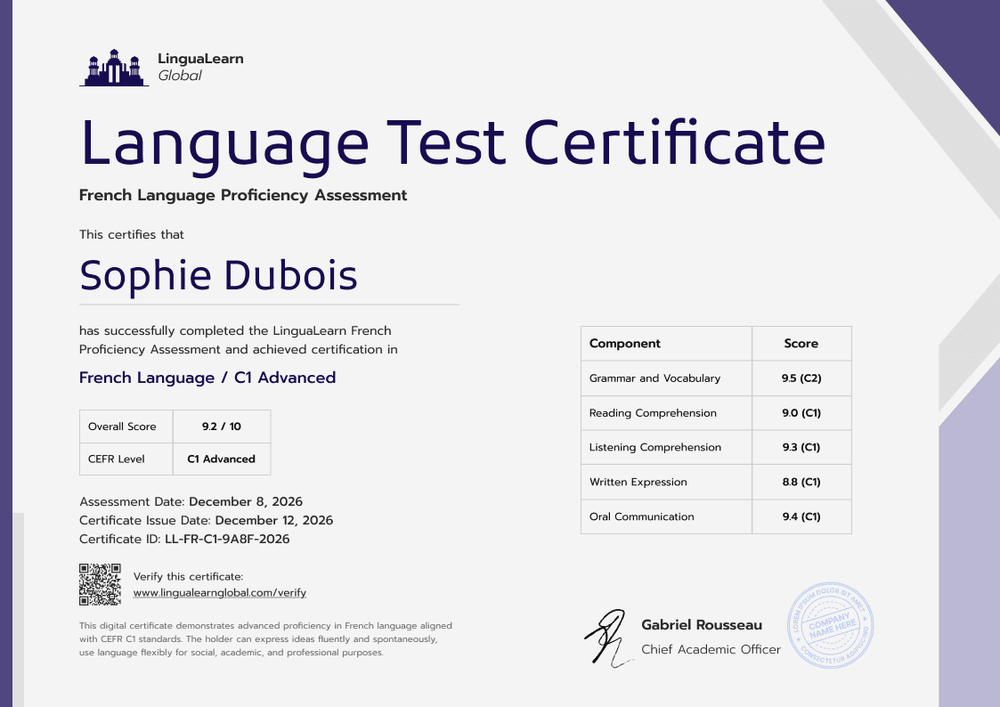
The design is modern and data-led: a light grey page with purple shapes in the corners and a large purple title. Under the learner's name, a line shows the language and level, and a small table holds the overall score and CEFR level. A larger table on the right lists component scores, such as grammar and vocabulary, reading, listening, writing, and speaking. The assessment date, issue date, certificate ID, verification link, QR code, and one signature line fill the bottom.
Connect your platform through native integrations or Zapier, or import results from a spreadsheet, to issue certificates as soon as learners finish. Each learner receives a credential page with a verification link.
What is a language proficiency assessment certificate?
A language proficiency assessment certificate shows the result a named learner achieved in an online language test on a specific date. Platforms issue it so learners can share their level with employers, schools, or on LinkedIn.
Many platforms report results using the CEFR, from A1 to C2. Describe results as aligned with the CEFR, based on how your test is designed and scored, since the Council of Europe doesn't certify tests. A platform certificate records your assessment and its result. It isn't an official exam result, and others decide for themselves whether to accept it.
This template is laid out on A4 landscape (29.7 x 21 cm). Sign up for a free Certifier account to edit the design and start issuing certificates with this template.
What should a language proficiency assessment certificate include?
A language assessment certificate should show the overall result and enough detail to explain it. Use the online builder to edit and customize the following fields:
Static fields
- Organization block: Your platform's name and logo.
- Certificate title and assessment name: The award type and test (e.g., Language Test Certificate, French Language Proficiency Assessment).
- Result statement: A short line describing what the level means and that it's aligned with the CEFR.
- Signature and role area: One signature line (e.g., Chief Academic Officer).
Dynamic fields (automatically populated by Certifier)
- Recipient name: The learner's full name (e.g., Sophie Dubois).
- Language and level: The language and level reached (e.g., French, C1 Advanced).
- Overall score: The overall result (e.g., 9.2 out of 10).
- Component scores: Grammar and vocabulary, reading, listening, writing, and speaking.
- Assessment date, issue date, and certificate ID: When the test was taken and issued, plus a unique identifier.
This list describes the template design, but it's not a fixed standard. You can rename, add, or remove fields in Certifier's design builder until the layout matches your results records.
How to issue a language proficiency assessment certificate
Follow these four steps to issue certificates to every learner who completes the assessment:
- Edit the design to match your brand: Upload your logo and signature, then fill in the assessment name and component labels.
- Connect your results: Send results from your platform through native integrations or Zapier, or import them from a spreadsheet.
- Issue the certificates: Certifier emails each learner their personalized certificate with a verification link. If results have a validity period, add an expiry date (Professional and Advanced plan feature).
- Track and keep records current: Use the Credential Repository to see who opened, viewed, downloaded, or shared their certificate, and correct a misspelled name without reissuing.
Available language proficiency assessment certificate template formats
Edit and issue the template online with Certifier
Let each completed test fill the score tables automatically, without any manual certificate work needed.
Download the template in Microsoft Word
Want an offline template for audits of your scoring? Submit your email to get the landscape template as a Word file, in A4 and US Letter formats.
PDF document export
Learners can download a PDF of their assessment certificate from the credential email.
Who issues language proficiency assessment certificates?
Online language platforms
Platforms with built-in tests issue a certificate automatically after each assessment, so learners get their result right away.
Assessment providers
Providers that run remote language tests for employers or schools can send every candidate a verifiable result.
Corporate language programs
Companies that test staff language levels online can record each employee's result in one place.
Frequently asked questions
You can customize this template on Certifier's free Starter plan, but its overall score, CEFR level, and five component scores go over the 5 custom attribute limit.
Yes. Connect your platform through native integrations or Zapier, and Certifier issues the certificate when a result comes through.
Yes, add "aligned with the CEFR," if your assessment is designed and scored against the framework. Avoid wording like "CEFR certified."
An employer can access the certificate page from the link on the learner's LinkedIn or CV and see the issuer, the learner, the issue date, and the certificate ID.
After confirming their email, the learner can send a correction from their result page. Once you approve it and the name changes, the certificate page updates automatically.
Certifier templates are provided for general informational and design purposes only. They do not constitute legal, regulatory, or compliance advice and are not guaranteed to satisfy the requirements of any regulator, auditor, standard, insurer, or jurisdiction. The issuing organization is responsible for the content of its training program and for verifying that its records meet the requirements that apply to it.