
Trauma-Informed Coaching Certificate
Coaching schools can present this formal certificate to coaches who finish a trauma-informed coaching course. It shows their specialization and PD hours, and each graduate gets a link to share.
Customize this template for free
Email and export in bulk
Track recipient engagement
Download in
Don't have Certifier account? Sign up
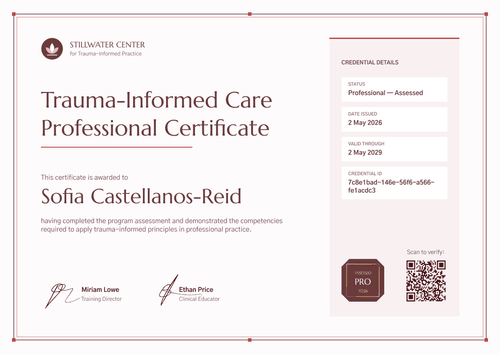
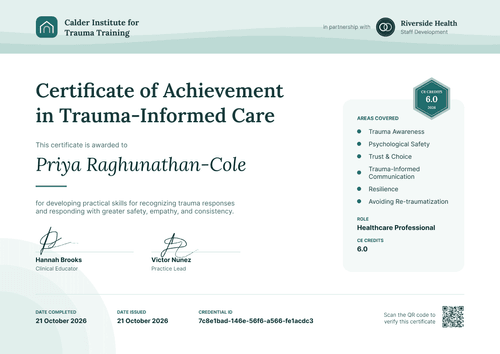
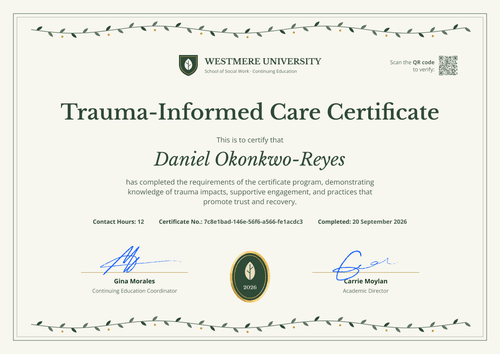
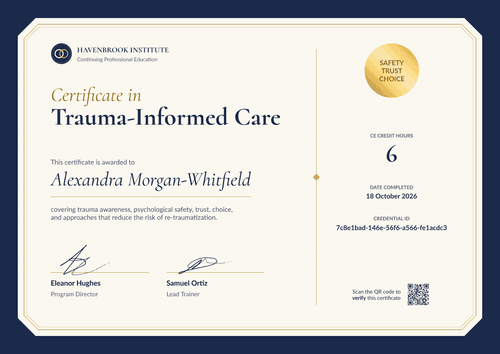
Formal ivory trauma-informed coaching certificate template
This free trauma-informed coaching certificate confirms that a coach completed your course on trauma-sensitive coaching practice. It's for coaching schools and academies that add trauma-informed modules to their programs, so graduates can show clients and employers what they studied.
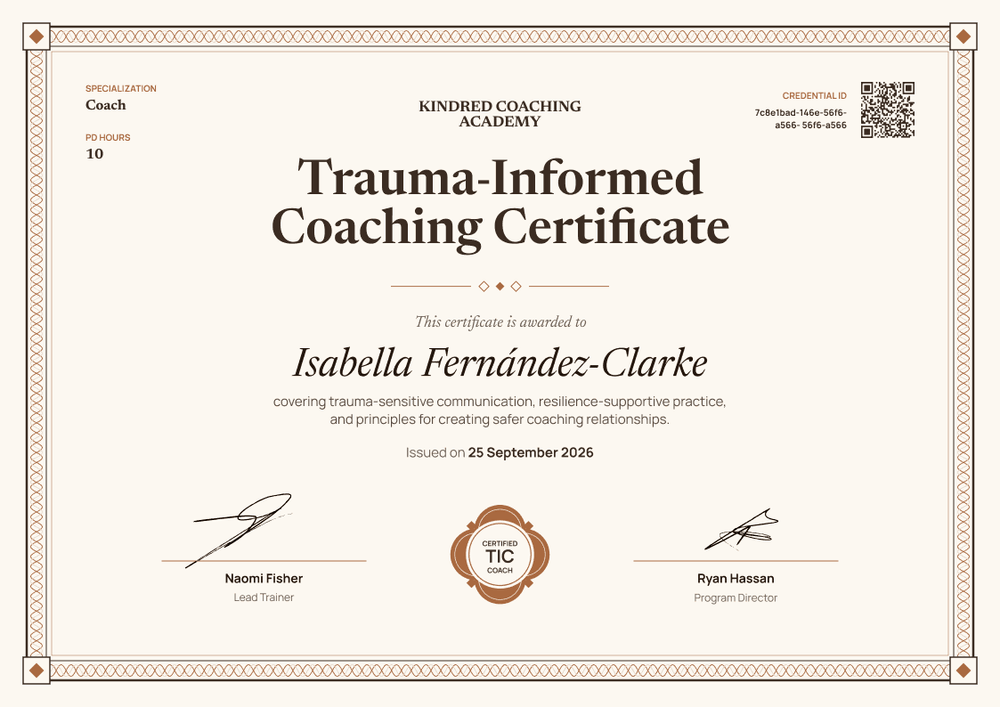
A copper-brown chain-link border with diamond corner tiles frames an ivory page. The academy name sits top center in serif capitals, with specialization and PD hours on the left and the credential ID and QR code on the right.
The two-line title is set in a heavy dark brown serif, followed by a small diamond divider, an italic line, and the coach's name in italics. A scalloped copper seal sits between two signature lines.
When a cohort graduates, import your graduate list from a spreadsheet or connect your course platform and issue every certificate in one run. Each coach gets a credential page with a verification link on every plan.
What is a trauma-informed coaching certificate?
A trauma-informed coaching certificate shows that a coach completed training in coaching people who may have experienced trauma, such as trauma-sensitive communication and building safer coaching relationships. Coaches use it to show prospective clients and employers what they've studied.
Only approved providers can award accredited CE. A coaching academy without that approval can still list hours on a course certificate, but it can't present them as accredited CE.
The sample seal reads "Certified TIC Coach." A course certificate is not a certification, so consider changing the seal to something like "Trauma-Informed Coaching" unless your academy runs a formal certification with an assessment.
This certificate records training, but it doesn't qualify a coach to provide therapy or treat trauma.
This template is laid out on A4 landscape (29.7 x 21 cm). Sign up for a free Certifier account to add your academy's details.
What should a trauma-informed coaching certificate include?
A coaching certificate should tell a client what the coach studied and who taught it.
Static fields
- Academy name: Your school's name (e.g., Kindred Coaching Academy).
- Certificate title: The course name (e.g., Trauma-Informed Coaching Certificate).
- Seal: A scalloped copper seal. The sample reads "Certified TIC Coach"; edit the words to describe your course accurately.
- Signature lines: Two signers and roles (e.g., Naomi Fisher, Lead Trainer, and Ryan Hassan, Program Director).
Dynamic fields (automatically populated by Certifier)
- Recipient name: The coach's full name (e.g., Isabella Fernández-Clarke).
- Course description: What the course covered (e.g., trauma-sensitive communication, resilience-supportive practice, and principles for creating safer coaching relationships).
- Specialization: The coach's focus (e.g., Coach). Use it for life, executive, or health coaching.
- PD hours: Professional development hours (e.g., 10). The label is editable.
Adjust any field in Certifier's design builder.
How to issue trauma-informed coaching certificates
- Review the seal and title: Edit the seal text so it matches what your course is. Add your academy name and signers.
- Prepare your graduate list: Collect names, emails, specializations, and hours in a spreadsheet, or connect the course platform where your cohort studies.
- Issue to the cohort: Map your columns to the certificate fields and send. Each coach receives an email with their certificate and a verification link.
- Encourage sharing: Coaches can add their credential page link to LinkedIn, a coaching directory profile, or their website. Each share points back to your academy as the issuer.
Available trauma-informed coaching certificate template formats
Edit and issue online with Certifier
Edit the design in your browser, add graduates, and send every certificate from one place. Each coach gets a credential page where anyone can verify it.
Download in Microsoft Word
Enter your email to receive a ZIP with editable Word files.
PDF document export
Coaches download a print-ready PDF from their credential page to frame or share with clients.
Who issues trauma-informed coaching certificates?
Coaching schools and academies
Schools add trauma-informed coaching as a standalone course or a specialization within a longer program.
Independent coach trainers
Experienced coaches run short trauma-informed courses for other coaches and need a professional certificate for each graduate.
Wellbeing and leadership programs
Organizations that train internal coaches or mentors add trauma-informed modules and recognize those who complete them.
Frequently asked questions
Yes. You can customize the design on the free Starter plan, which allows up to 5 custom attributes. This template's custom fields (course description, specialization, and PD hours) fit within that limit. The QR code needs the Professional or Advanced plan.
Only if your academy runs a formal certification with an assessment and clear standards. For a course, edit the seal to describe the training, such as "Trauma-Informed Coaching" or "Course Completed."
No. It shows the coach completed your training on trauma-informed coaching practice. Coaching isn't therapy, and the certificate doesn't license anyone to diagnose or treat trauma.
Yes. Add a specialization column to your spreadsheet, such as life coach, executive coach, or health coach. Each certificate shows the right one.
Yes. Each coach gets a credential page with its own link. They can share it on LinkedIn, in an email signature, or on their website, and anyone who opens it sees your academy as the issuer.
Certifier templates are provided for general informational and design purposes only. They do not constitute legal, regulatory, or compliance advice and are not guaranteed to satisfy the requirements of any regulator, auditor, standard, insurer, or jurisdiction. The issuing organization is responsible for the content of its training program and for verifying that its records meet the requirements that apply to it.