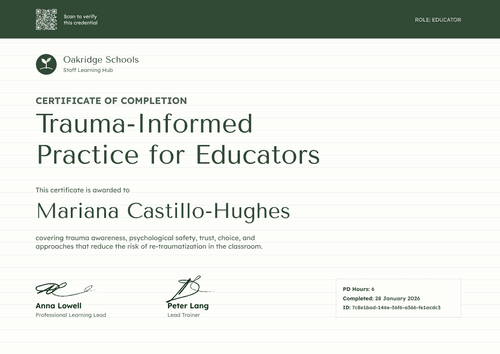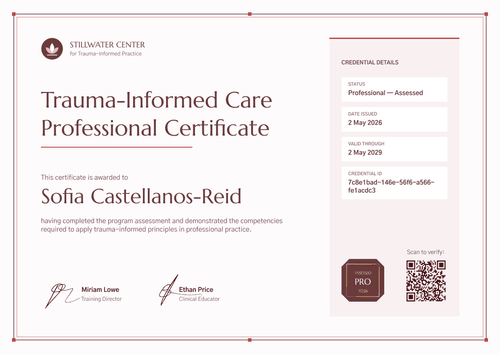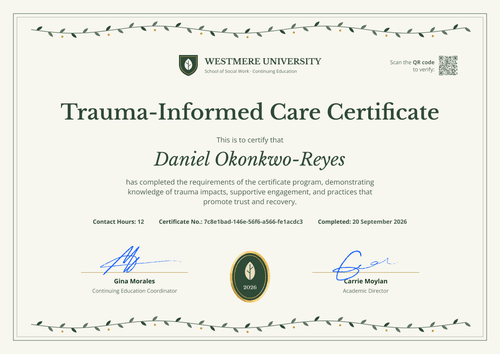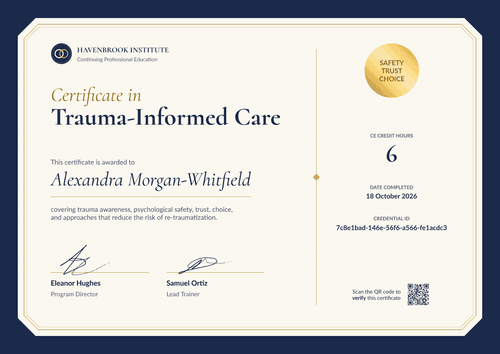

Trauma-Informed Care Achievement Certificate
Training institutes that deliver trauma-informed care for a health system can co-brand this certificate with both logos. It lists the areas covered, each person's role, and their contact hours.
Customize this template for free
Email and export in bulk
Track recipient engagement
Download in
Don't have Certifier account? Sign up
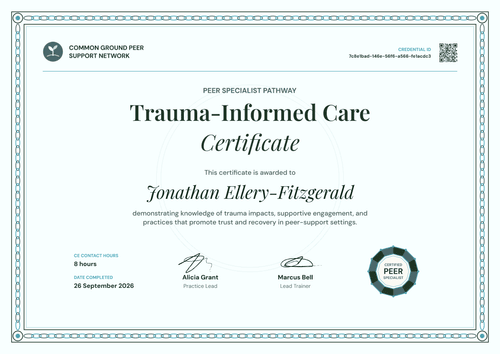
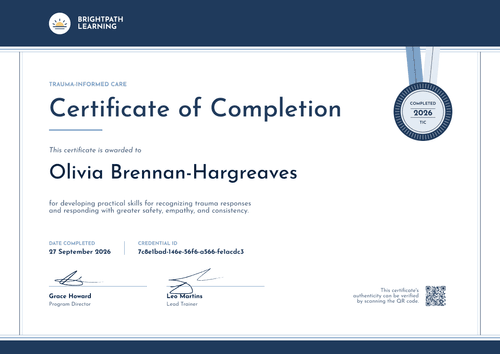
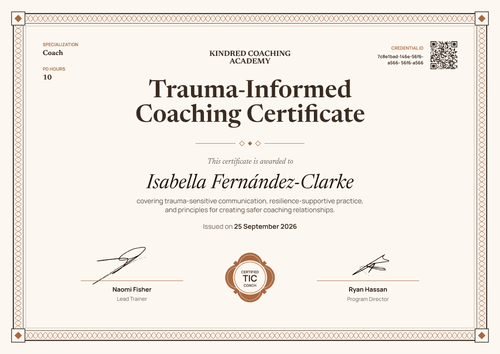
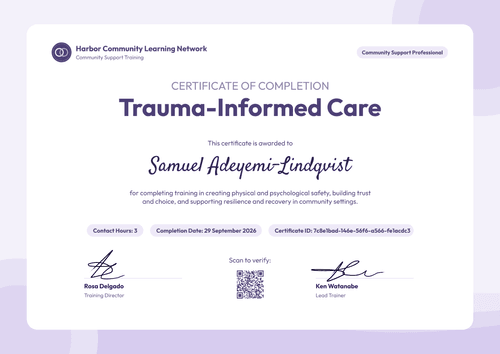
Professional mint green trauma-informed care achievement certificate template
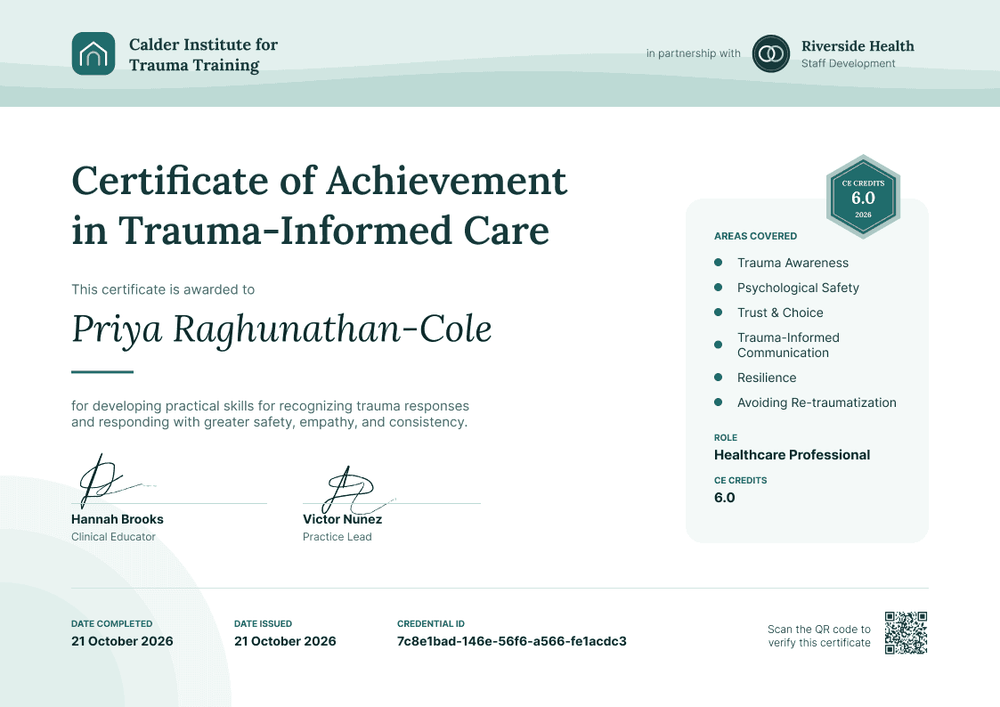
This free trauma-informed care achievement certificate recognizes staff who complete a skills program in trauma-informed care. It's built for training institutes that deliver programs for hospitals and health systems, where both organizations want their name on the certificate.
Soft mint and sage waves run across the top, with your logo on the left and a partner line and the health system's logo on the right. The title is set in a large dark teal serif, followed by the recipient's name in italics and a short teal rule.
A pale mint panel on the right lists the areas covered, the recipient's role, and their hours, topped by a teal hexagon that repeats the hours and year. Dates, the credential ID, and a QR code sit along the bottom.
Once a group finishes, import completions from a spreadsheet or connect your LMS to issue certificates in one run. Each person gets a credential page with a verification link on every plan.
What is a trauma-informed care achievement certificate?
A trauma-informed care achievement certificate recognizes that a staff member completed a trauma-informed care program and built specific skills, which the areas covered list spells out. Health systems use it to show which staff finished training, and the staff member keeps it as a record of their own development.
Only approved providers can award accredited CE. When neither the institute nor the health system holds that approval, the co-branded certificate can still list contact hours as a record of completion, without any accredited CE claim.
If your program offers CE for psychologists through an APA-approved sponsor, keep APA's rules in mind:
- The certificate carries the sponsor's approval statement.
- It shows the activity name, the date, and the credits earned.
- It gives a way to verify participation with the sponsor.
- APA approves sponsors, not single courses, so never call one course "APA-approved."
The certificate shows completion of the program and the topics it covered. It doesn't confirm that a person applies those skills in every patient interaction.
This template is laid out on A4 landscape (29.7 x 21 cm). Sign up for a free Certifier account to add both logos and your program details.
What should a trauma-informed care achievement certificate include?
When two organizations share a certificate, make it clear who delivered the training and who it was for.
Static fields
- Training provider: Your institute's name and logo (e.g., Calder Institute for Trauma Training).
- Partner block: The partner's name and department after "in partnership with" (e.g., Riverside Health, Staff Development).
- Certificate title: The award and topic (e.g., Certificate of Achievement in Trauma-Informed Care).
- Signature lines: Two signers and roles (e.g., Hannah Brooks, Clinical Educator, and Victor Nunez, Practice Lead).
Dynamic fields (automatically populated by Certifier)
- Recipient name: The staff member's full name (e.g., Priya Raghunathan-Cole).
- Achievement line: What they developed (e.g., practical skills for recognizing trauma responses and responding with greater safety, empathy, and consistency).
- Areas covered: The program topics (e.g., Trauma Awareness, Psychological Safety, Trust & Choice, Trauma-Informed Communication, Resilience, Avoiding Re-traumatization). Keep this as one text field so it fits the free plan.
- Role: The person's role (e.g., Healthcare Professional).
- Contact hours: Hours earned (e.g., 6.0). The sample label reads "CE Credits" in the panel and the hexagon. Both labels are editable, so change them to "Contact Hours" or your sponsor's term.
- Date completed: The date training ended (e.g., 21 October 2026).
You can add, rename, or remove fields in Certifier's design builder.
How to issue co-branded trauma-informed care certificates
- Add both organizations: Upload your logo and your partner's logo, and confirm the partner line with them. Add your signers.
- Set the areas covered and role options: Write the topic list for this program. Decide which role labels you'll use, such as clinical staff or support staff.
- Upload the participant list: Import a spreadsheet with names, emails, roles, and hours, or connect the LMS where the program runs. Certifier fills each certificate and emails it with a verification link.
- Share results with your partner: Use the Credential Repository to see who received, opened, and shared their certificate, so you can report back to the health system.
Available trauma-informed care achievement certificate template formats
Edit and issue online with Certifier
Edit the design in your browser, add participants, and send every certificate from one place. Each person gets a credential page where anyone can verify it.
Download in Microsoft Word
Enter your email to receive a ZIP with editable Word files.
PDF document export
Staff download a print-ready PDF from their credential page for their personnel file.
Who issues trauma-informed care achievement certificates?
Trauma training institutes
Specialist institutes deliver trauma-informed care programs under contract to hospitals and health systems, often across many sites.
Health system staff development teams
Internal education teams co-deliver programs with outside trainers and want both names on the certificate.
Behavioral health organizations
Clinics and community mental health centers train mixed teams of clinical and support staff and record each person's role.
Frequently asked questions
Yes. You can customize the design on the free Starter plan, which allows up to 5 custom attributes. This template's custom fields (achievement line, areas covered, role, contact hours, and date completed) fit exactly within that limit, as long as areas covered stays one field. The QR code needs the Professional or Advanced plan.
Yes. The design has room for two logos at the top. Upload each one in the design builder and edit the partner line to match your agreement.
Yes. Add a role column to your spreadsheet, such as nurse, physician, social worker, or front desk staff, and each certificate shows that person's role. This helps a health system see training coverage by role.
Yes. Each certificate records the staff member's name, role, contact hours, and completion date, and every certificate stays in your Credential Repository. When a survey asks for training records, you can show the health system who completed the program and when.
Certifier templates are provided for general informational and design purposes only. They do not constitute legal, regulatory, or compliance advice and are not guaranteed to satisfy the requirements of any regulator, auditor, standard, insurer, or jurisdiction. The issuing organization is responsible for the content of its training program and for verifying that its records meet the requirements that apply to it.