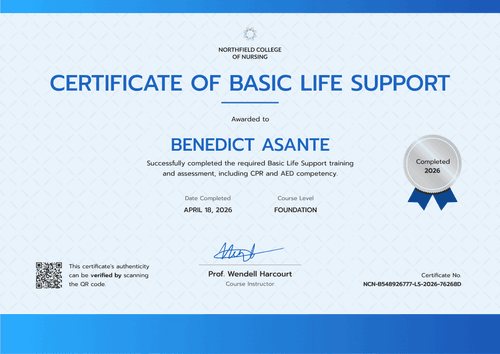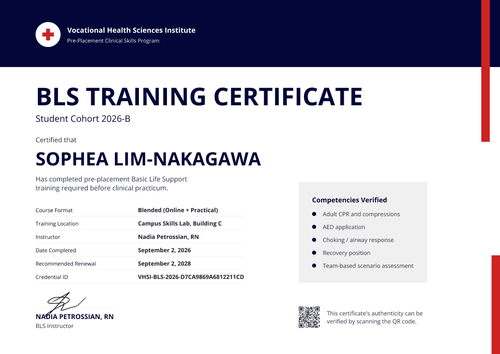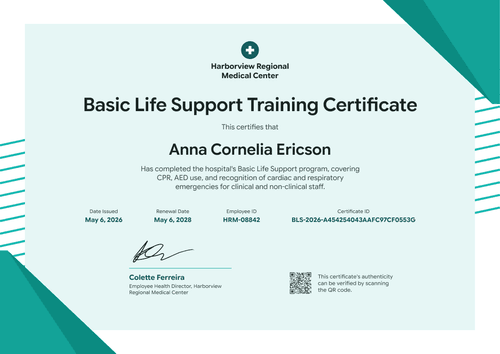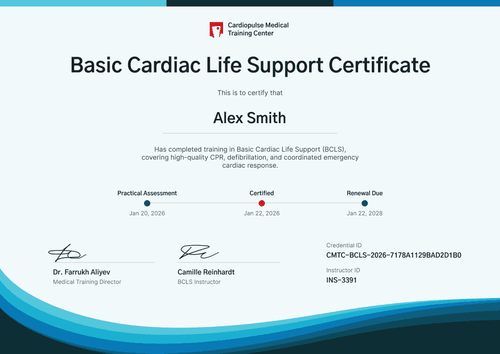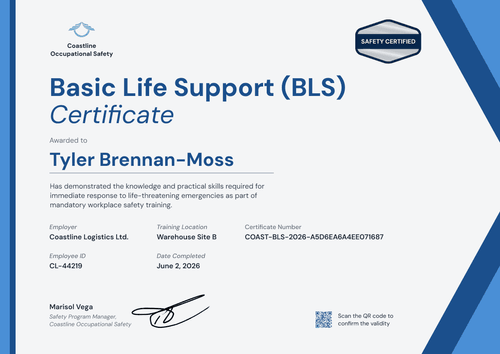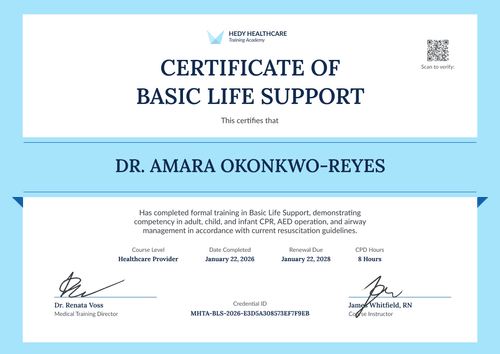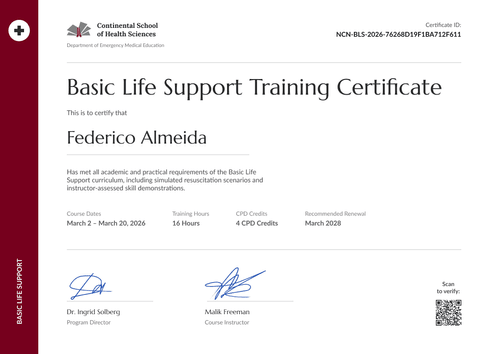

Basic Life Support Certificate
Give learners your own BLS course completion certificate, with the completion date, a 2-year expiry, and training hours. Each one links to a credential page employers can open.
Customize this template for free
Email and export in bulk
Track recipient engagement
Download in
Don't have Certifier account? Sign up
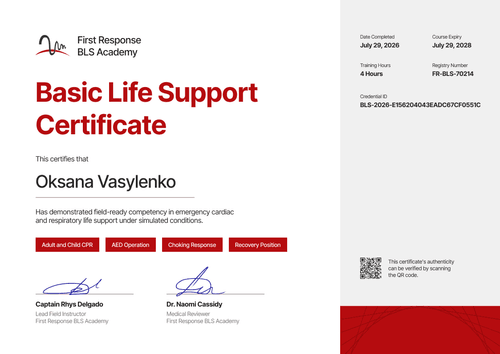
Simple red basic life support certificate template
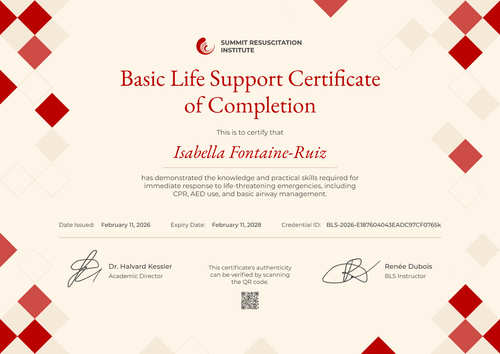
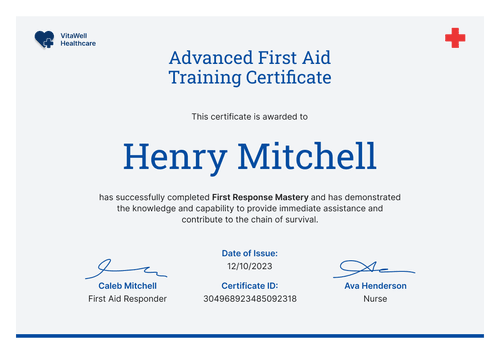
This free basic life support certificate confirms that a learner finished your BLS course on a given date. It's made for independent BLS and CPR providers that teach their own curriculum. Every learner gets your own BLS course completion certificate, with your name on it as the issuer.
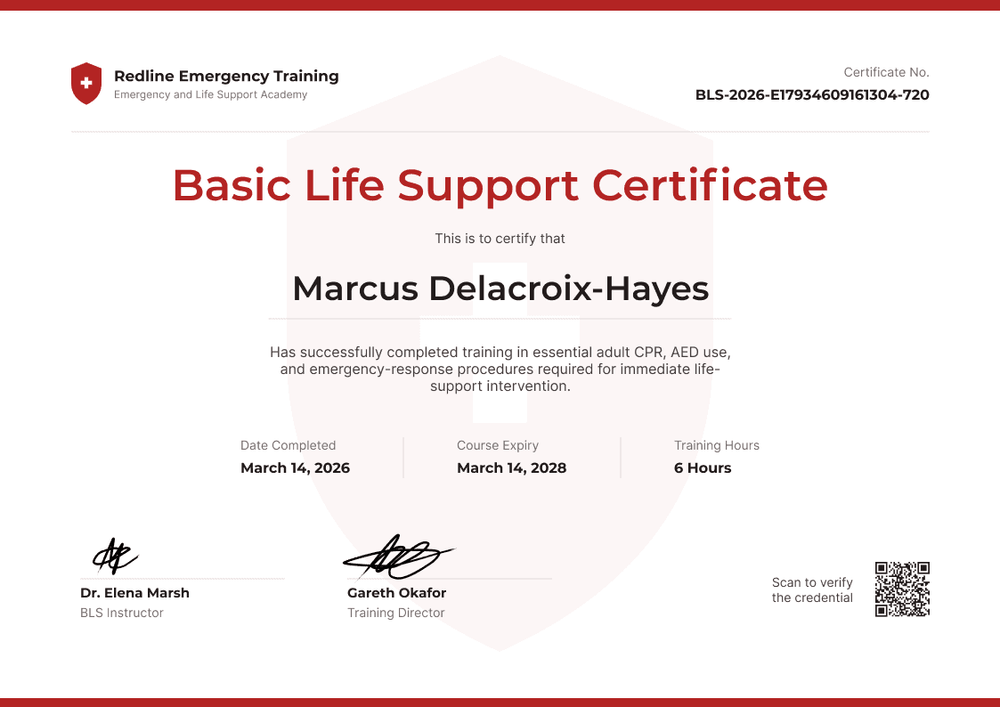
The design is white with a red bar along the top and bottom edges and a faint pale red shield behind the text. Your logo and academy name sit top left, and the certificate number sits top right. A large red title leads to the recipient's name, a short course description, and a row of three fields: date completed, course expiry, and training hours.
When a class ends, import the roster from a spreadsheet and issue every certificate in one run. Each learner gets a credential page with a verification link, on every plan.
What is a basic life support certificate?
A basic life support certificate shows that a named person completed BLS training, such as adult CPR and AED use, on a specific date. It also names the provider who taught it. Independent providers issue it as the completion record for their own course, so learners can show employers what they trained in and when.
A certificate from your own course records what your course covered. It doesn't show that the course was approved by the AHA or any other training network.
This template is laid out on A4 landscape (29.7 x 21 cm). Sign up for a free Certifier account and issue your next class from one spreadsheet.
What should a basic life support certificate include?
A BLS certificate should tell an employer who trained, what the course covered, who taught it, and how long the training is considered current. Use the online builder to edit these fields.
Static fields
- Organization block: Your provider name and tagline (e.g., Redline Emergency Training, Emergency and Life Support Academy).
- Logo: Your logo next to the organization name.
- Certificate title: The award name (e.g., Basic Life Support Certificate).
- Signature and role areas: Two signature lines for the people who stand behind the course (e.g., Dr. Elena Marsh, BLS Instructor, and Gareth Okafor, Training Director).
Dynamic fields (automatically populated by Certifier)
- Recipient name: The learner's full name (e.g., Marcus Delacroix-Hayes).
- Course description: What the course covered (e.g., essential adult CPR, AED use, and emergency-response procedures).
- Date completed: The day the learner finished the course (e.g., March 14, 2026).
- Course expiry (Professional and Advanced): When the training lapses (e.g., March 14, 2028). The default is 2 years after completion, and you can change it.
- Training hours: The course length (e.g., 6 Hours).
How to issue basic life support certificates
- Add your brand and instructors: Upload your logo, then add the signatures of your lead instructor and training director. Edit the course description to match what your BLS course teaches.
- Import the class list: Upload a spreadsheet with each learner's name, email, completion date, and training hours. You can issue up to 1,000 recipients per upload.
- Set the expiry and issue: Keep the 2-year expiry or set your own renewal period (Professional and Advanced plan feature). Certifier emails each learner a personalized certificate with a verification link.
- Answer employer checks: When an employer asks about a learner, point them to the verification link. If a learner spots a typo, fix the field and the public page updates at once, with nothing to reissue.
Available basic life support certificate template formats
Edit and issue the template online with Certifier
Edit the design in your browser, add learner data, and email every certificate from one place. Each learner gets a credential page where anyone can verify the certificate.
Download the template in Microsoft Word
Enter your email address to receive a ZIP file with editable Word documents.
PDF document export
Learners can download a print-ready PDF from the credential page linked in their delivery email.
Who issues basic life support certificates?
Independent BLS and CPR providers
Providers that write and teach their own BLS course issue a certificate under their own name. A verification link lets employers see exactly which course a learner completed.
Workplace safety trainers
Trainers who run CPR and AED sessions for companies give each employee a dated record, with an expiry that matches the employer's refresher cycle.
Hospital education teams
Education departments record internal BLS skills checks alongside the cards their staff already hold from a training network.
Frequently asked questions
Yes, you can customize this template on Certifier's free Starter plan, which allows up to 5 custom attributes. Its custom fields (course description and training hours) fit within that limit. The QR code and expiry date need the Professional or Advanced plan, but every Starter certificate still links to its credential page.
No. This template records a BLS course you delivered, and AHA course completion cards come only from AHA-authorized Training Centers. If your learners need an AHA card, they have to take an AHA course through an authorized Training Center.
Any training provider can issue a BLS certificate for a course it delivers. Network cards, such as those from the AHA or Red Cross, can only be issued through that network's authorized centers and instructors.
An employer can check a Certifier certificate by opening the verification link or by scanning the QR code on paid plans. It leads to the learner's credential page on Certifier, which shows the issuer, the recipient, the dates, and the credential ID.
Certifier templates are provided for general informational and design purposes only. They do not constitute legal, regulatory, or compliance advice and are not guaranteed to satisfy the requirements of any regulator, auditor, standard, insurer, or jurisdiction. The issuing organization is responsible for the content of its training program and for verifying that its records meet the requirements that apply to it. This template does not replace an AHA eCard, Red Cross certificate or other card issued by an authorized training network.