
Trusted by:
University of Southern California
Warner Bros.
Volvo
Amazon
Stanford University
Updated: October 07, 2026
12 min read
Issuing CEU and CPD certificates by hand doesn't scale. See how the right digital credential platform for continuing education automates branded, verifiable credentials at any volume.
Research with AI:
Every licensed professional knows the deadline: CEU credits before renewal, CPD hours before audits, and CPE records before reporting season. For issuers, a certificate is not just a completion PDF.
It needs credit data, recipient details, provider information, a verification path, and records that can support licensing checks.
That is why continuing education needs more than a generic certificate maker. The top digital credential platform should handle certificate creation, delivery, verification, tracking, and automation in one workflow.
This guide compares leading platforms for continuing education programs. You’ll see how CEU and CPD certificates differ, what a valid certificate needs and what certificate templates to use, and how to automate CEU certificate issuance without manual PDF edits.
A digital credential platform for continuing education automates CEU and CPD certificate issuance instead of manual PDF work.
The right platform adds verifiable QR codes and audit-ready records that licensing boards accept.
Certifier fits most CEU and CPD programs, while platforms like Accredible and Cadmium suit larger or event-heavy setups.
Certifier's free plan covers 250 credentials a year, with paid plans from $67 a month.

Before you compare platforms, it helps to know what your certificate represents, because the wording on it matters to the bodies that review it.
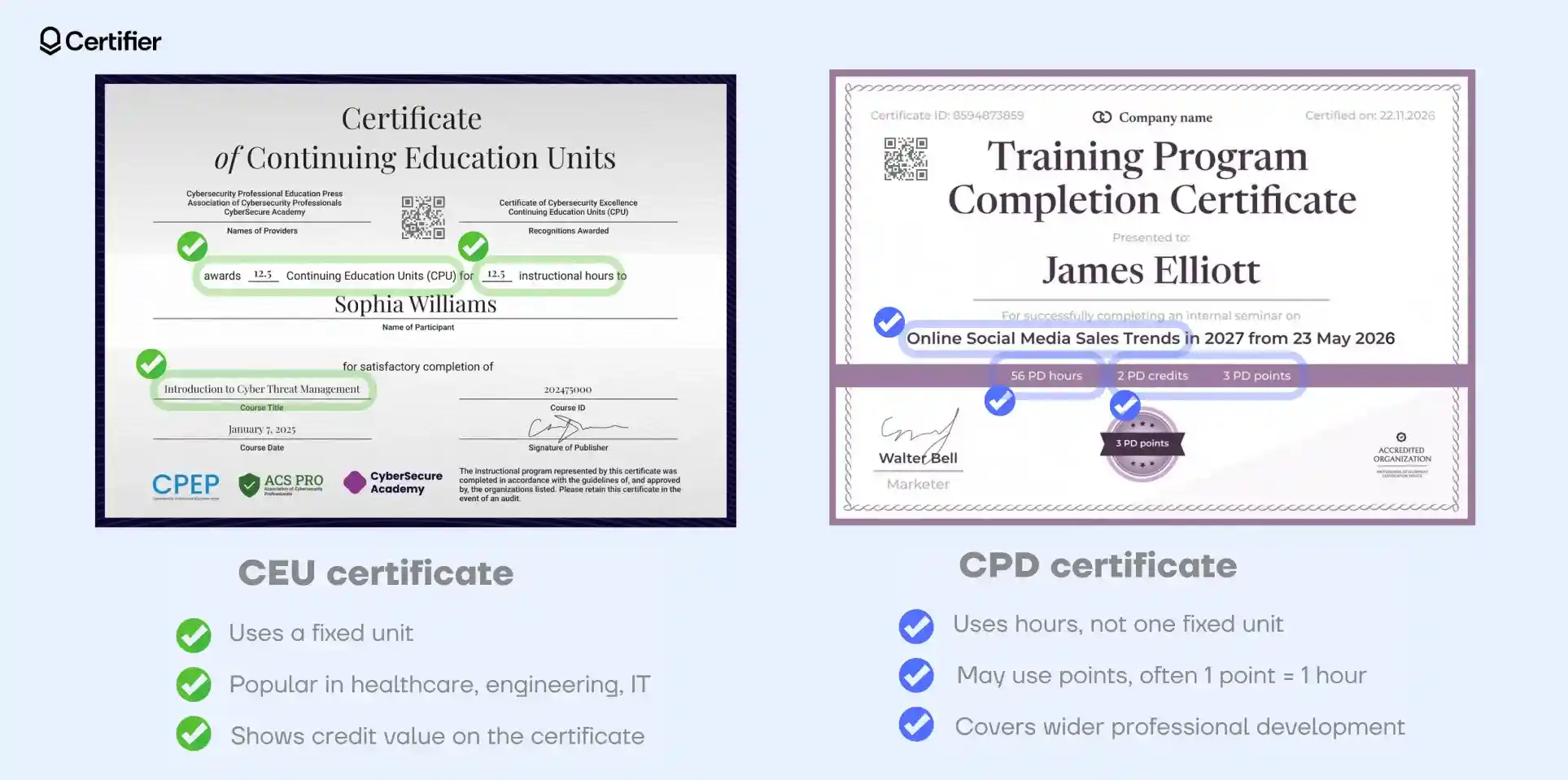
CEU = Continuing Education Units
The CEU certificate meaning follows one standard: one CEU equals 10 contact hours of organized instruction, as defined by IACET and approved by ANSI in the US.
CEUs are common in healthcare, engineering, and other licensed fields. The certificate proves completion of contact hours and shows the credit value.
CPD = Continuing Professional Development
The term is common in the UK and many global markets. The CPD certificate meaning centers on hours, not a fixed unit.
Most professional bodies count CPD in hours. If points apply, one point usually equals one hour. A CPD certificate confirms professional development hours that may count toward annual or multi-year targets.
If you run accredited training, our guide to building a CPD certification course covers the accreditation side.
Several profession-specific labels follow the same idea. A good continuing education certificate uses the wording each field expects:

CME: Continuing Medical Education, used by physicians and other healthcare staff
CLE: Continuing Legal Education, used for attorney license renewal
CPE: Continuing Professional Education, common for CPAs in accounting
PDH and PDU: Professional Development Hours for engineers and Professional Development Units for project managers
Why does the label matter? Licensing boards and auditors look for exact wording when they review proof of completion. A certificate for nurses should read differently from one for accountants, which is why a continuing education certificate platform needs custom fields rather than a fixed layout.
A continuing education certificate is only useful if the platform behind it fits how your program runs. Use this checklist when you evaluate a digital credential platform for continuing education:

Automated issuance: certificates are sent the moment training is marked complete, not by hand later
Custom data fields: space for the CEU value and contact hours, plus provider details like an IACET number
Verification: a QR code that leads to the verification page, so that a licensing board can check credential in seconds
Expiry and renewal: expiration dates with reminders, since many credentials lapse after a year or two
Audit trail: an exportable record of everything you issue or revoke
Branded delivery: certificates and emails that carry your organization's identity
Integrations: links to your LMS or registration system, plus webinar and form tools
Most general credentialing tools cover some of this, but few cover all of it, specifically for continuing professional education. If you want the wider category view beyond CE, our roundup of digital credential management software compares general-purpose tools.
Here's how the leading options compare for CEU and CPD programs in 2026.
Platform | Best For | Standout For Ce |
|---|---|---|
Certifier | CEU and CPD automation | Custom credit fields, QR verification, free plan |
SimpleCert | Lightweight CE certificates | Simple bulk delivery with a recipient portal |
Accredible | Large credential programs | Stackable microcredentials, white-label, LMS depth |
BadgeCert | Professional badge programs | Real-time badge authentication for associations |
Cadmium | Associations and CE events | CME accreditation and event infrastructure |
Certifier is one of the strongest overall digital credential platform for continuing education, and it's built around automation rather than one-off design.
You connect your training source, and certificates are issued when someone completes a course.
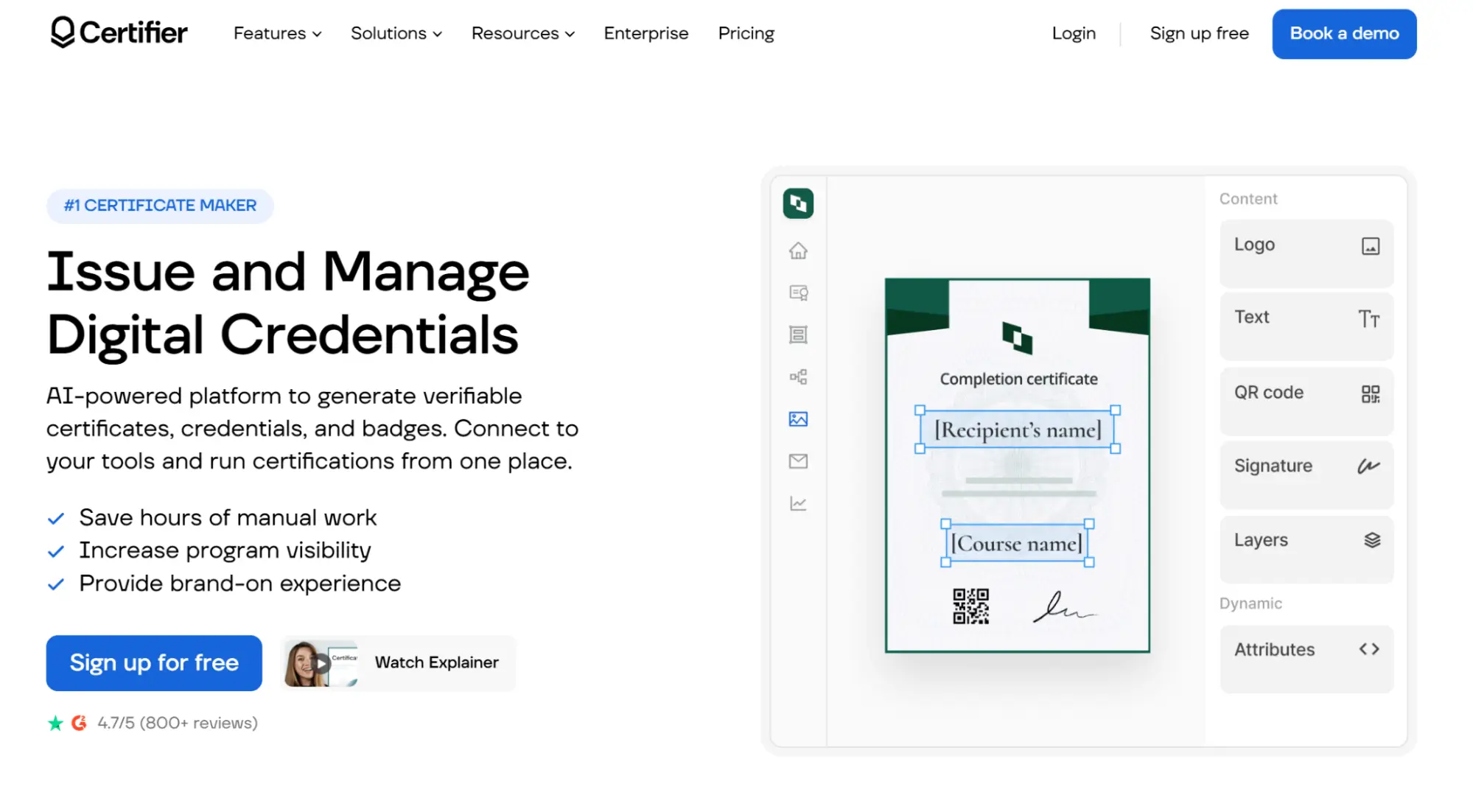
For CEU and CPD data, Certifier uses custom attribute fields. You can add the CEU value and contact hours to every certificate, alongside provider details like an IACET number.
Every credential carries a QR code and a unique verification URL, so a licensing board or employer can confirm it instantly. Expiration dates and renewal reminders handle credentials that lapse, and one-click LinkedIn sharing lets recipients show CPD credits on their profile.
Certifier connects to your workflow in several ways:
Native Google Sheets and HubSpot integrations
Zapier and Make for tools like Zoom or Typeform
A REST API for member portals or internal databases
CSV upload for one-off cohorts
Pricing is straightforward. The free plan covers 250 credentials a year with no watermark. The Professional plan runs 67 a month for 1,000 credentials, billed monthly with no annual lock-in.
Healthcare and legal teams use it for license-renewal credentials, while finance and HR teams lean on it for compliance records.
Certifier also ranks among the top digital credential platform choices well beyond continuing education, and our digital credential service overview covers those wider use cases.
Ready to set this up for your program? You can generate CPD certificates with Certifier and route every cohort to the right credit format.
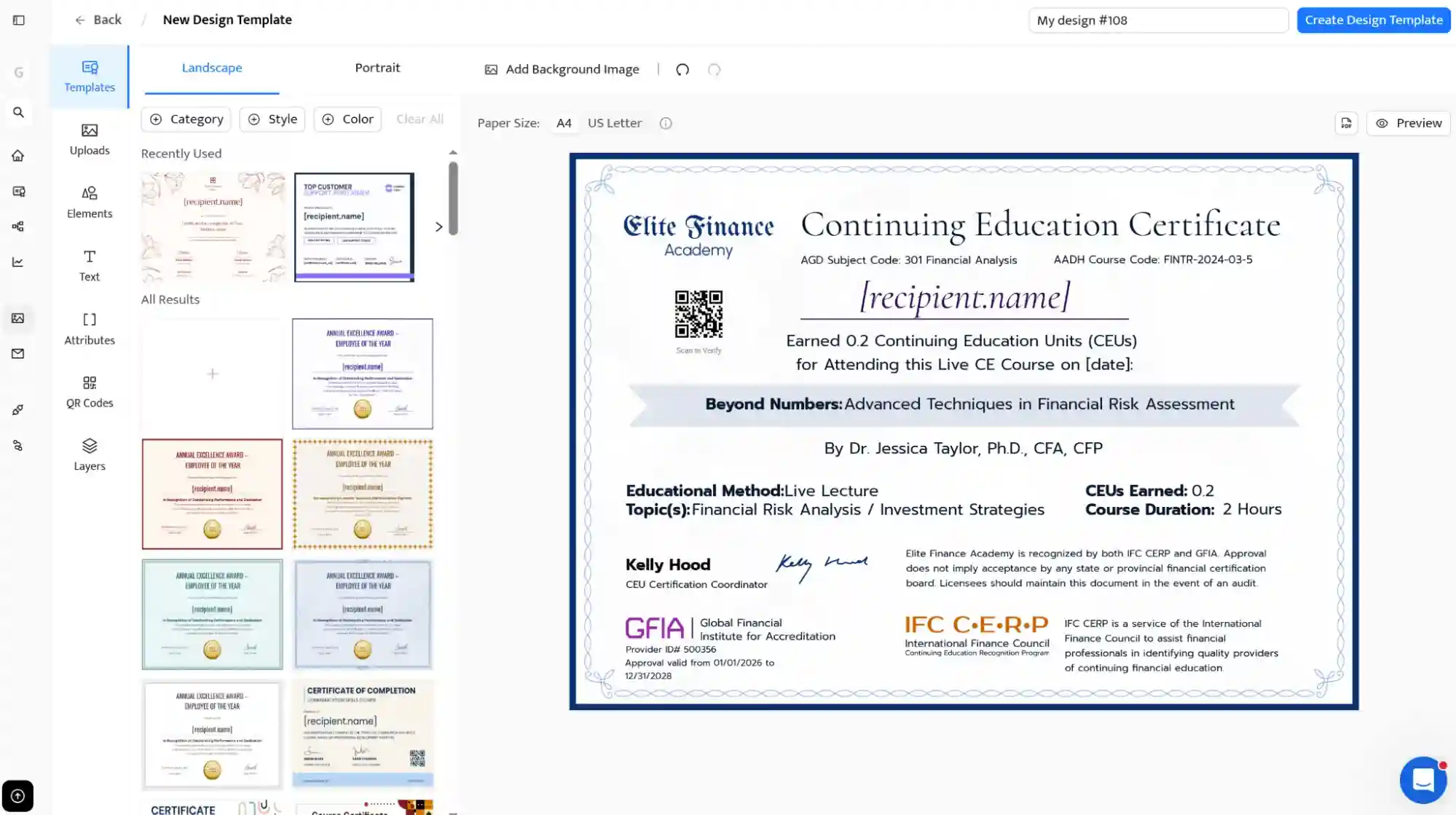
For broader options, the completion certificate templates gallery covers more formats.
SimpleCert is built around simplicity. It's a solid pick for smaller CE providers that need branded certificate templates and quick delivery without heavy automation.
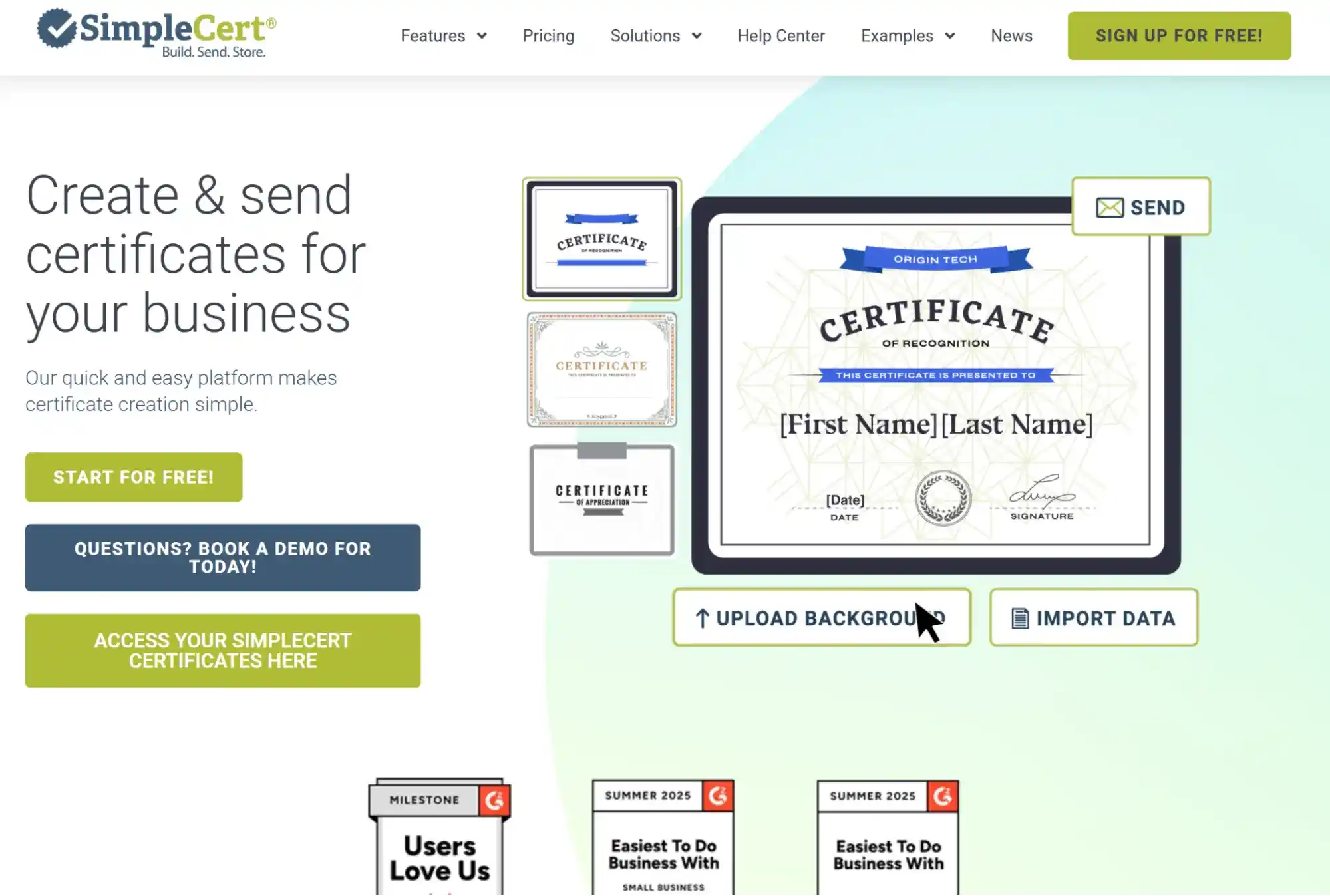
You build certificates with custom data, send them in bulk, and give recipients an online portal to download their copy. For one-off workshops or small cohorts, that's often enough.
Where it trails Certifier: verification and analytics are lighter, and expiration management for renewable credentials isn't built in.
Accredible Accredible suits established certification bodies and universities with structured programs.

The platform leans into stackable microcredentials and visual learning pathways, with white-label options for custom URLs and emails. It integrates with most LMS and CMS tools and includes analytics, along with expiry and revocation controls.
Pricing starts at $45 a month on the Launch plan, billed annually, with custom pricing above that. That formal infrastructure fits larger teams better than a small CEU program looking for flexible monthly billing.
BadgeCert is badge-first. It's an enterprise option for associations and regulatory agencies that want digital badges tied to professional learning.
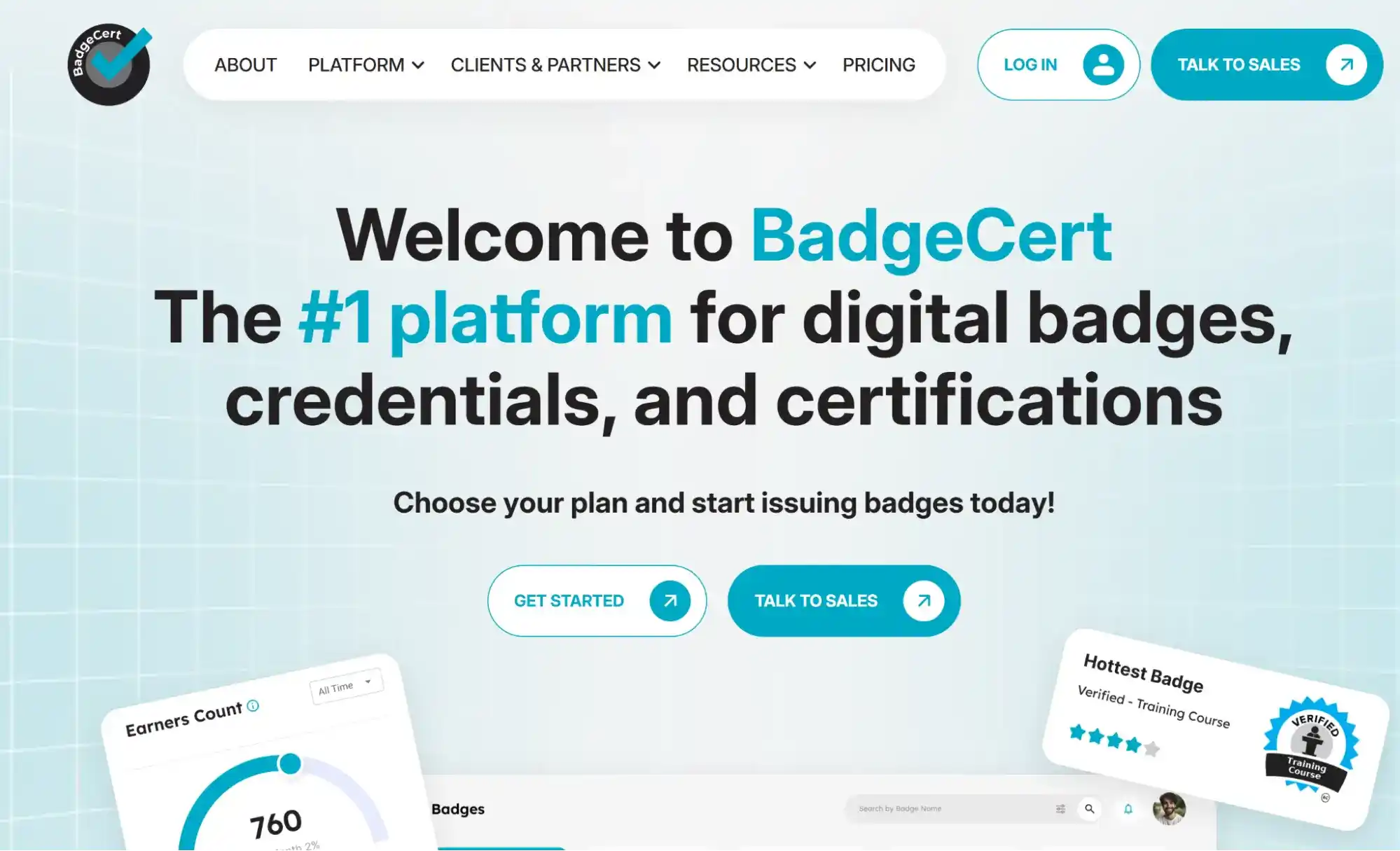
Badges authenticate in real time, and the platform supports expiration rules and micro-credential pathways, which is one of the great benefits of digital badges, plus CRM and LMS APIs. There's a blockchain option for added security.
If your program is certificate-first rather than badge-first, you may want to consider other BadgeCert alternatives.
Cadmium fits associations and conference organizers that need full event and education infrastructure.
Its EthosCE product handles CME with ACCME PARS and CE Broker reporting, and its Elevate LMS tracks credits for association learners.

It's a heavier system with a 25-year association focus. For teams that mainly need to generate and deliver CEU or CPD certificates with solid verification, that infrastructure is more than the job requires.
Before you compare names, match the tool to your workflow. The right platform aligns with how your program verifies completion and stores credit data. It should also handle delivery and later verification without extra tools.
Weigh these factors:
Credential type: CEU and CPD, or a variant such as CME or CLE
Data fields: the credit hours and provider details your board expects
Issuance trigger: what starts it, such as a webinar or an LMS completion
Verification: QR codes and a public verification page, with revocation if needed
Scale: a one-time workshop versus a member-wide or high-volume program
Recipient experience: branded delivery and easy LinkedIn sharing
Admin workflow: bulk issuance, plus expirations and dashboard tracking
Integration path: native connectors and Zapier, or an API for custom setups
This quick reference maps program types to the platform features that matter most:
Program Type | Main Credential Need | What To Look For |
|---|---|---|
Professional association | CEU or CPD certificates for members | Bulk issuance with verification URLs and audit records |
Corporate L&D or compliance | Proof of training for audits | Automated issuance with dashboard tracking and exports |
University extension | Branded certificates for non-credit courses | Strong templates with LMS or form integrations |
Healthcare or medical CE | CME or CEU with board-facing proof | Strict data fields, verification, and audit trails |
Legal or CLE | Certificates matching the attorney reporting | Custom credit labels with verification links |
Small training provider | CEU or CPD certificates for small cohorts | Easy templates first, automation as volume grows |
If you're starting from a design, see how to create a certificate of completion using a template.
Automating CEU certificate issuance with Certifier takes four steps:
01Adjust your CEU certificate template. Add custom fields for the CEU value and contact hours, plus provider details. It takes about 10 minutes to set up your first one.
02Connect your training source. Link a Zoom webinar or your LMS through a custom, native integration or Zapier.
03Trigger issuance on completion. When someone finishes, the certificate generates and sends automatically.
04Track everything. The dashboard logs each issuance and lets you resend or export records for an audit.
ONE CREDENTIAL, MULTIPLE DOCS
Create both designs in one go and issue credentials in bulk.
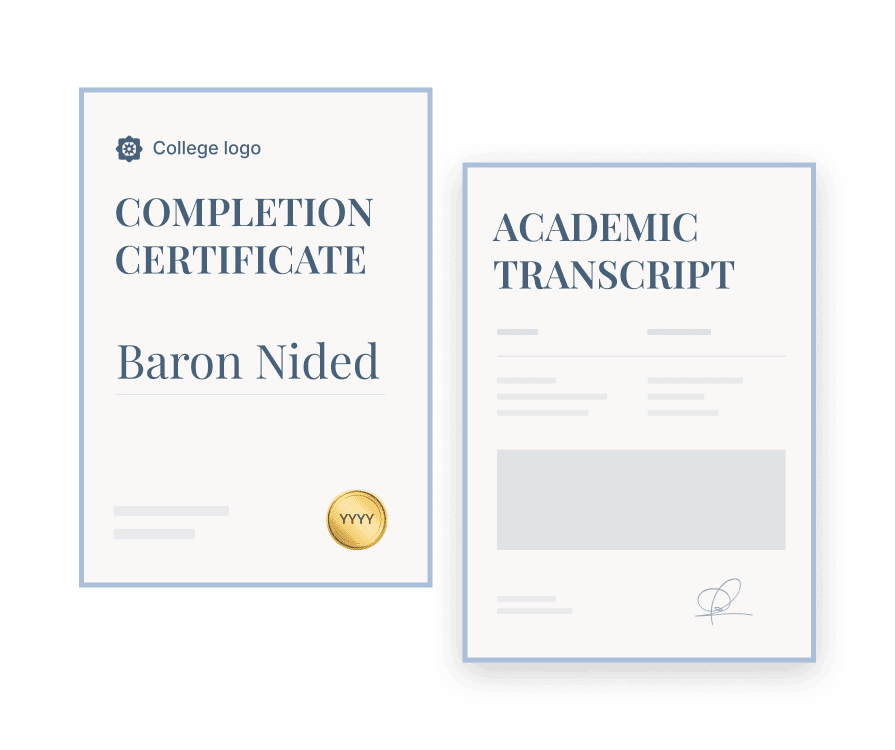
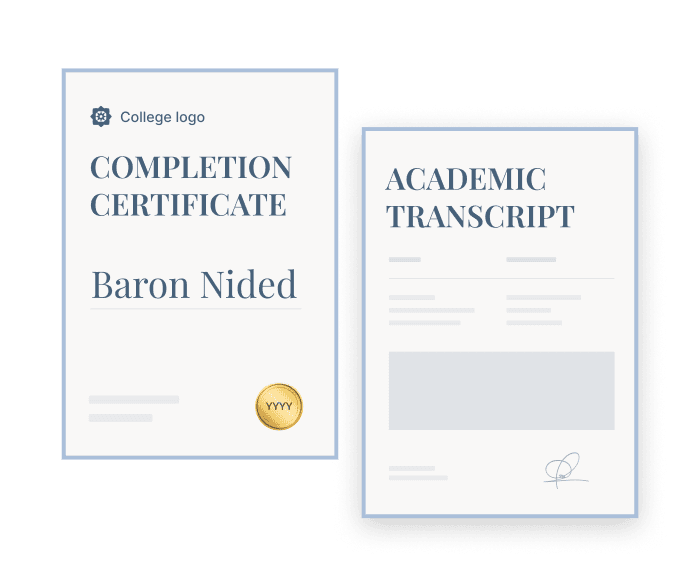
Recipients get a branded email with their certificate and a LinkedIn share link. The result is a verifiable CEU certificate of completion that a board can check, not a static PDF. The flow scales the same way whether you issue 50 certificates or 5,000.

Industry example: For a dental-specific version of this workflow, including ADA CERP and AGD PACE record rules, see our guide to dental CE certificate automation.
For IACET-accredited programs, a CEU certificate of completion typically shows:
The learner's full name
The CEU value awarded
The program or course title
The completion date
The provider organization's name and contact
The IACET provider number, if accredited
Certifier's custom attribute fields hold all of these, so your continuing education certificate matches what auditors expect. Because each field is editable per recipient, a single template can serve a 5,000-person cohort without manual edits.
A ready-made CEU certificate template saves time, but the credential online editor is what turns it into a certificate that fits your program. Add learner details, CEU value, course title, completion date, provider data, and accreditation notes in one branded layout.
Browse the CE certificate templates to start with a professional development certificate template, then tailor it before issuing certificates at scale. Issue it with a matching document like this formal green CEU transcript to summarize activities, dates, providers and earned credits across a longer learning period.
The best digital credential platform for continuing education is the one that matches your credit type and your volume, with verification your boards will accept. For most CEU and CPD programs, that's Certifier. It automates issuance and keeps audit-ready records. And it stays affordable as you scale.
Ready to simplify your continuing education credentials? Start generating CEU certificates with Certifier–issue your first 250 certificates without paying a cent.
For education, the strongest options are Certifier and Accredible, with BadgeCert and Cadmium suited to badge and event programs. Among the top digital credential platforms 2026 buyers shortlist, Certifier fits CEU and CPD certificate work best, and it's the easiest entry point for universities running non-credit courses.
Certifier is the best platform for generating CEU certificates for most teams. It automates issuance with QR verification and includes the custom fields a CEU certificate needs, like the credit value and provider details.
Yes. With Certifier, a CEU certificate is sent automatically when a learner completes a course, through native or custom integration or Zapier. An API is available for custom setups. No manual PDF work required.
A CEU certificate measures contact hours against a fixed unit, where one CEU equals 10 contact hours, and it's common in the US.
A CPD certificate records professional development hours and is used widely in the UK and internationally.
Both need verifiable proof, which Certifier provides through QR-verified digital credentials for higher education.
Certifier doesn't issue IACET accreditation itself, but its custom fields hold every detail an IACET CEU certificate of completion typically needs, from the learner's name to the CEU value, plus provider details like an IACET number.
Yes. Certifier's free plan issues up to 250 continuing education certificates a year with no watermark, which covers many smaller CEU and CPD programs.
You can browse ready-made options in Certifier's continuing education certificate templates gallery and customize any of them. A continuing education certificate template or CEU certificate template lets you start fast, then automate issuance once your volume grows.

- Content Strategy
- SEO & AEO/GEO strategy
- Conversion Rate Optimization
- Organic Growth
- Buyer Psychology
Head of Content
Vlad Melnic leads content at Certifier, bringing 10+ years of experience in SEO content marketing and conversion-focused content. His focus is turning complex product value into clear benefits.
CPD Certification Service
https://www.cpduk.co.uk/IACET (International Association for Continuing Education and Training)
https://www.iacet.org